

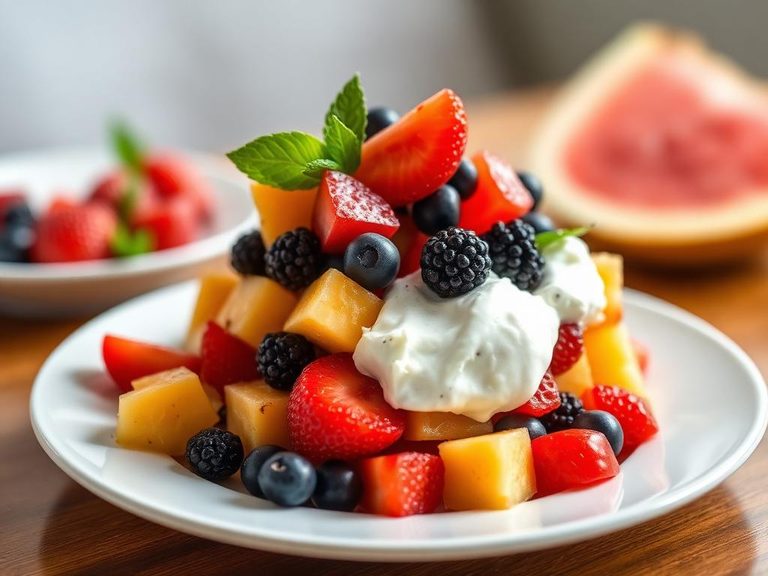
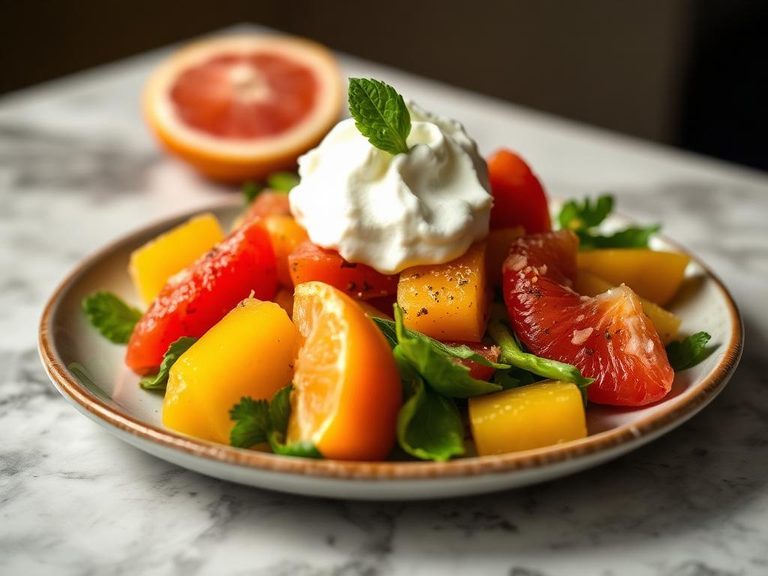
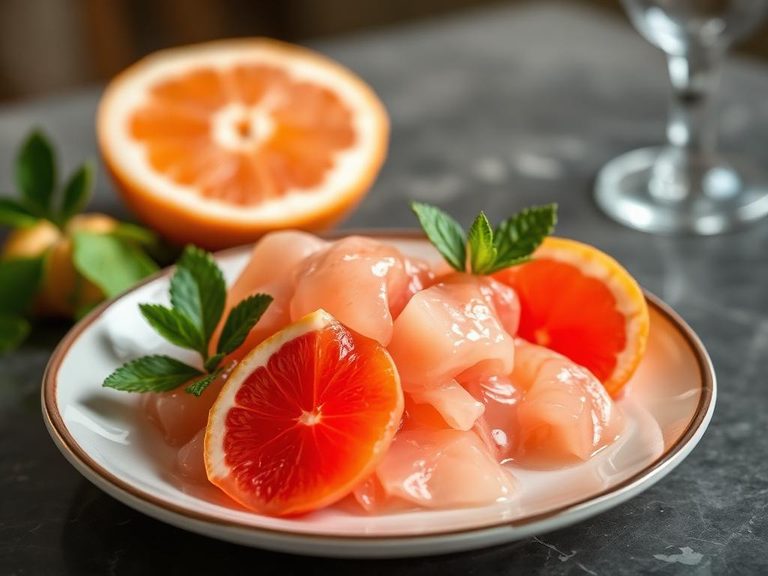
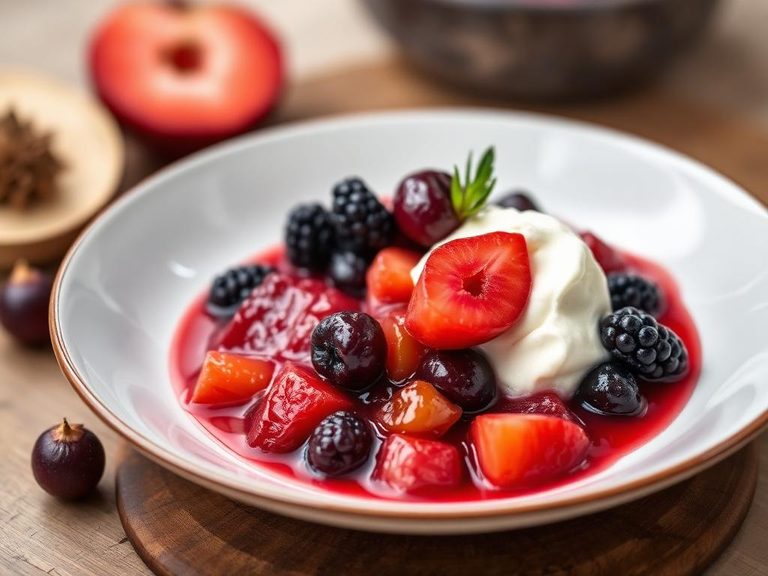
Fruit salad, including citrus fruit, with whipped cream
Common food

Photo: Wikipedia
A vibrant medley of fresh citrus segments—think juicy oranges, tangy grapefruits, and sweet mandarins—tossed together and crowned with a cloud of lightly sweetened whipped cream. The texture is a delightful contrast: the crisp, juicy burst of citrus against the smooth, airy cream. Nutritionally, it's a light treat offering a good dose of vitamin C from the fruit, balanced by the fat and sugar from the cream.
Calorie split: 5% protein · 37% carbs · 58% fat
↓ Full nutrition💚 Why it's loved
People adore it for the perfect harmony of bright, zesty citrus cutting through the rich, cool sweetness of whipped cream. It's a versatile dessert that feels both indulgent and refreshing, often served at brunches, picnics, and as a light finish to a heavy meal.
⚠️ Watch-outs & how to enjoy it better
The high sugar content from both fruit and whipped cream can cause a rapid blood-sugar spike, which is a concern for those managing diabetes or insulin resistance. To counteract this, pair it with a source of protein or healthy fat (like a handful of nuts on the side) to slow sugar absorption, and practice portion control. Some may also have citrus allergies or find the acidity bothersome for acid reflux.
Key benefits
- Excellent source of vitamin C from citrus fruits.
- Provides dietary fiber, aiding digestion.
- Offers a quick energy boost from natural fruit sugars.
- The fat in whipped cream can help with absorption of fat-soluble vitamins.
- A refreshing, hydrating dessert option.
🍽️ Popular dishes

🌍 Where it's eaten
💡 Did you know?
The whipped cream traditionally used in such salads is often stabilized with a small amount of gelatin or cornstarch to prevent it from weeping and making the fruit soggy.
Full nutrition (USDA data · scales with serving)
| Water | 72.4 g |
| Energy | 158 kcal |
| Protein | 2.1 g |
| Total lipid (fat) | 10.4 g |
| Carbohydrate, by difference | 14.6 g |
| Fiber, total dietary | 2.0 g |
| Total Sugars | 10.6 g |
| Calcium, Ca | 29.0 mg |
| Iron, Fe | 0.27 mg |
| Magnesium, Mg | 24.0 mg |
| Phosphorus, P | 52.0 mg |
| Potassium, K | 216 mg |
| Sodium, Na | 3.0 mg |
| Zinc, Zn | 0.33 mg |
| Copper, Cu | 0.15 mg |
| Selenium, Se | 0.90 ug |
| Vitamin C, total ascorbic acid | 18.1 mg |
| Thiamin | 0.07 mg |
| Riboflavin | 0.06 mg |
| Niacin | 0.37 mg |
| Vitamin B-6 | 0.14 mg |
| Folate, total | 21.0 ug |
| Folic acid | 0.00 ug |
| Folate, food | 21.0 ug |
| Folate, DFE | 21.0 ug |
| Choline, total | 11.1 mg |
| Vitamin B-12 | 0.00 ug |
| Vitamin B-12, added | 0.00 ug |
| Vitamin A, RAE | 42.0 ug |
| Retinol | 38.0 ug |
| Carotene, beta | 32.0 ug |
| Carotene, alpha | 5.0 ug |
| Cryptoxanthin, beta | 32.0 ug |
| Lycopene | 0.00 ug |
| Lutein + zeaxanthin | 54.0 ug |
| Vitamin E (alpha-tocopherol) | 0.30 mg |
| Vitamin E, added | 0.00 mg |
| Vitamin D (D2 + D3) | 0.20 ug |
| Vitamin K (phylloquinone) | 2.9 ug |
| Alcohol, ethyl | 0.00 g |
| Caffeine | 0.00 mg |
| Theobromine | 0.00 mg |
Fat & fatty acid profile (per 100g)
| Fatty acids, total saturated | 2.9 g |
| SFA 4:0 | 0.09 g |
| SFA 6:0 | 0.07 g |
| SFA 8:0 | 0.04 g |
| SFA 10:0 | 0.10 g |
| SFA 12:0 | 0.13 g |
| SFA 14:0 | 0.40 g |
| SFA 16:0 | 1.5 g |
| SFA 18:0 | 0.52 g |
| Fatty acids, total monounsaturated | 1.7 g |
| MUFA 16:1 | 0.08 g |
| MUFA 18:1 | 1.7 g |
| MUFA 20:1 | 0.02 g |
| MUFA 22:1 | 0.00 g |
| Fatty acids, total polyunsaturated | 4.5 g |
| PUFA 18:2 | 3.4 g |
| PUFA 18:3 | 0.82 g |
| PUFA 18:4 | 0.00 g |
| PUFA 20:4 | 0.01 g |
| PUFA 20:5 n-3 (EPA) | 0.00 g |
| PUFA 22:5 n-3 (DPA) | 0.00 g |
| PUFA 22:6 n-3 (DHA) | 0.00 g |
| Cholesterol | 12.0 mg |
FAQ
Can I use other fruits besides citrus?
Absolutely! While citrus is the star here, adding berries, kiwi, or pomegranate arils can enhance color and flavor. Just be mindful that softer fruits may break down faster.
How do I keep the whipped cream from melting too fast?
Use chilled heavy cream and a cold bowl. Whip to soft peaks just before serving. You can also fold in a tablespoon of mascarpone or cream cheese for extra stability.
Is this a healthy dessert?
It's a relatively light option compared to baked goods or ice cream, offering vitamins and fiber from fruit. However, the whipped cream adds saturated fat and sugar, so it's best enjoyed as an occasional treat within a balanced diet.
Nutrient density (calculated · NRF9.3)
Nutrient Rich Foods index: beneficial nutrients (protein, fiber, vitamins, minerals) minus saturated fat, added sugar & sodium, per 100 kcal.
NRF9.3 index — Fulgoni, Keast & Drewnowski, 2009. Computed from USDA nutrients.
Weight-loss friendliness (composite index)
Energy density 1.58 kcal/g · 5% calories from protein · 2.0 g fiber · 10.6 g sugar per 100 g.
Composite of energy density (Rolls et al., 1999), protein & fiber satiety, minus sugar. A calculated heuristic — ranks satiety-per-calorie, not a clinical measure.
Dietary load (calculated from USDA values)
Potential renal acid load. Positive = acid-forming, negative = alkaline-forming.
Sodium-to-potassium ratio: 0.01 (lower is better — aim for ≤ 1)
Sodium:potassium per WHO potassium guidance. Computed from USDA nutrients.