

Frito pie
Common food
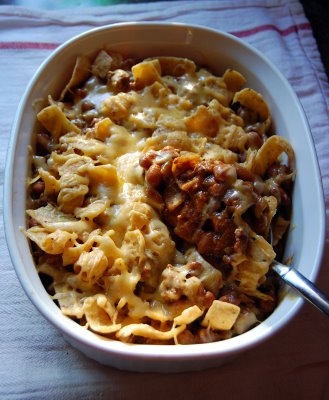
Photo: Wikipedia
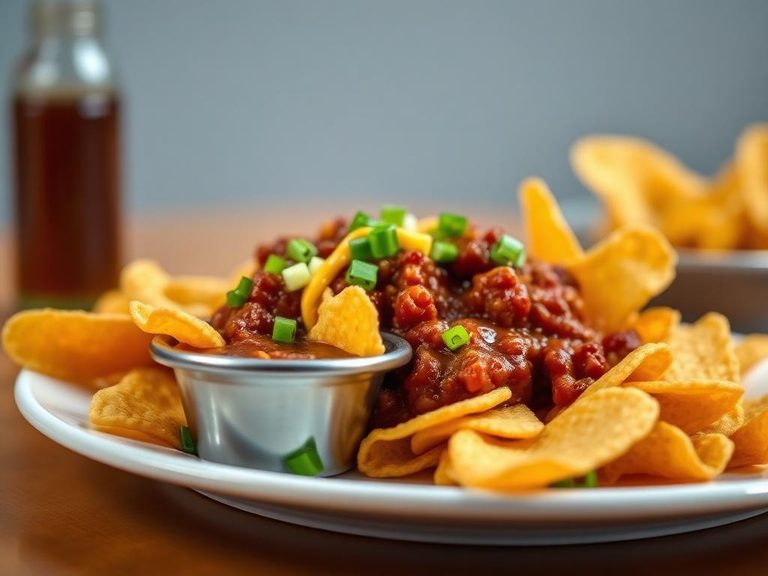
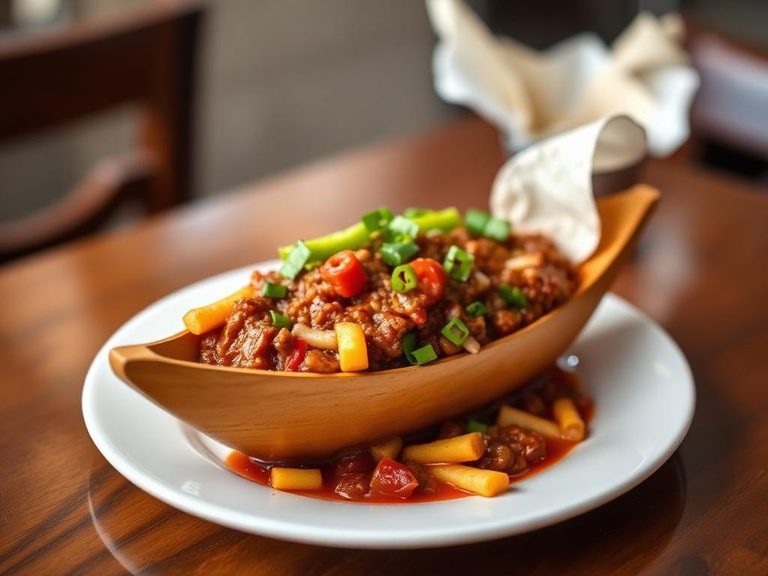
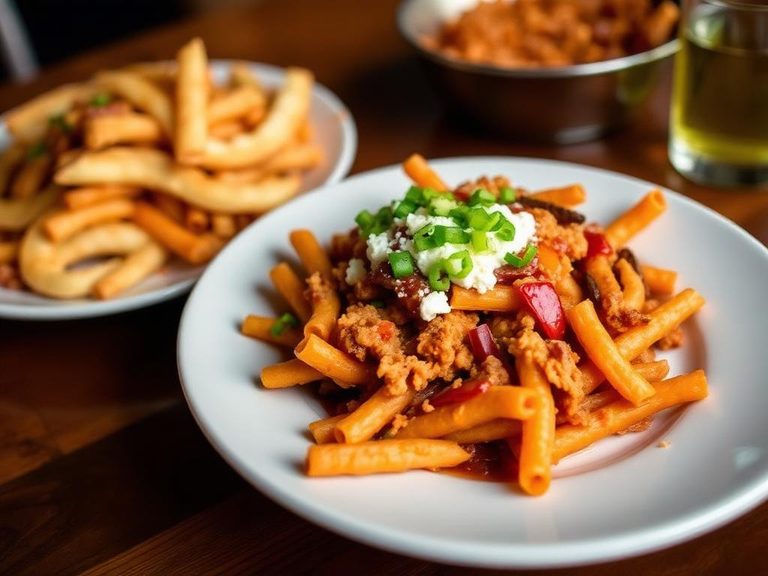
Frito pie is a beloved Tex-Mex casserole, typically a hearty chili ladled over crunchy corn chips and topped with melted cheese and onions. It delivers a satisfying, salty crunch followed by the savory, spiced warmth of chili, creating a rich and indulgent texture profile. With nearly 21g of fat and 10g of protein per 100g, it's a calorie-dense, highly satiating comfort food.
Calorie split: 12% protein · 32% carbs · 57% fat
↓ Full nutrition💚 Why it's loved
People love Frito pie for its unapologetic, bold flavor combination of salty, crunchy chips with spicy, meaty chili and gooey cheese. It's a deeply nostalgic comfort food, often associated with childhood, community events, and the simple joy of a messy, satisfying meal.
⚠️ Watch-outs & how to enjoy it better
The high sodium and fat content can be problematic for those monitoring heart health or blood pressure, and the refined carbs in the chips may cause blood-sugar spikes. To mitigate this, pair it with a side of non-starchy vegetables like a simple green salad, practice portion control by using a smaller bowl, and consider adding extra beans or lean ground turkey to the chili to boost fiber and protein without excessive fat.
Key benefits
- Provides a substantial source of protein (10g per 100g) for muscle maintenance.
- High in fat content (21g per 100g) offers prolonged satiety and energy.
- Contains dietary fiber (2.9g per 100g) to support digestive health.
- Convenient and quick to assemble as a one-dish meal or snack.
- A cultural staple that brings people together at fairs, ballparks, and home gatherings.
🍽️ Popular dishes
🌍 Where it's eaten
💡 Did you know?
The Frito Pie is famously credited to Daisy Dean Doolin, the sister of Fritos founder Charles Elmer Doolin, who is said to have invented the dish in the 1930s as a way to promote her brother's corn chips.
Full nutrition (USDA data · scales with serving)
| Water | 40.3 g |
| Energy | 328 kcal |
| Protein | 10.0 g |
| Total lipid (fat) | 21.0 g |
| Carbohydrate, by difference | 26.3 g |
| Fiber, total dietary | 2.9 g |
| Total Sugars | 0.86 g |
| Calcium, Ca | 184 mg |
| Iron, Fe | 1.2 mg |
| Magnesium, Mg | 42.0 mg |
| Phosphorus, P | 196 mg |
| Potassium, K | 187 mg |
| Sodium, Na | 572 mg |
| Zinc, Zn | 1.8 mg |
| Copper, Cu | 0.10 mg |
| Selenium, Se | 8.8 ug |
| Vitamin C, total ascorbic acid | 2.6 mg |
| Thiamin | 0.06 mg |
| Riboflavin | 0.12 mg |
| Niacin | 0.94 mg |
| Vitamin B-6 | 0.14 mg |
| Folate, total | 28.0 ug |
| Folic acid | 0.00 ug |
| Folate, food | 28.0 ug |
| Folate, DFE | 28.0 ug |
| Choline, total | 19.9 mg |
| Vitamin B-12 | 0.41 ug |
| Vitamin B-12, added | 0.00 ug |
| Vitamin A, RAE | 45.0 ug |
| Retinol | 40.0 ug |
| Carotene, beta | 54.0 ug |
| Carotene, alpha | 5.0 ug |
| Cryptoxanthin, beta | 22.0 ug |
| Lycopene | 860 ug |
| Lutein + zeaxanthin | 204 ug |
| Vitamin E (alpha-tocopherol) | 3.3 mg |
| Vitamin E, added | 0.00 mg |
| Vitamin D (D2 + D3) | 0.00 ug |
| Vitamin K (phylloquinone) | 6.4 ug |
| Alcohol, ethyl | 0.00 g |
| Caffeine | 0.00 mg |
| Theobromine | 0.00 mg |
Fat & fatty acid profile (per 100g)
| Fatty acids, total saturated | 5.5 g |
| SFA 4:0 | 0.14 g |
| SFA 6:0 | 0.07 g |
| SFA 8:0 | 0.06 g |
| SFA 10:0 | 0.12 g |
| SFA 12:0 | 0.17 g |
| SFA 14:0 | 0.55 g |
| SFA 16:0 | 3.3 g |
| SFA 18:0 | 0.92 g |
| Fatty acids, total monounsaturated | 5.9 g |
| MUFA 16:1 | 0.19 g |
| MUFA 18:1 | 5.8 g |
| MUFA 20:1 | 0.06 g |
| MUFA 22:1 | 0.00 g |
| Fatty acids, total polyunsaturated | 7.1 g |
| PUFA 18:2 | 6.8 g |
| PUFA 18:3 | 0.24 g |
| PUFA 18:4 | 0.00 g |
| PUFA 20:4 | 0.01 g |
| PUFA 20:5 n-3 (EPA) | 0.00 g |
| PUFA 22:5 n-3 (DPA) | 0.00 g |
| PUFA 22:6 n-3 (DHA) | 0.00 g |
| Cholesterol | 24.0 mg |
FAQ
Is Frito pie a dessert or a main dish?
Frito pie is unequivocally a savory main dish or hearty snack, centered around chili and cheese, not a sweet dessert.
What's the difference between Frito pie and chili cheese nachos?
Frito pie uses corn chips (Fritos) as the base, often served in the bag, and is typically topped with chili and cheese, while nachos use tortilla chips and are often loaded with a wider variety of toppings like jalapeños, sour cream, and guacamole.
Can I make a healthier version of Frito pie?
Yes, you can use baked corn chips, lean ground turkey or beans for the chili, reduce the cheese, and add plenty of fresh toppings like diced onions, tomatoes, and cilantro to boost nutrition without losing the core flavor.
Nutrient density (calculated · NRF9.3)
Nutrient Rich Foods index: beneficial nutrients (protein, fiber, vitamins, minerals) minus saturated fat, added sugar & sodium, per 100 kcal.
NRF9.3 index — Fulgoni, Keast & Drewnowski, 2009. Computed from USDA nutrients.
Weight-loss friendliness (composite index)
Energy density 3.28 kcal/g · 12% calories from protein · 2.9 g fiber · 0.9 g sugar per 100 g.
Composite of energy density (Rolls et al., 1999), protein & fiber satiety, minus sugar. A calculated heuristic — ranks satiety-per-calorie, not a clinical measure.
Dietary load (calculated from USDA values)
Potential renal acid load. Positive = acid-forming, negative = alkaline-forming.
Sodium-to-potassium ratio: 3.06 (lower is better — aim for ≤ 1)
Sodium:potassium per WHO potassium guidance. Computed from USDA nutrients.