

Fajita, vegetable
Common food
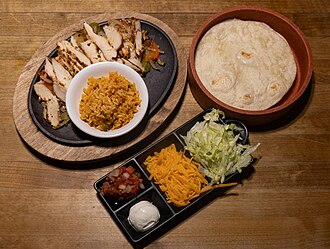
Photo: Wikipedia
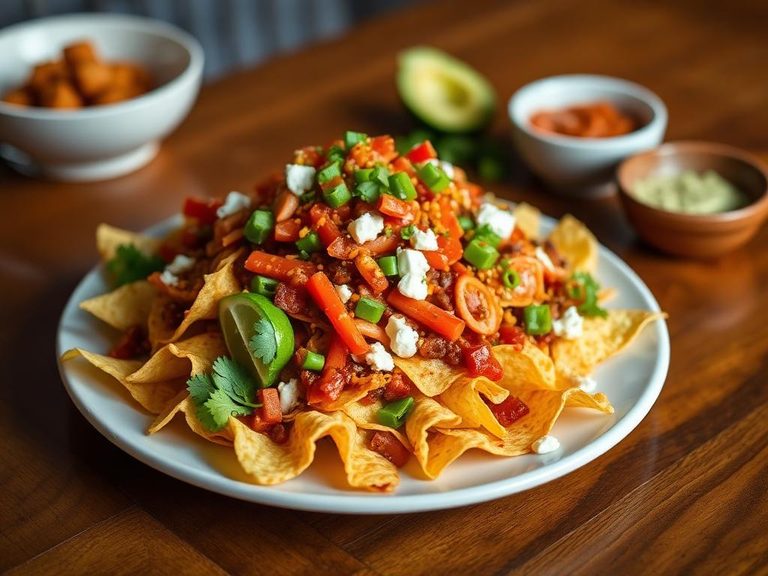
Vegetable fajitas are a sizzling, colorful medley of bell peppers and onions, charred to smoky perfection and wrapped in a warm tortilla. The taste is a vibrant balance of sweet, caramelized vegetables with a subtle, earthy spice, offering a satisfying, slightly crisp texture. At just 166 kcal per 100g, they are a light yet flavorful option, providing a good source of fiber and carbohydrates for sustained energy.
Calorie split: 8% protein · 49% carbs · 43% fat
↓ Full nutrition💚 Why it's loved
People love vegetable fajitas for their explosive, customizable flavor and the interactive, communal experience of building their own wrap. The smoky, sweet char of the vegetables combined with warm spices creates a deeply satisfying and comforting meal.
⚠️ Watch-outs & how to enjoy it better
The high carbohydrate content from tortillas and vegetables can cause blood-sugar spikes if not balanced. To counteract this, pair with a source of protein (like beans or grilled chicken) and healthy fat (like avocado or cheese) to slow digestion. Also, be mindful of sodium in pre-made fajita seasonings; opt for homemade blends or low-sodium versions.
Key benefits
- Low in calories, supporting weight management.
- Rich in dietary fiber for digestive health.
- Provides complex carbohydrates for steady energy.
- Contains vitamins A and C from bell peppers.
- Versatile base for adding lean protein or healthy fats.
🍽️ Popular dishes

🌍 Where it's eaten
💡 Did you know?
The word 'fajita' comes from the Spanish 'faja,' meaning 'belt' or 'sash,' originally referring to the skirt steak cut of beef used in the dish, which was a byproduct given to Mexican cowboys in Texas.
Full nutrition (USDA data · scales with serving)
| Water | 67.2 g |
| Energy | 166 kcal |
| Protein | 3.2 g |
| Total lipid (fat) | 7.8 g |
| Carbohydrate, by difference | 20.4 g |
| Fiber, total dietary | 2.0 g |
| Total Sugars | 3.7 g |
| Calcium, Ca | 55.0 mg |
| Iron, Fe | 1.3 mg |
| Magnesium, Mg | 14.0 mg |
| Phosphorus, P | 82.0 mg |
| Potassium, K | 160 mg |
| Sodium, Na | 343 mg |
| Zinc, Zn | 0.28 mg |
| Copper, Cu | 0.06 mg |
| Selenium, Se | 7.1 ug |
| Vitamin C, total ascorbic acid | 47.8 mg |
| Thiamin | 0.19 mg |
| Riboflavin | 0.14 mg |
| Niacin | 1.8 mg |
| Vitamin B-6 | 0.16 mg |
| Folate, total | 47.0 ug |
| Folic acid | 25.0 ug |
| Folate, food | 22.0 ug |
| Folate, DFE | 64.0 ug |
| Choline, total | 6.5 mg |
| Vitamin B-12 | 0.00 ug |
| Vitamin B-12, added | 0.00 ug |
| Vitamin A, RAE | 38.0 ug |
| Retinol | 0.00 ug |
| Carotene, beta | 393 ug |
| Carotene, alpha | 9.0 ug |
| Cryptoxanthin, beta | 107 ug |
| Lycopene | 0.00 ug |
| Lutein + zeaxanthin | 88.0 ug |
| Vitamin E (alpha-tocopherol) | 1.4 mg |
| Vitamin E, added | 0.00 mg |
| Vitamin D (D2 + D3) | 0.00 ug |
| Vitamin K (phylloquinone) | 10.4 ug |
| Alcohol, ethyl | 0.00 g |
| Caffeine | 0.00 mg |
| Theobromine | 0.00 mg |
Fat & fatty acid profile (per 100g)
| Fatty acids, total saturated | 1.7 g |
| SFA 4:0 | 0.00 g |
| SFA 6:0 | 0.00 g |
| SFA 8:0 | 0.00 g |
| SFA 10:0 | 0.00 g |
| SFA 12:0 | 0.00 g |
| SFA 14:0 | 0.01 g |
| SFA 16:0 | 1.1 g |
| SFA 18:0 | 0.52 g |
| Fatty acids, total monounsaturated | 2.8 g |
| MUFA 16:1 | 0.02 g |
| MUFA 18:1 | 2.7 g |
| MUFA 20:1 | 0.04 g |
| MUFA 22:1 | 0.00 g |
| Fatty acids, total polyunsaturated | 2.8 g |
| PUFA 18:2 | 2.5 g |
| PUFA 18:3 | 0.32 g |
| PUFA 18:4 | 0.00 g |
| PUFA 20:4 | 0.00 g |
| PUFA 20:5 n-3 (EPA) | 0.00 g |
| PUFA 22:5 n-3 (DPA) | 0.00 g |
| PUFA 22:6 n-3 (DHA) | 0.00 g |
| Cholesterol | 0.00 mg |
FAQ
Are vegetable fajitas healthy?
Yes, they are a nutritious, low-calorie option rich in fiber, vitamins, and antioxidants, especially when paired with lean protein and healthy fats.
What vegetables are typically used in fajitas?
Bell peppers (green, red, yellow) and onions are the classic base, but you can also add zucchini, mushrooms, or corn for variety.
How can I reduce the carbohydrate content of fajitas?
Use lettuce wraps or low-carb tortillas instead of traditional flour tortillas, and focus on filling the wrap with more vegetables and protein.
Nutrient density (calculated · NRF9.3)
Nutrient Rich Foods index: beneficial nutrients (protein, fiber, vitamins, minerals) minus saturated fat, added sugar & sodium, per 100 kcal.
NRF9.3 index — Fulgoni, Keast & Drewnowski, 2009. Computed from USDA nutrients.
Weight-loss friendliness (composite index)
Energy density 1.66 kcal/g · 8% calories from protein · 2.0 g fiber · 3.7 g sugar per 100 g.
Composite of energy density (Rolls et al., 1999), protein & fiber satiety, minus sugar. A calculated heuristic — ranks satiety-per-calorie, not a clinical measure.
Dietary load (calculated from USDA values)
Potential renal acid load. Positive = acid-forming, negative = alkaline-forming.
Sodium-to-potassium ratio: 2.14 (lower is better — aim for ≤ 1)
Sodium:potassium per WHO potassium guidance. Computed from USDA nutrients.