

Dragon fruit
Common food

Photo: Wikipedia
Dragon fruit, also known as pitaya, is the vibrant pink or yellow fruit of a cactus, featuring a speckled, kiwi-like flesh. Its flavor is mildly sweet and floral, with a soft, juicy texture punctuated by tiny, edible black seeds. Nutritionally, it's a low-calorie, hydrating choice that provides a good dose of fiber and vitamin C.
Calorie split: 4% protein · 93% carbs · 3% fat
↓ Full nutrition💚 Why it's loved
People adore dragon fruit for its stunning, Instagram-worthy appearance and its refreshing, subtly sweet taste that isn't overpowering. It's incredibly versatile, adding a pop of color and texture to everything from smoothie bowls to salads.
⚠️ Watch-outs & how to enjoy it better
The primary caution is its natural sugar content (12g per 100g), which can cause blood sugar spikes if eaten in large quantities, especially for those managing diabetes. To counteract this, pair it with a source of protein or healthy fat (like Greek yogurt or nuts) and practice portion control. The seeds contain small amounts of oxalates, so individuals with a history of kidney stones should moderate intake.
Key benefits
- Rich in antioxidants like betalains and flavonoids
- Good source of prebiotic fiber for gut health
- High water content aids hydration
- Contains magnesium for nerve and muscle function
- Low in calories and naturally fat-free
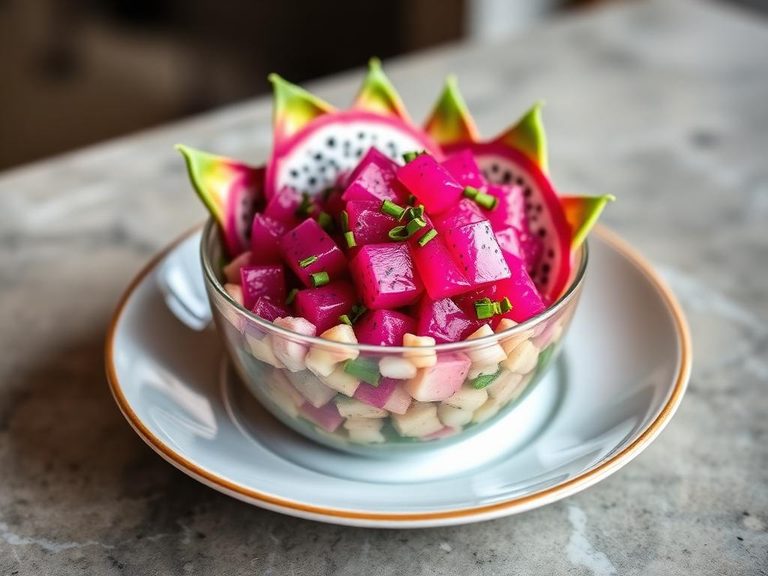
🍽️ Popular dishes
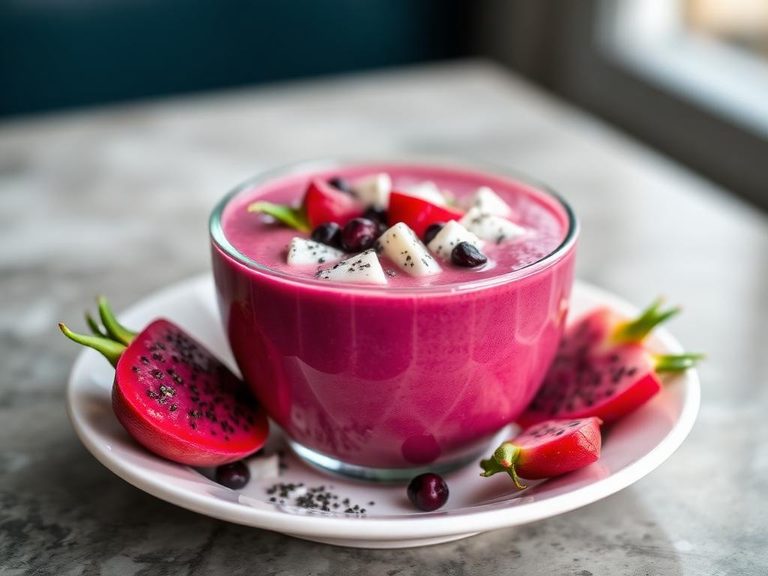
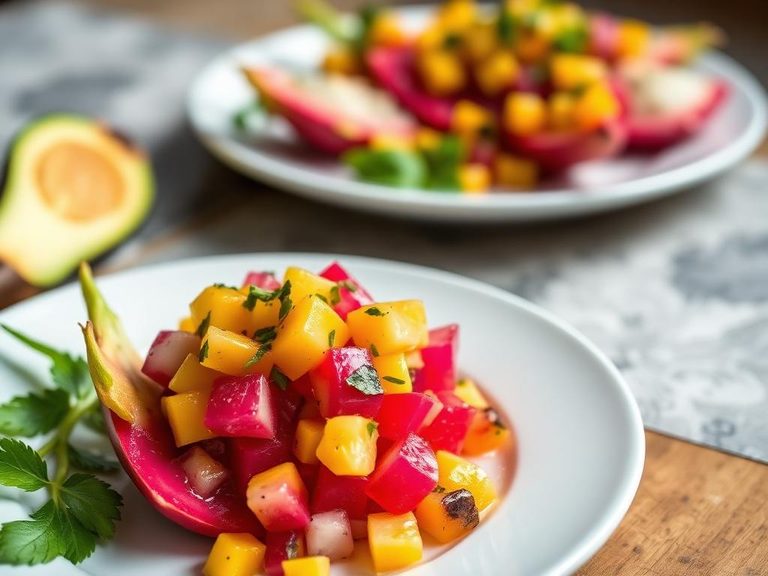
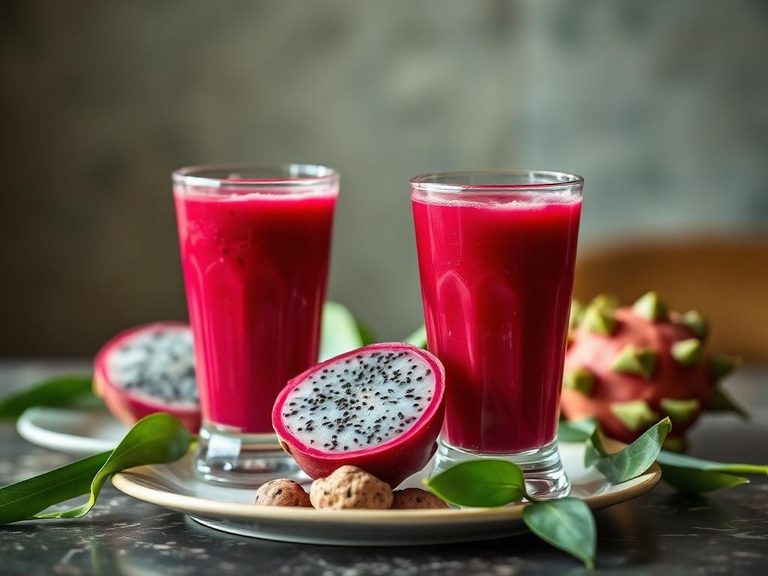
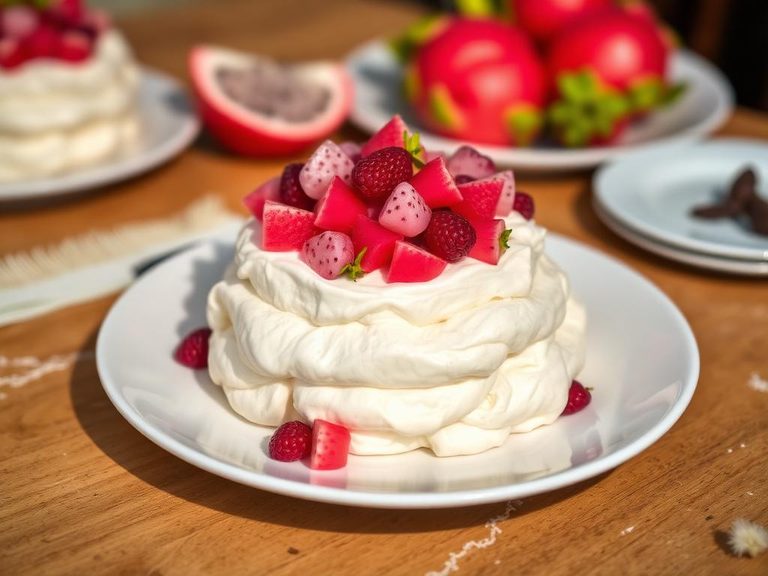
🌍 Where it's eaten
💡 Did you know?
The plant is a night-blooming cactus, and its large, fragrant white flowers open only for a single night, requiring pollination by bats or moths in the wild.
Full nutrition (USDA data · scales with serving)
| Water | 82.4 g |
| Energy | 68.0 kcal |
| Protein | 0.68 g |
| Total lipid (fat) | 0.21 g |
| Carbohydrate, by difference | 16.2 g |
| Fiber, total dietary | 1.8 g |
| Total Sugars | 12.0 g |
| Calcium, Ca | 13.0 mg |
| Iron, Fe | 0.12 mg |
| Magnesium, Mg | 14.0 mg |
| Phosphorus, P | 18.0 mg |
| Potassium, K | 206 mg |
| Sodium, Na | 1.0 mg |
| Zinc, Zn | 0.09 mg |
| Copper, Cu | 0.06 mg |
| Selenium, Se | 0.20 ug |
| Vitamin C, total ascorbic acid | 19.8 mg |
| Thiamin | 0.05 mg |
| Riboflavin | 0.03 mg |
| Niacin | 0.36 mg |
| Vitamin B-6 | 0.10 mg |
| Folate, total | 11.0 ug |
| Folic acid | 0.00 ug |
| Folate, food | 11.0 ug |
| Folate, DFE | 11.0 ug |
| Choline, total | 6.8 mg |
| Vitamin B-12 | 0.00 ug |
| Vitamin B-12, added | 0.00 ug |
| Vitamin A, RAE | 5.0 ug |
| Retinol | 0.00 ug |
| Carotene, beta | 42.0 ug |
| Carotene, alpha | 4.0 ug |
| Cryptoxanthin, beta | 24.0 ug |
| Lycopene | 227 ug |
| Lutein + zeaxanthin | 49.0 ug |
| Vitamin E (alpha-tocopherol) | 0.18 mg |
| Vitamin E, added | 0.00 mg |
| Vitamin D (D2 + D3) | 0.00 ug |
| Vitamin K (phylloquinone) | 3.8 ug |
| Alcohol, ethyl | 0.00 g |
| Caffeine | 0.00 mg |
| Theobromine | 0.00 mg |
Fat & fatty acid profile (per 100g)
| Fatty acids, total saturated | 0.05 g |
| SFA 4:0 | 0.00 g |
| SFA 6:0 | 0.00 g |
| SFA 8:0 | 0.00 g |
| SFA 10:0 | 0.00 g |
| SFA 12:0 | 0.00 g |
| SFA 14:0 | 0.00 g |
| SFA 16:0 | 0.04 g |
| SFA 18:0 | 0.00 g |
| Fatty acids, total monounsaturated | 0.02 g |
| MUFA 16:1 | 0.00 g |
| MUFA 18:1 | 0.02 g |
| MUFA 20:1 | 0.00 g |
| MUFA 22:1 | 0.00 g |
| Fatty acids, total polyunsaturated | 0.05 g |
| PUFA 18:2 | 0.04 g |
| PUFA 18:3 | 0.02 g |
| PUFA 18:4 | 0.00 g |
| PUFA 20:4 | 0.00 g |
| PUFA 20:5 n-3 (EPA) | 0.00 g |
| PUFA 22:5 n-3 (DPA) | 0.00 g |
| PUFA 22:6 n-3 (DHA) | 0.00 g |
| Cholesterol | 0.00 mg |
FAQ
How do I pick a ripe dragon fruit?
Look for bright, even-colored skin (pink or yellow). The fruit should give slightly to gentle pressure, similar to a ripe kiwi. Avoid fruit with many dark bruises or dry, shriveled stems.
Can I eat the skin?
No, the skin of dragon fruit is tough and not typically eaten. The edible part is the flesh inside, which you scoop out with a spoon or peel away.
Why is the flesh white, red, or yellow?
The color depends on the variety. White-fleshed (Hylocereus undatus) is most common. Red-fleshed (Hylocereus costaricensis) is sweeter and richer in antioxidants. Yellow-skinned (Selenicereus megalanthus) has white flesh and is often the sweetest variety.
Nutrient density (calculated · NRF9.3)
Nutrient Rich Foods index: beneficial nutrients (protein, fiber, vitamins, minerals) minus saturated fat, added sugar & sodium, per 100 kcal.
NRF9.3 index — Fulgoni, Keast & Drewnowski, 2009. Computed from USDA nutrients.
Weight-loss friendliness (composite index)
Energy density 0.68 kcal/g · 4% calories from protein · 1.8 g fiber · 12.0 g sugar per 100 g.
Composite of energy density (Rolls et al., 1999), protein & fiber satiety, minus sugar. A calculated heuristic — ranks satiety-per-calorie, not a clinical measure.
Dietary load (calculated from USDA values)
Potential renal acid load. Positive = acid-forming, negative = alkaline-forming.
Sodium-to-potassium ratio: 0.00 (lower is better — aim for ≤ 1)
Sodium:potassium per WHO potassium guidance. Computed from USDA nutrients.