

Chicken salad sandwich on wheat
Common food

Photo: Wikipedia
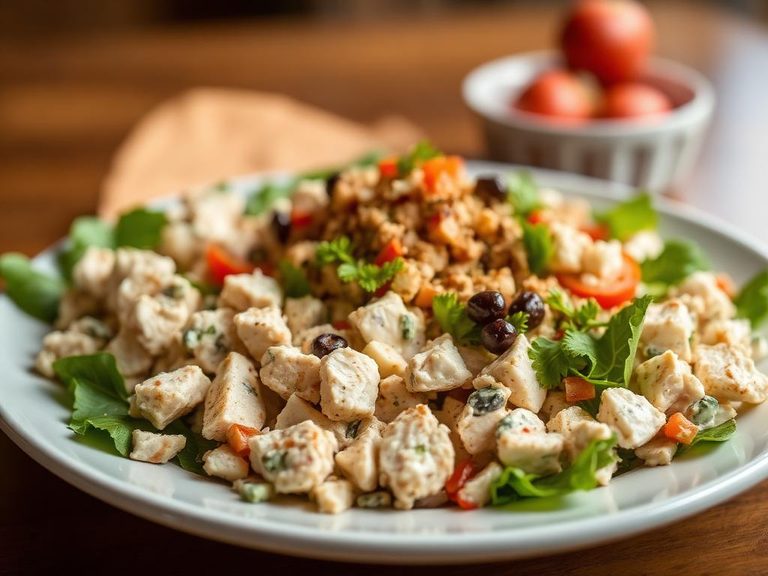
A classic, comforting staple, the chicken salad sandwich on wheat features a creamy, savory filling of diced chicken, mayonnaise, and crisp vegetables nestled between two slices of hearty whole wheat bread. The texture is a satisfying contrast of soft, tender chicken and crunchy celery or onion against the chewy, nutty bread. Nutritionally, it offers a solid protein boost from the chicken and fiber from the wheat, making it a more balanced option than many deli sandwiches.
Calorie split: 21% protein · 28% carbs · 51% fat
↓ Full nutrition💚 Why it's loved
People adore it for its nostalgic, homestyle comfort and the perfect balance of creamy, savory, and fresh flavors. Its versatility allows for endless customization, making it a beloved and adaptable staple in American deli culture and home kitchens.
⚠️ Watch-outs & how to enjoy it better
The mayonnaise-based dressing can be high in saturated fat and calories, and the bread may cause blood sugar spikes for some. To counteract this, opt for light mayo or Greek yogurt, choose high-fiber whole grain bread, and pair with a side salad or vegetables to increase fiber and nutrient intake.
Key benefits
- Good source of high-quality protein for muscle maintenance.
- Provides dietary fiber from whole wheat bread for digestive health.
- Balanced macronutrient profile for sustained energy.
- Versatile base for adding vegetables and healthy fats.
- Convenient, portable meal option for lunches.
🍽️ Popular dishes





🌍 Where it's eaten
💡 Did you know?
The chicken salad sandwich is a staple of American deli culture, and its popularity surged in the mid-20th century as a convenient, protein-rich lunch option, often served at picnics and potlucks.
Full nutrition (USDA data · scales with serving)
| Water | 54.3 g |
| Energy | 245 kcal |
| Protein | 13.1 g |
| Total lipid (fat) | 13.8 g |
| Carbohydrate, by difference | 17.1 g |
| Fiber, total dietary | 2.1 g |
| Total Sugars | 3.1 g |
| Calcium, Ca | 67.0 mg |
| Iron, Fe | 1.4 mg |
| Magnesium, Mg | 29.0 mg |
| Phosphorus, P | 143 mg |
| Potassium, K | 201 mg |
| Sodium, Na | 469 mg |
| Zinc, Zn | 1.0 mg |
| Copper, Cu | 0.09 mg |
| Selenium, Se | 17.6 ug |
| Vitamin C, total ascorbic acid | 0.50 mg |
| Thiamin | 0.16 mg |
| Riboflavin | 0.14 mg |
| Niacin | 4.3 mg |
| Vitamin B-6 | 0.15 mg |
| Folate, total | 34.0 ug |
| Folic acid | 5.0 ug |
| Folate, food | 28.0 ug |
| Folate, DFE | 36.0 ug |
| Choline, total | 35.3 mg |
| Vitamin B-12 | 0.14 ug |
| Vitamin B-12, added | 0.00 ug |
| Vitamin A, RAE | 11.0 ug |
| Retinol | 5.0 ug |
| Carotene, beta | 62.0 ug |
| Carotene, alpha | 5.0 ug |
| Cryptoxanthin, beta | 12.0 ug |
| Lycopene | 0.00 ug |
| Lutein + zeaxanthin | 76.0 ug |
| Vitamin E (alpha-tocopherol) | 0.77 mg |
| Vitamin E, added | 0.00 mg |
| Vitamin D (D2 + D3) | 0.00 ug |
| Vitamin K (phylloquinone) | 31.9 ug |
| Alcohol, ethyl | 0.00 g |
| Caffeine | 0.00 mg |
| Theobromine | 0.00 mg |
Fat & fatty acid profile (per 100g)
| Fatty acids, total saturated | 2.4 g |
| SFA 4:0 | 0.00 g |
| SFA 6:0 | 0.00 g |
| SFA 8:0 | 0.00 g |
| SFA 10:0 | 0.00 g |
| SFA 12:0 | 0.00 g |
| SFA 14:0 | 0.02 g |
| SFA 16:0 | 1.7 g |
| SFA 18:0 | 0.60 g |
| Fatty acids, total monounsaturated | 3.5 g |
| MUFA 16:1 | 0.17 g |
| MUFA 18:1 | 3.2 g |
| MUFA 20:1 | 0.04 g |
| MUFA 22:1 | 0.01 g |
| Fatty acids, total polyunsaturated | 7.0 g |
| PUFA 18:2 | 6.2 g |
| PUFA 18:3 | 0.82 g |
| PUFA 18:4 | 0.00 g |
| PUFA 20:4 | 0.01 g |
| PUFA 20:5 n-3 (EPA) | 0.00 g |
| PUFA 22:5 n-3 (DPA) | 0.00 g |
| PUFA 22:6 n-3 (DHA) | 0.00 g |
| Cholesterol | 44.0 mg |
FAQ
Is a chicken salad sandwich on wheat healthy?
It can be a balanced meal, offering protein from chicken and fiber from whole wheat bread. However, the healthiness depends on the mayo content and portion size. Using light mayo or Greek yogurt and adding vegetables can improve its nutritional profile.
How many calories are in a chicken salad sandwich on wheat?
A typical 100g serving contains about 245 calories, but this varies based on ingredients like mayo type, added vegetables, and bread thickness. A standard sandwich is usually around 400-500 calories.
Can I make a chicken salad sandwich healthier?
Yes, you can use Greek yogurt instead of mayo, add more vegetables like celery, grapes, or spinach, choose whole grain bread, and control portion sizes. Adding nuts or seeds can also boost healthy fats and fiber.
Nutrient density (calculated · NRF9.3)
Nutrient Rich Foods index: beneficial nutrients (protein, fiber, vitamins, minerals) minus saturated fat, added sugar & sodium, per 100 kcal.
NRF9.3 index — Fulgoni, Keast & Drewnowski, 2009. Computed from USDA nutrients.
Weight-loss friendliness (composite index)
Energy density 2.45 kcal/g · 21% calories from protein · 2.1 g fiber · 3.1 g sugar per 100 g.
Composite of energy density (Rolls et al., 1999), protein & fiber satiety, minus sugar. A calculated heuristic — ranks satiety-per-calorie, not a clinical measure.
Dietary load (calculated from USDA values)
Potential renal acid load. Positive = acid-forming, negative = alkaline-forming.
Sodium-to-potassium ratio: 2.33 (lower is better — aim for ≤ 1)
Sodium:potassium per WHO potassium guidance. Computed from USDA nutrients.