

Breakfast pastry, NFS
Common food

Photo: Wikipedia
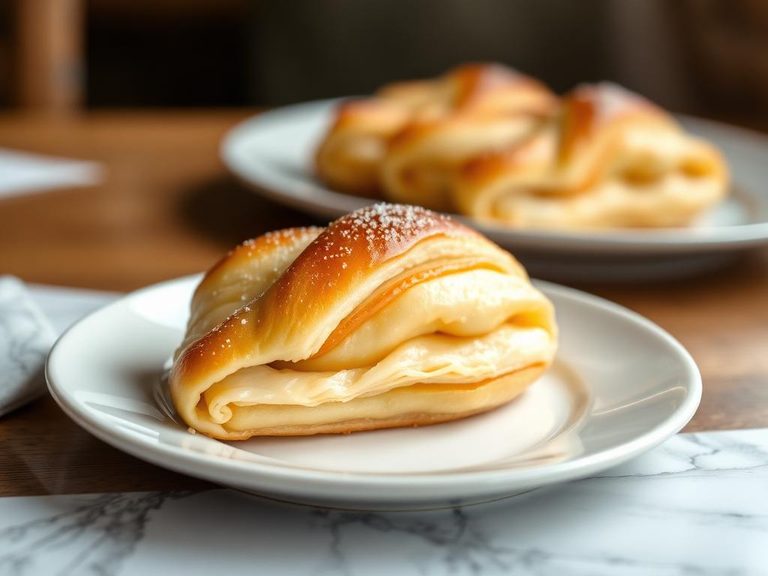
Breakfast pastry, NFS (Not Further Specified), is a broad category of sweet, baked goods designed for a morning meal, ranging from flaky croissants and Danish pastries to soft, cake-like muffins and sweet rolls. Its texture can vary from light, airy, and buttery to dense and crumbly, with a taste profile dominated by sweetness, often enhanced by fillings like fruit, cream, or chocolate. Nutritionally, it is a high-energy, carbohydrate-dense food, providing quick fuel but with a significant sugar content.
Calorie split: 6% protein · 50% carbs · 44% fat
↓ Full nutrition💚 Why it's loved
People love breakfast pastries for their indulgent, sweet flavors and satisfying textures, from the shatter of a croissant's crust to the soft chew of a cinnamon roll. They are a versatile staple, enjoyed with coffee, tea, or milk, and are deeply embedded in morning rituals and café cultures worldwide.
⚠️ Watch-outs & how to enjoy it better
The high sugar and refined carbohydrate content can lead to rapid blood sugar spikes and subsequent crashes, potentially causing hunger soon after eating. Many are also high in saturated fats and calories, making them a less ideal choice for those managing weight or heart health. To mitigate this, pair a small portion with a source of protein (like Greek yogurt or eggs) and healthy fat (like nuts or avocado) to slow digestion and promote satiety.
Key benefits
- Provides a quick source of energy from carbohydrates.
- Offers a small amount of protein from flour and eggs.
- Can be a convenient and portable breakfast option.
- Often contains some dietary fiber, especially if made with whole grains.
- Can be a source of enjoyment and comfort as part of a balanced diet.
🍽️ Popular dishes





🌍 Where it's eaten
💡 Did you know?
The laminated dough technique used for croissants and Danish pastries, which creates their iconic flaky layers, was actually perfected in Vienna before becoming a hallmark of French viennoiserie.
Full nutrition (USDA data · scales with serving)
| Water | 27.1 g |
| Energy | 371 kcal |
| Protein | 5.4 g |
| Total lipid (fat) | 18.5 g |
| Carbohydrate, by difference | 47.8 g |
| Fiber, total dietary | 1.9 g |
| Total Sugars | 27.5 g |
| Calcium, Ca | 46.0 mg |
| Iron, Fe | 1.8 mg |
| Magnesium, Mg | 15.0 mg |
| Phosphorus, P | 89.0 mg |
| Potassium, K | 83.0 mg |
| Sodium, Na | 445 mg |
| Zinc, Zn | 0.54 mg |
| Copper, Cu | 0.07 mg |
| Selenium, Se | 14.8 ug |
| Vitamin C, total ascorbic acid | 3.9 mg |
| Thiamin | 0.26 mg |
| Riboflavin | 0.22 mg |
| Niacin | 2.0 mg |
| Vitamin B-6 | 0.04 mg |
| Folate, total | 47.0 ug |
| Folic acid | 31.0 ug |
| Folate, food | 16.0 ug |
| Folate, DFE | 68.0 ug |
| Choline, total | 21.8 mg |
| Vitamin B-12 | 0.09 ug |
| Vitamin B-12, added | 0.00 ug |
| Vitamin A, RAE | 15.0 ug |
| Retinol | 15.0 ug |
| Carotene, beta | 1.0 ug |
| Carotene, alpha | 0.00 ug |
| Cryptoxanthin, beta | 1.0 ug |
| Lycopene | 0.00 ug |
| Lutein + zeaxanthin | 49.0 ug |
| Vitamin E (alpha-tocopherol) | 0.34 mg |
| Vitamin E, added | 0.00 mg |
| Vitamin D (D2 + D3) | 0.00 ug |
| Vitamin K (phylloquinone) | 5.3 ug |
| Alcohol, ethyl | 0.00 g |
| Caffeine | 0.00 mg |
| Theobromine | 0.00 mg |
Fat & fatty acid profile (per 100g)
| Fatty acids, total saturated | 4.9 g |
| SFA 4:0 | 0.00 g |
| SFA 6:0 | 0.00 g |
| SFA 8:0 | 0.00 g |
| SFA 10:0 | 0.00 g |
| SFA 12:0 | 0.00 g |
| SFA 14:0 | 0.09 g |
| SFA 16:0 | 2.7 g |
| SFA 18:0 | 2.1 g |
| Fatty acids, total monounsaturated | 10.0 g |
| MUFA 16:1 | 0.07 g |
| MUFA 18:1 | 9.9 g |
| MUFA 20:1 | 0.01 g |
| MUFA 22:1 | 0.00 g |
| Fatty acids, total polyunsaturated | 2.4 g |
| PUFA 18:2 | 2.2 g |
| PUFA 18:3 | 0.11 g |
| PUFA 18:4 | 0.00 g |
| PUFA 20:4 | 0.04 g |
| PUFA 20:5 n-3 (EPA) | 0.02 g |
| PUFA 22:5 n-3 (DPA) | 0.00 g |
| PUFA 22:6 n-3 (DHA) | 0.01 g |
| Cholesterol | 114 mg |
FAQ
What does 'NFS' mean on a nutrition label?
NFS stands for 'Not Further Specified.' It's a catch-all category used when a food item (like a breakfast pastry) is too varied to fit into a more specific database entry, so the nutritional values are an average estimate.
Are all breakfast pastries high in sugar?
While most sweet breakfast pastries contain significant sugar, the amount varies widely. A plain croissant has less sugar than a glazed cinnamon roll or a fruit-filled Danish. Checking nutrition labels or asking for less sweet options can help.
How can I make a breakfast pastry a more balanced meal?
Pair a smaller portion of pastry with protein and fiber. For example, have half a croissant with scrambled eggs and a side of berries, or a small muffin with a cup of plain yogurt and a sprinkle of nuts.
Nutrient density (calculated · NRF9.3)
Nutrient Rich Foods index: beneficial nutrients (protein, fiber, vitamins, minerals) minus saturated fat, added sugar & sodium, per 100 kcal.
NRF9.3 index — Fulgoni, Keast & Drewnowski, 2009. Computed from USDA nutrients.
Weight-loss friendliness (composite index)
Energy density 3.71 kcal/g · 6% calories from protein · 1.9 g fiber · 27.5 g sugar per 100 g.
Composite of energy density (Rolls et al., 1999), protein & fiber satiety, minus sugar. A calculated heuristic — ranks satiety-per-calorie, not a clinical measure.
Dietary load (calculated from USDA values)
Potential renal acid load. Positive = acid-forming, negative = alkaline-forming.
Sodium-to-potassium ratio: 5.36 (lower is better — aim for ≤ 1)
Sodium:potassium per WHO potassium guidance. Computed from USDA nutrients.