

Bologna sandwich on wheat
Common food

Photo: Wikipedia
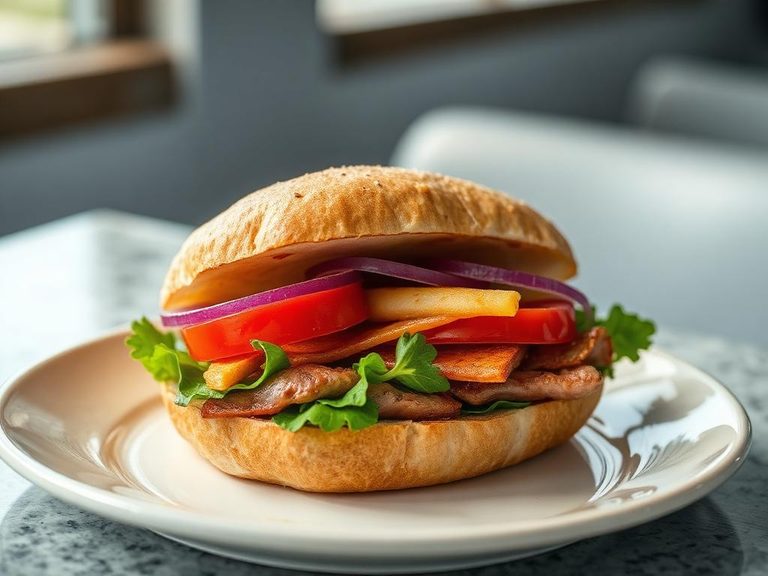
A classic Bologna sandwich on wheat bread is a simple, satisfying staple: soft, pink slices of finely ground, emulsified sausage layered between two slices of whole-grain bread, offering a mild, savory, and slightly smoky flavor with a tender, uniform texture. It provides a solid protein punch (about 11g per 100g) alongside a moderate calorie count, making it a quick, energy-dense meal. The whole-wheat bread adds a nutty depth and boosts the fiber content, balancing the sandwich's softer textures.
Calorie split: 16% protein · 39% carbs · 45% fat
↓ Full nutrition💚 Why it's loved
People love it for its nostalgic, comforting simplicity and the perfect balance of savory, salty meat with the earthy chew of wheat bread. It's endlessly versatile, easily customized with condiments like mustard, mayonnaise, or pickles to suit any taste.
⚠️ Watch-outs & how to enjoy it better
The primary downsides are the high sodium and saturated fat content typical of processed meats, which can contribute to blood pressure and cardiovascular concerns if consumed excessively. To counteract this, opt for low-sodium Bologna, use just one slice per sandwich, and load up on fresh vegetable toppings like lettuce, tomato, and onion to add volume, fiber, and nutrients without extra salt.
Key benefits
- High-quality protein source for muscle maintenance
- Whole-wheat bread provides dietary fiber and B vitamins
- Quick, no-cook meal solution for busy schedules
- Calorie-dense for efficient energy provision
- Contains iron and zinc from the processed meat
🍽️ Popular dishes



🌍 Where it's eaten
💡 Did you know?
The name 'Bologna' comes from the Italian city of Bologna, where the original mortadella sausage originated, but American-style Bologna is a distinctly different, smoother, and milder product.
Full nutrition (USDA data · scales with serving)
| Water | 46.1 g |
| Energy | 272 kcal |
| Protein | 10.9 g |
| Total lipid (fat) | 13.5 g |
| Carbohydrate, by difference | 26.5 g |
| Fiber, total dietary | 2.8 g |
| Total Sugars | 3.6 g |
| Calcium, Ca | 144 mg |
| Iron, Fe | 2.2 mg |
| Magnesium, Mg | 36.0 mg |
| Phosphorus, P | 188 mg |
| Potassium, K | 252 mg |
| Sodium, Na | 759 mg |
| Zinc, Zn | 1.2 mg |
| Copper, Cu | 0.12 mg |
| Selenium, Se | 21.2 ug |
| Vitamin C, total ascorbic acid | 0.10 mg |
| Thiamin | 0.23 mg |
| Riboflavin | 0.19 mg |
| Niacin | 4.1 mg |
| Vitamin B-6 | 0.18 mg |
| Folate, total | 41.0 ug |
| Folic acid | 7.0 ug |
| Folate, food | 33.0 ug |
| Folate, DFE | 46.0 ug |
| Choline, total | 39.6 mg |
| Vitamin B-12 | 0.23 ug |
| Vitamin B-12, added | 0.00 ug |
| Vitamin A, RAE | 0.00 ug |
| Retinol | 0.00 ug |
| Carotene, beta | 1.0 ug |
| Carotene, alpha | 0.00 ug |
| Cryptoxanthin, beta | 0.00 ug |
| Lycopene | 0.00 ug |
| Lutein + zeaxanthin | 33.0 ug |
| Vitamin E (alpha-tocopherol) | 0.46 mg |
| Vitamin E, added | 0.00 mg |
| Vitamin D (D2 + D3) | 0.40 ug |
| Vitamin K (phylloquinone) | 3.7 ug |
| Alcohol, ethyl | 0.00 g |
| Caffeine | 0.00 mg |
| Theobromine | 0.00 mg |
Fat & fatty acid profile (per 100g)
| Fatty acids, total saturated | 3.9 g |
| SFA 4:0 | 0.00 g |
| SFA 6:0 | 0.00 g |
| SFA 8:0 | 0.00 g |
| SFA 10:0 | 0.01 g |
| SFA 12:0 | 0.01 g |
| SFA 14:0 | 0.00 g |
| SFA 16:0 | 2.8 g |
| SFA 18:0 | 1.1 g |
| Fatty acids, total monounsaturated | 5.3 g |
| MUFA 16:1 | 0.46 g |
| MUFA 18:1 | 4.7 g |
| MUFA 20:1 | 0.10 g |
| MUFA 22:1 | 0.04 g |
| Fatty acids, total polyunsaturated | 3.0 g |
| PUFA 18:2 | 2.7 g |
| PUFA 18:3 | 0.18 g |
| PUFA 18:4 | 0.00 g |
| PUFA 20:4 | 0.05 g |
| PUFA 20:5 n-3 (EPA) | 0.00 g |
| PUFA 22:5 n-3 (DPA) | 0.01 g |
| PUFA 22:6 n-3 (DHA) | 0.00 g |
| Cholesterol | 44.0 mg |
FAQ
Is a Bologna sandwich on wheat bread healthy?
It can be part of a balanced diet when chosen wisely. Selecting whole-wheat bread adds fiber, and opting for lower-sodium or leaner Bologna reduces sodium and fat. Pairing it with plenty of vegetables and a piece of fruit makes it a more nutritionally complete meal.
What's the difference between Bologna and mortadella?
While both originate from Italy, American Bologna is a finely ground, emulsified sausage that is typically smooth and mild. Traditional Italian mortadella is coarser, often studded with pistachios or peppercorns, and has a richer, more complex flavor.
How can I make a Bologna sandwich less salty?
Choose a low-sodium brand, use only one slice of meat, and rinse the slice briefly under water before assembling. Counterbalance the saltiness with unsalted toppings like avocado, cucumber, or a homemade spread, and drink water with your meal.
Nutrient density (calculated · NRF9.3)
Nutrient Rich Foods index: beneficial nutrients (protein, fiber, vitamins, minerals) minus saturated fat, added sugar & sodium, per 100 kcal.
NRF9.3 index — Fulgoni, Keast & Drewnowski, 2009. Computed from USDA nutrients.
Weight-loss friendliness (composite index)
Energy density 2.72 kcal/g · 16% calories from protein · 2.8 g fiber · 3.6 g sugar per 100 g.
Composite of energy density (Rolls et al., 1999), protein & fiber satiety, minus sugar. A calculated heuristic — ranks satiety-per-calorie, not a clinical measure.
Dietary load (calculated from USDA values)
Potential renal acid load. Positive = acid-forming, negative = alkaline-forming.
Sodium-to-potassium ratio: 3.01 (lower is better — aim for ≤ 1)
Sodium:potassium per WHO potassium guidance. Computed from USDA nutrients.