

Beef egg foo yung
Common food

Photo: Wikipedia
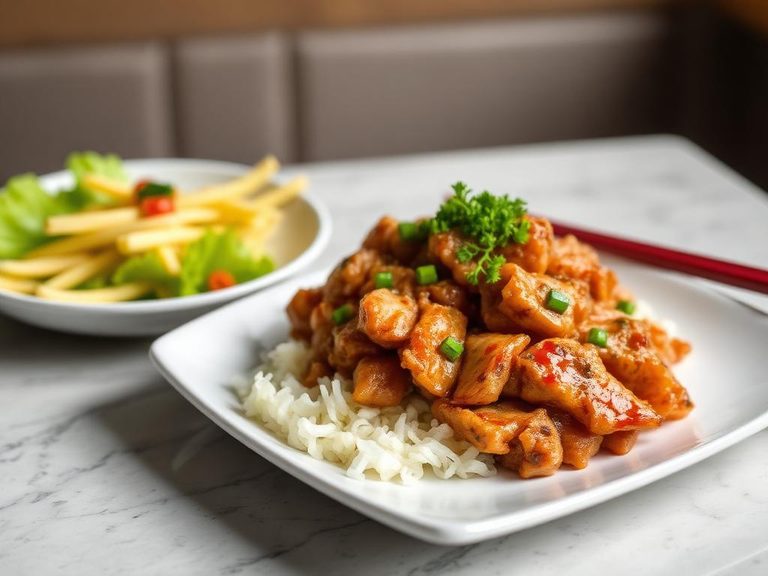
Beef egg foo yung is a savory Chinese-American omelette patty, typically featuring minced beef, bean sprouts, and scallions bound in egg and pan-fried until golden. It has a tender, fluffy interior with a slightly crisp exterior, and is traditionally served smothered in a rich, savory brown gravy. Nutritionally, it's a protein-packed dish with a moderate calorie count, making it a satisfying yet balanced option.
Calorie split: 38% protein · 13% carbs · 49% fat
↓ Full nutrition💚 Why it's loved
People love it for its comforting, umami-rich flavor profile where the savory beef and egg are perfectly complemented by the glossy, flavorful gravy. It's a beloved staple in Chinese-American cuisine, valued for its hearty texture and its role as a versatile, satisfying main course.
⚠️ Watch-outs & how to enjoy it better
The brown gravy can be high in sodium, which may be a concern for those monitoring salt intake. To counteract this, you can request sauce on the side to control portioning or pair the dish with unsalted steamed vegetables. Additionally, those with egg or soy allergies (common in the sauce) should exercise caution.
Key benefits
- Excellent source of high-quality protein for muscle maintenance
- Low in carbohydrates, suitable for low-carb dietary patterns
- Contains essential vitamins and minerals from eggs and vegetables
- Provides a quick and filling meal option
- Can be easily customized with additional vegetables
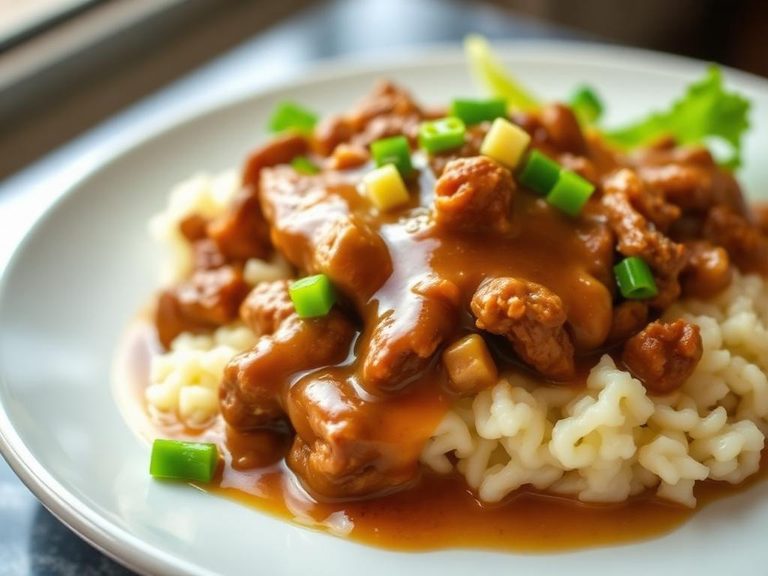
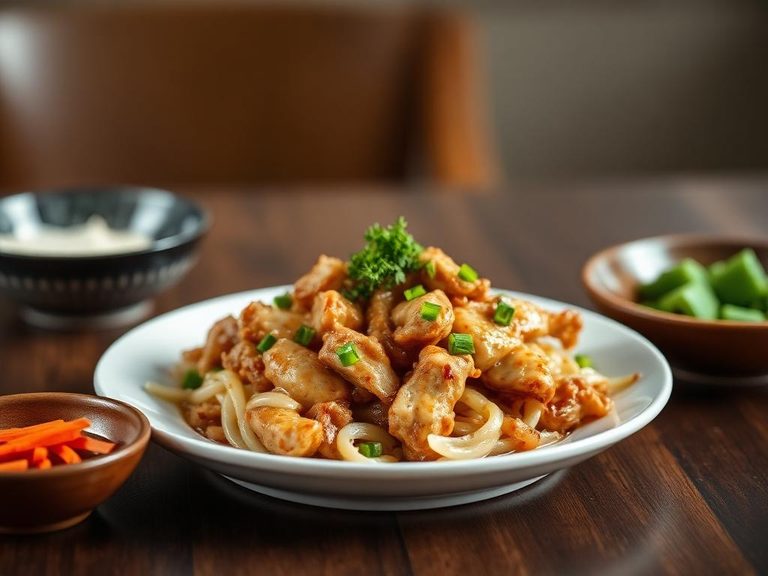
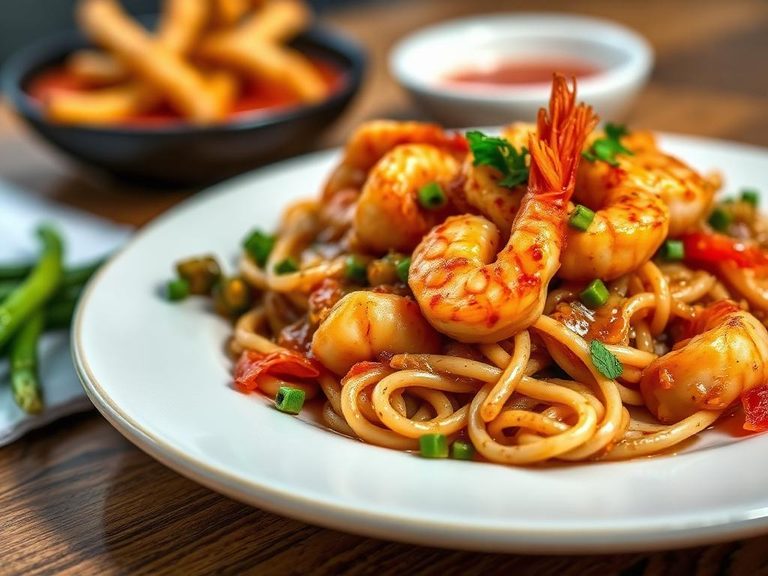
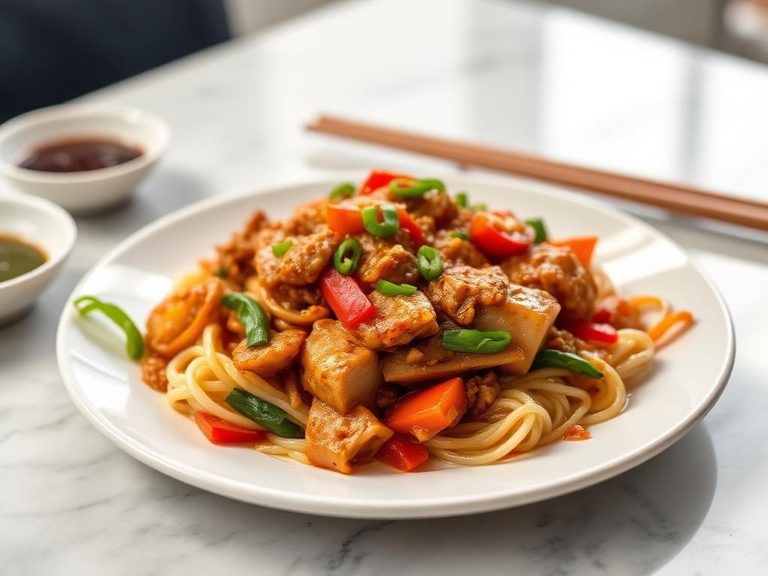
🍽️ Popular dishes
🌍 Where it's eaten
💡 Did you know?
The name 'foo yung' is a phonetic approximation of the Cantonese term for 'hibiscus,' referring to the dish's flower-like shape when the egg mixture is ladled into the hot pan.
Full nutrition (USDA data · scales with serving)
| Water | 71.8 g |
| Energy | 147 kcal |
| Protein | 13.8 g |
| Total lipid (fat) | 8.1 g |
| Carbohydrate, by difference | 4.8 g |
| Fiber, total dietary | 0.30 g |
| Total Sugars | 3.0 g |
| Calcium, Ca | 32.0 mg |
| Iron, Fe | 1.6 mg |
| Magnesium, Mg | 14.0 mg |
| Phosphorus, P | 138 mg |
| Potassium, K | 165 mg |
| Sodium, Na | 321 mg |
| Zinc, Zn | 2.0 mg |
| Copper, Cu | 0.03 mg |
| Selenium, Se | 22.0 ug |
| Vitamin C, total ascorbic acid | 1.7 mg |
| Thiamin | 0.05 mg |
| Riboflavin | 0.23 mg |
| Niacin | 1.5 mg |
| Vitamin B-6 | 0.14 mg |
| Folate, total | 31.0 ug |
| Folic acid | 0.00 ug |
| Folate, food | 31.0 ug |
| Folate, DFE | 31.0 ug |
| Choline, total | 155 mg |
| Vitamin B-12 | 0.83 ug |
| Vitamin B-12, added | 0.00 ug |
| Vitamin A, RAE | 83.0 ug |
| Retinol | 77.0 ug |
| Carotene, beta | 64.0 ug |
| Carotene, alpha | 0.00 ug |
| Cryptoxanthin, beta | 6.0 ug |
| Lycopene | 0.00 ug |
| Lutein + zeaxanthin | 325 ug |
| Vitamin E (alpha-tocopherol) | 0.89 mg |
| Vitamin E, added | 0.00 mg |
| Vitamin D (D2 + D3) | 1.1 ug |
| Vitamin K (phylloquinone) | 24.0 ug |
| Alcohol, ethyl | 0.00 g |
| Caffeine | 0.00 mg |
| Theobromine | 0.00 mg |
Fat & fatty acid profile (per 100g)
| Fatty acids, total saturated | 2.5 g |
| SFA 4:0 | 0.00 g |
| SFA 6:0 | 0.00 g |
| SFA 8:0 | 0.00 g |
| SFA 10:0 | 0.01 g |
| SFA 12:0 | 0.01 g |
| SFA 14:0 | 0.09 g |
| SFA 16:0 | 1.7 g |
| SFA 18:0 | 0.65 g |
| Fatty acids, total monounsaturated | 3.2 g |
| MUFA 16:1 | 0.21 g |
| MUFA 18:1 | 2.9 g |
| MUFA 20:1 | 0.01 g |
| MUFA 22:1 | 0.00 g |
| Fatty acids, total polyunsaturated | 1.4 g |
| PUFA 18:2 | 1.2 g |
| PUFA 18:3 | 0.09 g |
| PUFA 18:4 | 0.00 g |
| PUFA 20:4 | 0.01 g |
| PUFA 20:5 n-3 (EPA) | 0.00 g |
| PUFA 22:5 n-3 (DPA) | 0.00 g |
| PUFA 22:6 n-3 (DHA) | 0.00 g |
| Cholesterol | 201 mg |
FAQ
Is beef egg foo yung the same as an omelette?
While similar, it's distinct. It's a Chinese-American creation where beaten egg is mixed with fillings (like beef and bean sprouts) and fried into a patty, then served with a separate brown gravy, unlike a folded Western omelette.
What gives egg foo yung its characteristic flavor?
The key is the combination of the savory, slightly caramelized egg patty and the rich, umami-packed brown gravy, which is typically made with soy sauce, broth, and sometimes oyster sauce or mushrooms.
Can I make it healthier at home?
Absolutely. Use lean ground beef, load up on vegetables like mushrooms and bok choy, use low-sodium soy sauce for the gravy, and consider serving it over cauliflower rice instead of white rice to reduce carbs.
Nutrient density (calculated · NRF9.3)
Nutrient Rich Foods index: beneficial nutrients (protein, fiber, vitamins, minerals) minus saturated fat, added sugar & sodium, per 100 kcal.
NRF9.3 index — Fulgoni, Keast & Drewnowski, 2009. Computed from USDA nutrients.
Weight-loss friendliness (composite index)
Energy density 1.47 kcal/g · 38% calories from protein · 0.3 g fiber · 3.0 g sugar per 100 g.
Composite of energy density (Rolls et al., 1999), protein & fiber satiety, minus sugar. A calculated heuristic — ranks satiety-per-calorie, not a clinical measure.
Dietary load (calculated from USDA values)
Potential renal acid load. Positive = acid-forming, negative = alkaline-forming.
Sodium-to-potassium ratio: 1.95 (lower is better — aim for ≤ 1)
Sodium:potassium per WHO potassium guidance. Computed from USDA nutrients.