

Barfi or Burfi, Indian dessert
Common food

Photo: Wikipedia
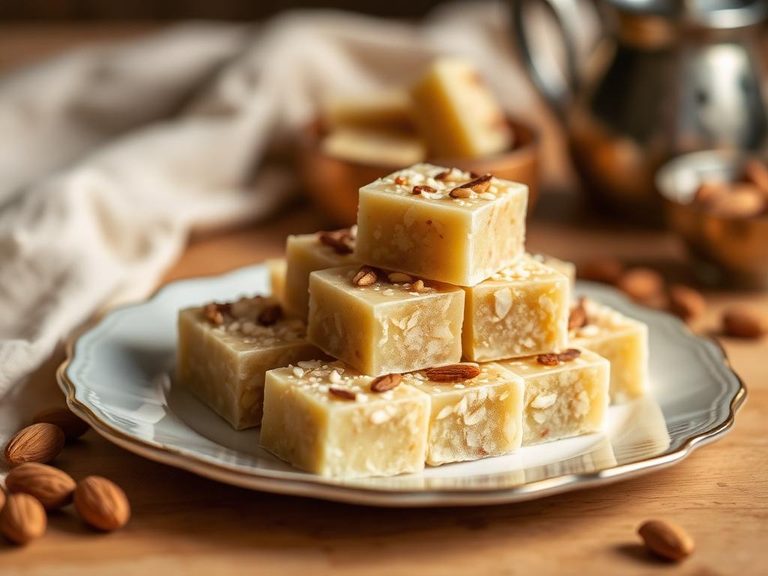
Barfi is a dense, fudge-like Indian sweet made primarily from condensed milk, sugar, and often flavored with cardamom, saffron, or nuts. It has a smooth, melt-in-the-mouth texture that can range from soft and chewy to slightly grainy, depending on the base ingredient like coconut, cashew, or chickpea flour. Nutritionally, it is a concentrated source of quick energy, with over 40g of carbohydrates and nearly 37g of sugar per 100g.
Calorie split: 8% protein · 57% carbs · 36% fat
↓ Full nutrition💚 Why it's loved
People love barfi for its rich, sweet, and often aromatic flavor profile, which can be customized with countless variations. It is a cornerstone of Indian celebrations, symbolizing joy and hospitality during festivals like Diwali and weddings.
⚠️ Watch-outs & how to enjoy it better
Its high sugar and calorie content can lead to blood-sugar spikes, making it unsuitable for those managing diabetes or watching their sugar intake. To enjoy it mindfully, practice strict portion control (one small piece) and pair it with a protein or fat source like a handful of nuts or a cup of unsweetened tea to slow sugar absorption.
Key benefits
- Provides a quick source of energy from carbohydrates.
- Contains some protein from milk solids or nuts.
- Offers calcium and phosphorus from dairy-based varieties.
- Can be a source of healthy fats if made with nuts like almonds or cashews.
🍽️ Popular dishes
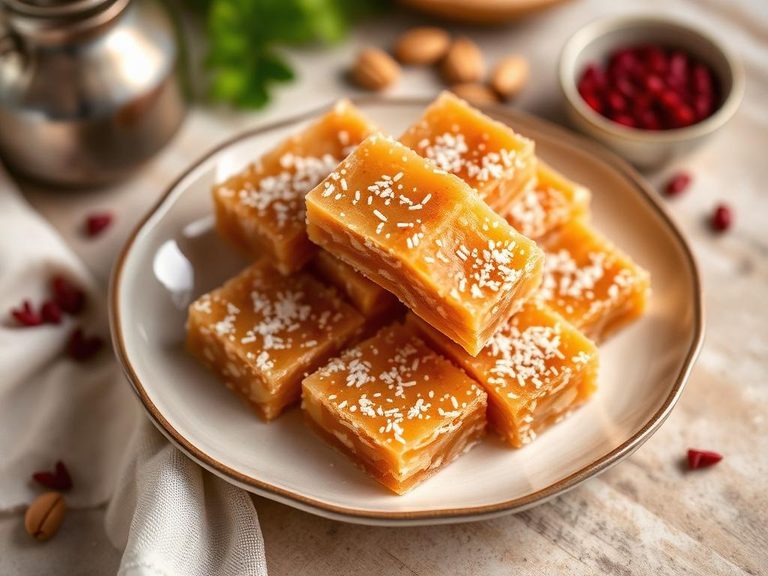
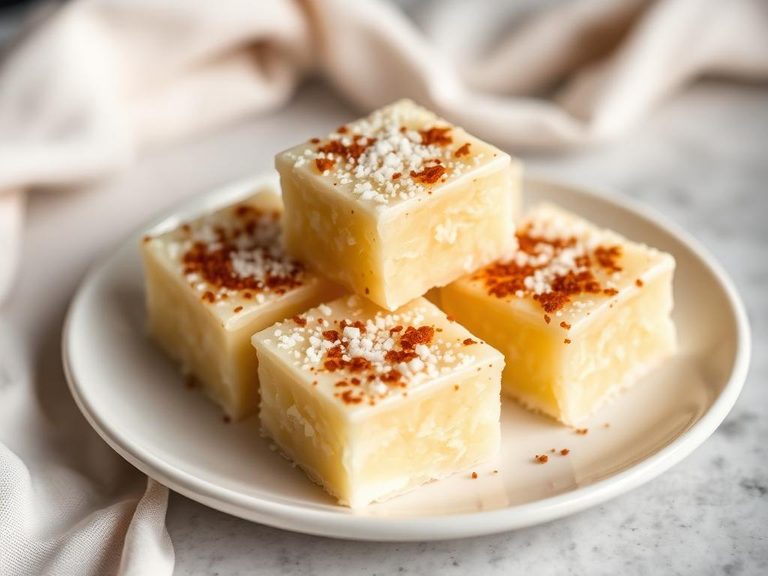
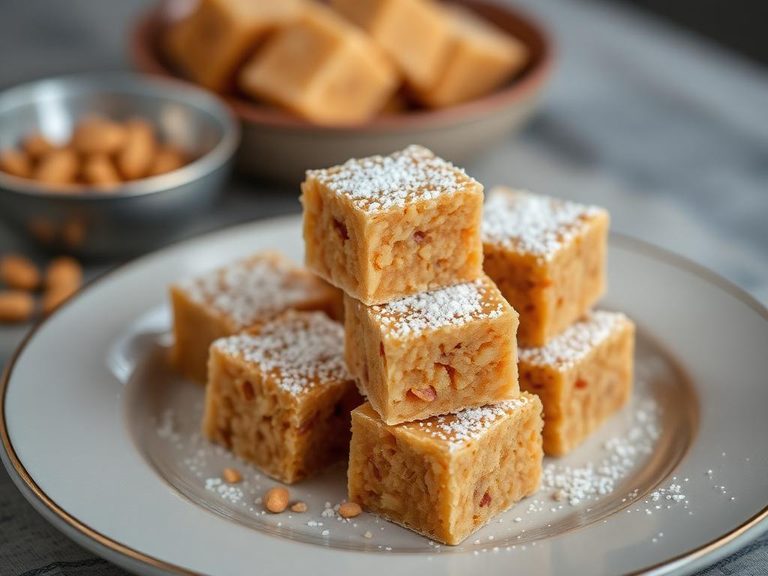
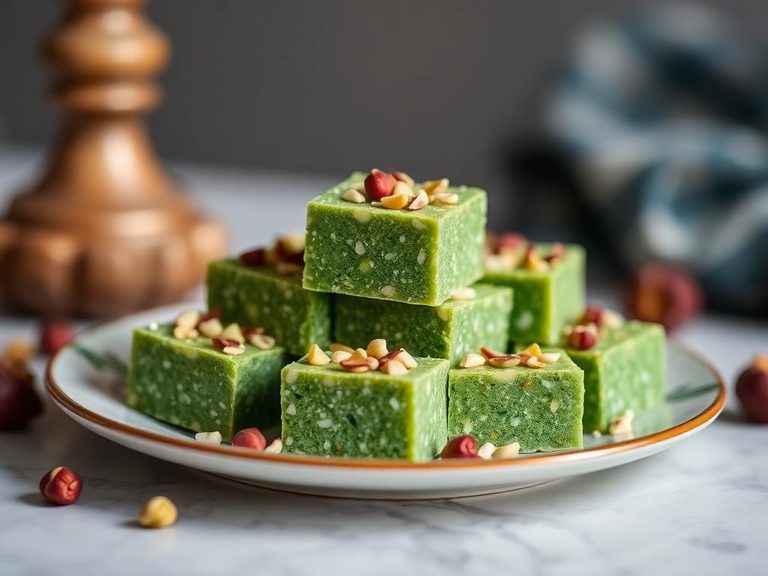
🌍 Where it's eaten
💡 Did you know?
The word 'barfi' comes from the Persian word 'barf', meaning snow, a reference to its original white, snow-like appearance from its primary ingredient: milk.
Full nutrition (USDA data · scales with serving)
| Water | 41.8 g |
| Energy | 284 kcal |
| Protein | 5.4 g |
| Total lipid (fat) | 11.4 g |
| Carbohydrate, by difference | 40.4 g |
| Fiber, total dietary | 0.40 g |
| Total Sugars | 37.0 g |
| Calcium, Ca | 148 mg |
| Iron, Fe | 0.22 mg |
| Magnesium, Mg | 19.0 mg |
| Phosphorus, P | 127 mg |
| Potassium, K | 185 mg |
| Sodium, Na | 71.0 mg |
| Zinc, Zn | 0.50 mg |
| Copper, Cu | 0.04 mg |
| Selenium, Se | 4.2 ug |
| Vitamin C, total ascorbic acid | 0.30 mg |
| Thiamin | 0.04 mg |
| Riboflavin | 0.25 mg |
| Niacin | 0.21 mg |
| Vitamin B-6 | 0.07 mg |
| Folate, total | 4.0 ug |
| Folic acid | 0.00 ug |
| Folate, food | 4.0 ug |
| Folate, DFE | 4.0 ug |
| Choline, total | 13.7 mg |
| Vitamin B-12 | 0.23 ug |
| Vitamin B-12, added | 0.00 ug |
| Vitamin A, RAE | 96.0 ug |
| Retinol | 95.0 ug |
| Carotene, beta | 12.0 ug |
| Carotene, alpha | 0.00 ug |
| Cryptoxanthin, beta | 0.00 ug |
| Lycopene | 0.00 ug |
| Lutein + zeaxanthin | 20.0 ug |
| Vitamin E (alpha-tocopherol) | 0.71 mg |
| Vitamin E, added | 0.00 mg |
| Vitamin D (D2 + D3) | 0.10 ug |
| Vitamin K (phylloquinone) | 1.0 ug |
| Alcohol, ethyl | 0.00 g |
| Caffeine | 0.00 mg |
| Theobromine | 0.00 mg |
Fat & fatty acid profile (per 100g)
| Fatty acids, total saturated | 6.1 g |
| SFA 4:0 | 0.21 g |
| SFA 6:0 | 0.17 g |
| SFA 8:0 | 0.11 g |
| SFA 10:0 | 0.26 g |
| SFA 12:0 | 0.30 g |
| SFA 14:0 | 0.98 g |
| SFA 16:0 | 2.9 g |
| SFA 18:0 | 0.97 g |
| Fatty acids, total monounsaturated | 3.5 g |
| MUFA 16:1 | 0.21 g |
| MUFA 18:1 | 3.2 g |
| MUFA 20:1 | 0.02 g |
| MUFA 22:1 | 0.00 g |
| Fatty acids, total polyunsaturated | 0.83 g |
| PUFA 18:2 | 0.80 g |
| PUFA 18:3 | 0.04 g |
| PUFA 18:4 | 0.00 g |
| PUFA 20:4 | 0.01 g |
| PUFA 20:5 n-3 (EPA) | 0.00 g |
| PUFA 22:5 n-3 (DPA) | 0.01 g |
| PUFA 22:6 n-3 (DHA) | 0.00 g |
| Cholesterol | 35.0 mg |
FAQ
Is barfi gluten-free?
It depends on the variety. Traditional milk or nut-based barfis are gluten-free, but some recipes use wheat flour or semolina as a base, which contain gluten. Always check the specific ingredients.
How long does barfi last?
When stored in an airtight container at room temperature, it can last for 3-4 days. In the refrigerator, it can last for up to 2 weeks.
Can I make a healthier version at home?
Yes, you can reduce sugar significantly or use natural sweeteners like dates or jaggery. Using bases like oats, almond flour, or coconut can also increase fiber and protein content.
Nutrient density (calculated · NRF9.3)
Nutrient Rich Foods index: beneficial nutrients (protein, fiber, vitamins, minerals) minus saturated fat, added sugar & sodium, per 100 kcal.
NRF9.3 index — Fulgoni, Keast & Drewnowski, 2009. Computed from USDA nutrients.
Weight-loss friendliness (composite index)
Energy density 2.84 kcal/g · 8% calories from protein · 0.4 g fiber · 37.0 g sugar per 100 g.
Composite of energy density (Rolls et al., 1999), protein & fiber satiety, minus sugar. A calculated heuristic — ranks satiety-per-calorie, not a clinical measure.
Dietary load (calculated from USDA values)
Potential renal acid load. Positive = acid-forming, negative = alkaline-forming.
Sodium-to-potassium ratio: 0.38 (lower is better — aim for ≤ 1)
Sodium:potassium per WHO potassium guidance. Computed from USDA nutrients.