

Alfredo sauce with seafood
Common food

Photo: Wikipedia
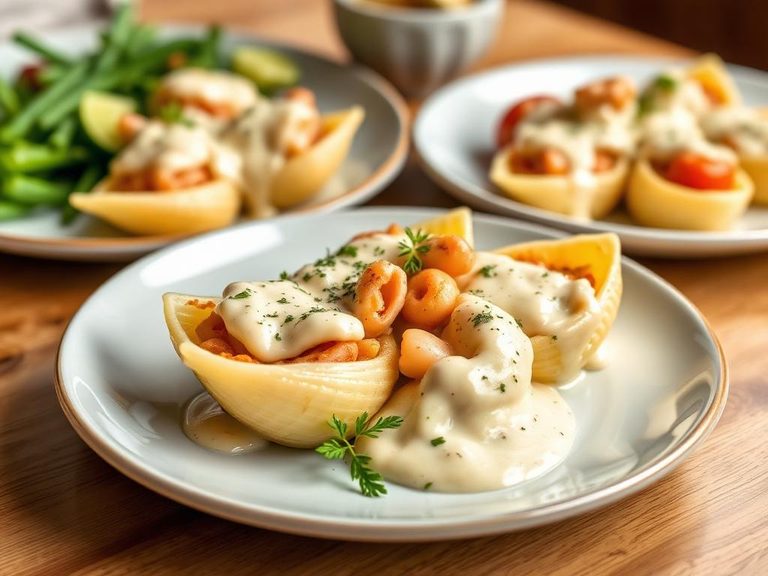
A rich, velvety sauce made from butter, cream, and Parmesan cheese, here studded with tender morsels of shrimp, scallops, or crab. It delivers a luxurious, savory flavor with a smooth, coating texture that clings to pasta. Nutritionally, it's a high-fat, moderate-protein condiment, offering a significant calorie boost to any dish.
Calorie split: 16% protein · 6% carbs · 78% fat
↓ Full nutrition💚 Why it's loved
People adore it for its decadent, umami-rich taste that feels indulgent and comforting. It's incredibly versatile, transforming simple pasta, chicken, or vegetables into a restaurant-quality meal.
⚠️ Watch-outs & how to enjoy it better
Its high saturated fat and calorie content can be a concern for those monitoring heart health or weight. To counteract this, practice strict portion control, use it as a flavor accent rather than the main event, and pair it with large servings of fibrous vegetables like steamed broccoli or a side salad to add volume and nutrients without excess calories.
Key benefits
- High in fat for satiety and flavor delivery
- Good source of protein from the seafood and cheese
- Contains calcium from the Parmesan cheese
- Provides quick energy from its calorie density
- Enhances the palatability of lean proteins and vegetables
🍽️ Popular dishes
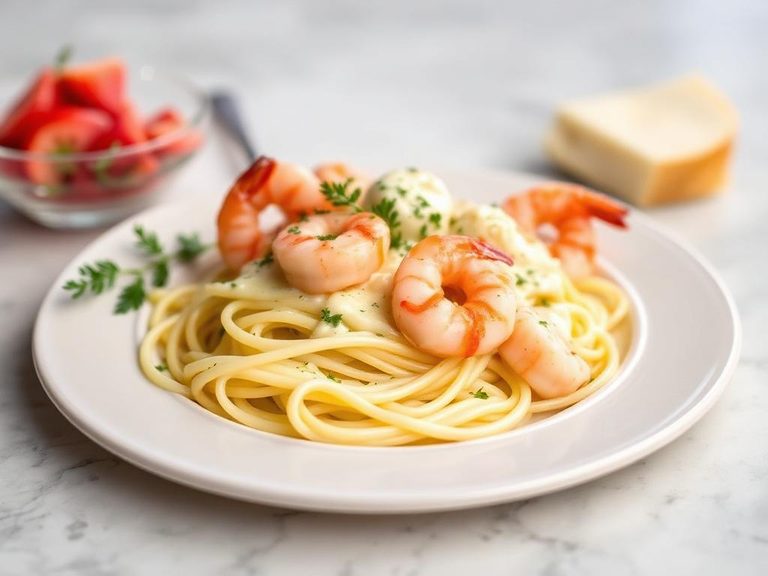
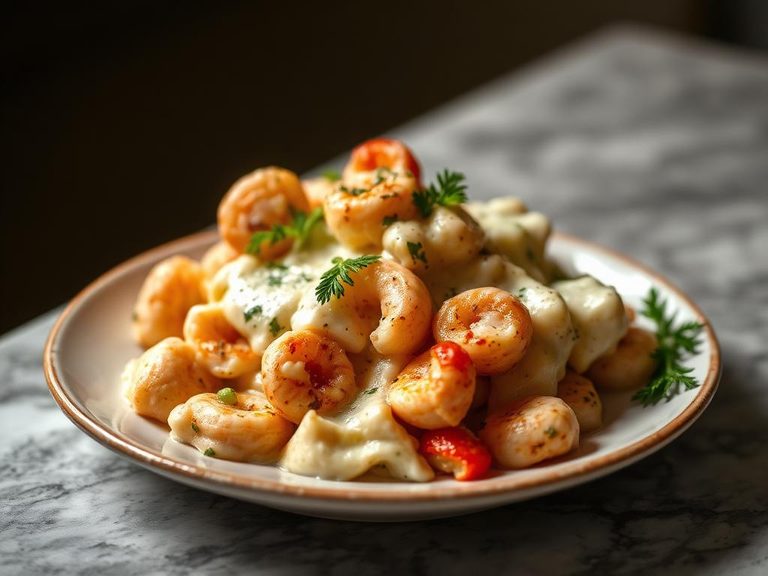
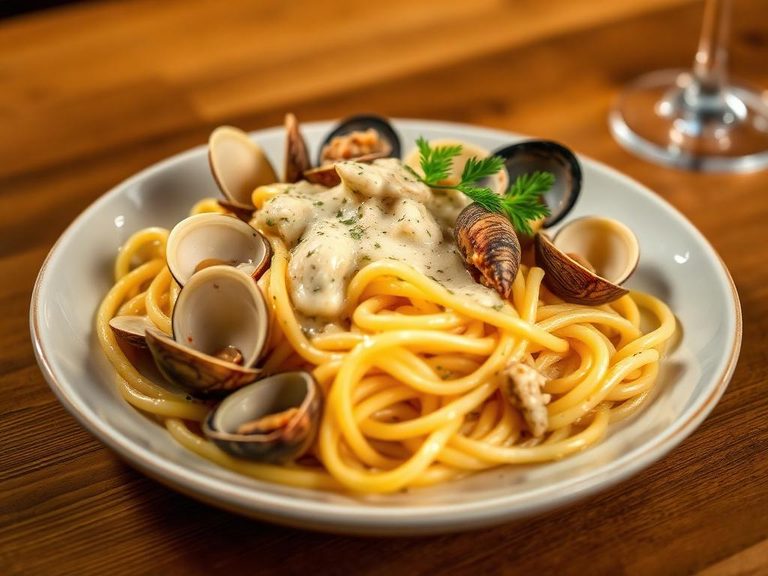
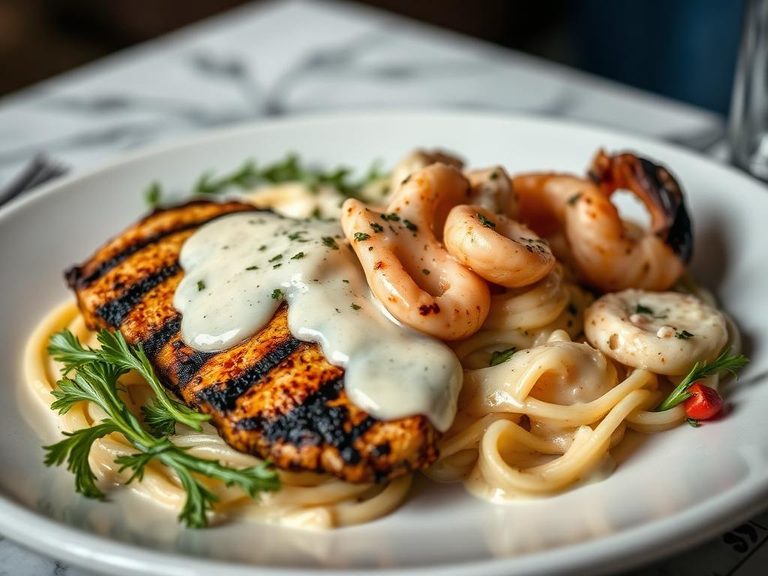
🌍 Where it's eaten
💡 Did you know?
The original Alfredo sauce, created by Alfredo di Lelio in Rome, was simply butter and Parmesan, emulsified with pasta water. The cream and seafood additions are a popular American evolution.
Full nutrition (USDA data · scales with serving)
| Water | 77.7 g |
| Energy | 145 kcal |
| Protein | 5.9 g |
| Total lipid (fat) | 12.5 g |
| Carbohydrate, by difference | 2.0 g |
| Fiber, total dietary | 0.00 g |
| Total Sugars | 0.73 g |
| Calcium, Ca | 73.0 mg |
| Iron, Fe | 0.47 mg |
| Magnesium, Mg | 10.0 mg |
| Phosphorus, P | 89.0 mg |
| Potassium, K | 98.0 mg |
| Sodium, Na | 541 mg |
| Zinc, Zn | 0.50 mg |
| Copper, Cu | 0.04 mg |
| Selenium, Se | 11.4 ug |
| Vitamin C, total ascorbic acid | 0.50 mg |
| Thiamin | 0.01 mg |
| Riboflavin | 0.07 mg |
| Niacin | 0.12 mg |
| Vitamin B-6 | 0.01 mg |
| Folate, total | 3.0 ug |
| Folic acid | 0.00 ug |
| Folate, food | 3.0 ug |
| Folate, DFE | 3.0 ug |
| Choline, total | 22.9 mg |
| Vitamin B-12 | 1.9 ug |
| Vitamin B-12, added | 0.00 ug |
| Vitamin A, RAE | 125 ug |
| Retinol | 125 ug |
| Carotene, beta | 5.0 ug |
| Carotene, alpha | 0.00 ug |
| Cryptoxanthin, beta | 0.00 ug |
| Lycopene | 0.00 ug |
| Lutein + zeaxanthin | 0.00 ug |
| Vitamin E (alpha-tocopherol) | 0.45 mg |
| Vitamin E, added | 0.00 mg |
| Vitamin D (D2 + D3) | 0.40 ug |
| Vitamin K (phylloquinone) | 1.1 ug |
| Alcohol, ethyl | 0.00 g |
| Caffeine | 0.00 mg |
| Theobromine | 0.00 mg |
Fat & fatty acid profile (per 100g)
| Fatty acids, total saturated | 7.0 g |
| SFA 4:0 | 0.26 g |
| SFA 6:0 | 0.21 g |
| SFA 8:0 | 0.13 g |
| SFA 10:0 | 0.30 g |
| SFA 12:0 | 0.36 g |
| SFA 14:0 | 1.1 g |
| SFA 16:0 | 3.2 g |
| SFA 18:0 | 1.1 g |
| Fatty acids, total monounsaturated | 2.6 g |
| MUFA 16:1 | 0.21 g |
| MUFA 18:1 | 2.7 g |
| MUFA 20:1 | 0.02 g |
| MUFA 22:1 | 0.00 g |
| Fatty acids, total polyunsaturated | 0.60 g |
| PUFA 18:2 | 0.30 g |
| PUFA 18:3 | 0.05 g |
| PUFA 18:4 | 0.00 g |
| PUFA 20:4 | 0.02 g |
| PUFA 20:5 n-3 (EPA) | 0.04 g |
| PUFA 22:5 n-3 (DPA) | 0.01 g |
| PUFA 22:6 n-3 (DHA) | 0.03 g |
| Cholesterol | 64.0 mg |
FAQ
Is Alfredo sauce with seafood gluten-free?
The sauce itself is typically gluten-free, as its core ingredients (butter, cream, cheese, seafood) do not contain gluten. However, it's almost always served over pasta, which contains gluten. Ensure any thickeners used are gluten-free if you have celiac disease.
Can I make a lighter version?
Yes. You can substitute some of the heavy cream with low-sodium chicken broth or whole milk, and use a smaller amount of high-quality Parmesan. Thickening with a small amount of cornstarch or pureed cauliflower can also reduce fat while maintaining a creamy texture.
What seafood works best?
Quick-cooking, tender seafood is ideal. Shrimp, bay scallops, lump crabmeat, and flaky white fish like cod are excellent choices. Add delicate seafood like lobster or shrimp in the last few minutes of cooking to prevent overcooking and toughness.
Nutrient density (calculated · NRF9.3)
Nutrient Rich Foods index: beneficial nutrients (protein, fiber, vitamins, minerals) minus saturated fat, added sugar & sodium, per 100 kcal.
NRF9.3 index — Fulgoni, Keast & Drewnowski, 2009. Computed from USDA nutrients.
Weight-loss friendliness (composite index)
Energy density 1.45 kcal/g · 16% calories from protein · 0.0 g fiber · 0.7 g sugar per 100 g.
Composite of energy density (Rolls et al., 1999), protein & fiber satiety, minus sugar. A calculated heuristic — ranks satiety-per-calorie, not a clinical measure.
Dietary load (calculated from USDA values)
Potential renal acid load. Positive = acid-forming, negative = alkaline-forming.
Sodium-to-potassium ratio: 5.52 (lower is better — aim for ≤ 1)
Sodium:potassium per WHO potassium guidance. Computed from USDA nutrients.