

Vegetable smoothie
Common food

Photo: Wikipedia
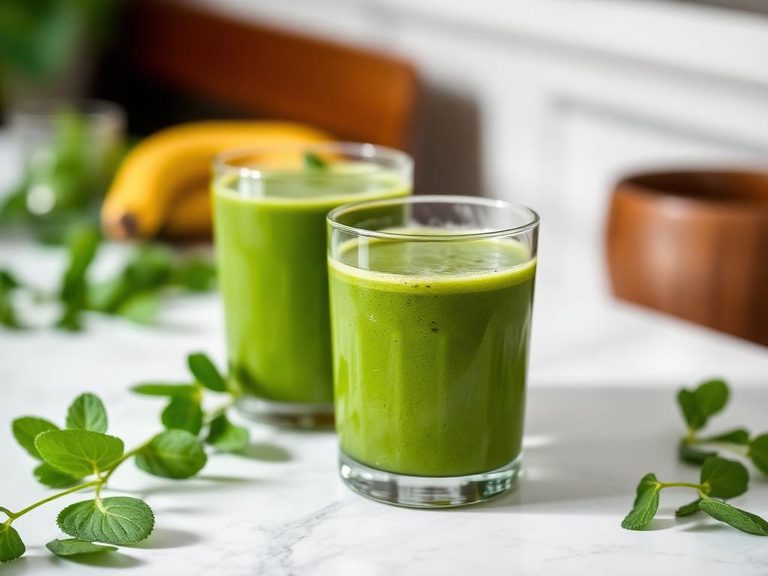
A vibrant, blended beverage that transforms raw vegetables into a smooth, drinkable meal, often with a slightly earthy, fresh, and subtly sweet flavor depending on the ingredients. Its texture is typically thick and creamy, especially when blended with leafy greens, cucumbers, or celery. Nutritionally, it's a low-calorie powerhouse, delivering a good dose of fiber and healthy fats relative to its energy content.
Calorie split: 12% protein · 25% carbs · 63% fat
↓ Full nutrition💚 Why it's loved
People love it for its incredible versatility and ability to pack a huge amount of nutrients into a single, convenient glass. It's a staple in health-conscious cultures and modern wellness routines, offering a refreshing and customizable way to start the day or refuel after exercise.
⚠️ Watch-outs & how to enjoy it better
Some find the taste of raw vegetables, especially leafy greens like kale or spinach, to be overly bitter or grassy, which can be off-putting. To counteract this, blend with a small amount of naturally sweet fruit (like a quarter apple or a few berries) or add a squeeze of lemon juice to brighten the flavor. Those watching blood sugar should be mindful of added sweeteners or high-sugar fruit blends.
Key benefits
- Low calorie density supports weight management
- Good source of dietary fiber for digestive health
- Provides essential vitamins and minerals from whole vegetables
- Easy way to increase daily vegetable intake
- Naturally hydrating due to high water content
🍽️ Popular dishes
🌍 Where it's eaten
💡 Did you know?
The modern vegetable smoothie as we know it gained massive popularity in the 1960s and 70s counterculture movement, often associated with natural food stores and the rise of the blender as a kitchen staple.
Full nutrition (USDA data · scales with serving)
| Water | 83.6 g |
| Energy | 89.0 kcal |
| Protein | 2.8 g |
| Total lipid (fat) | 6.6 g |
| Carbohydrate, by difference | 5.8 g |
| Fiber, total dietary | 2.8 g |
| Total Sugars | 2.6 g |
| Calcium, Ca | 73.0 mg |
| Iron, Fe | 0.41 mg |
| Magnesium, Mg | 31.0 mg |
| Phosphorus, P | 73.0 mg |
| Potassium, K | 349 mg |
| Sodium, Na | 38.0 mg |
| Zinc, Zn | 0.51 mg |
| Copper, Cu | 0.09 mg |
| Selenium, Se | 1.0 ug |
| Vitamin C, total ascorbic acid | 8.1 mg |
| Thiamin | 0.06 mg |
| Riboflavin | 0.14 mg |
| Niacin | 0.80 mg |
| Vitamin B-6 | 0.16 mg |
| Folate, total | 50.0 ug |
| Folic acid | 0.00 ug |
| Folate, food | 50.0 ug |
| Folate, DFE | 50.0 ug |
| Choline, total | 16.7 mg |
| Vitamin B-12 | 0.26 ug |
| Vitamin B-12, added | 0.00 ug |
| Vitamin A, RAE | 75.0 ug |
| Retinol | 26.0 ug |
| Carotene, beta | 570 ug |
| Carotene, alpha | 9.0 ug |
| Cryptoxanthin, beta | 11.0 ug |
| Lycopene | 0.00 ug |
| Lutein + zeaxanthin | 1067 ug |
| Vitamin E (alpha-tocopherol) | 1.1 mg |
| Vitamin E, added | 0.00 mg |
| Vitamin D (D2 + D3) | 0.50 ug |
| Vitamin K (phylloquinone) | 85.4 ug |
| Alcohol, ethyl | 0.00 g |
| Caffeine | 0.00 mg |
| Theobromine | 0.00 mg |
Fat & fatty acid profile (per 100g)
| Fatty acids, total saturated | 1.4 g |
| SFA 4:0 | 0.02 g |
| SFA 6:0 | 0.02 g |
| SFA 8:0 | 0.01 g |
| SFA 10:0 | 0.03 g |
| SFA 12:0 | 0.03 g |
| SFA 14:0 | 0.10 g |
| SFA 16:0 | 1.1 g |
| SFA 18:0 | 0.12 g |
| Fatty acids, total monounsaturated | 3.9 g |
| MUFA 16:1 | 0.28 g |
| MUFA 18:1 | 3.6 g |
| MUFA 20:1 | 0.01 g |
| MUFA 22:1 | 0.00 g |
| Fatty acids, total polyunsaturated | 0.75 g |
| PUFA 18:2 | 0.67 g |
| PUFA 18:3 | 0.07 g |
| PUFA 18:4 | 0.00 g |
| PUFA 20:4 | 0.00 g |
| PUFA 20:5 n-3 (EPA) | 0.00 g |
| PUFA 22:5 n-3 (DPA) | 0.00 g |
| PUFA 22:6 n-3 (DHA) | 0.00 g |
| Cholesterol | 4.0 mg |
FAQ
Is a vegetable smoothie the same as a juice?
No. A smoothie is blended and retains the whole vegetable, including fiber, while a juice extracts the liquid and removes most of the pulp and fiber.
Can I make a vegetable smoothie without fruit?
Yes, you can make a purely savory smoothie using vegetables like cucumber, celery, and avocado, often seasoned with herbs, lemon, and a pinch of salt.
How long can I store a vegetable smoothie?
It's best consumed immediately for maximum nutrient retention, but you can store it in an airtight container in the refrigerator for up to 24 hours. Separation is normal; just shake or stir before drinking.
Nutrient density (calculated · NRF9.3)
Nutrient Rich Foods index: beneficial nutrients (protein, fiber, vitamins, minerals) minus saturated fat, added sugar & sodium, per 100 kcal.
NRF9.3 index — Fulgoni, Keast & Drewnowski, 2009. Computed from USDA nutrients.
Weight-loss friendliness (composite index)
Energy density 0.89 kcal/g · 12% calories from protein · 2.8 g fiber · 2.6 g sugar per 100 g.
Composite of energy density (Rolls et al., 1999), protein & fiber satiety, minus sugar. A calculated heuristic — ranks satiety-per-calorie, not a clinical measure.
Dietary load (calculated from USDA values)
Potential renal acid load. Positive = acid-forming, negative = alkaline-forming.
Sodium-to-potassium ratio: 0.11 (lower is better — aim for ≤ 1)
Sodium:potassium per WHO potassium guidance. Computed from USDA nutrients.