

Veal parmigiana
Common food

Photo: Wikipedia
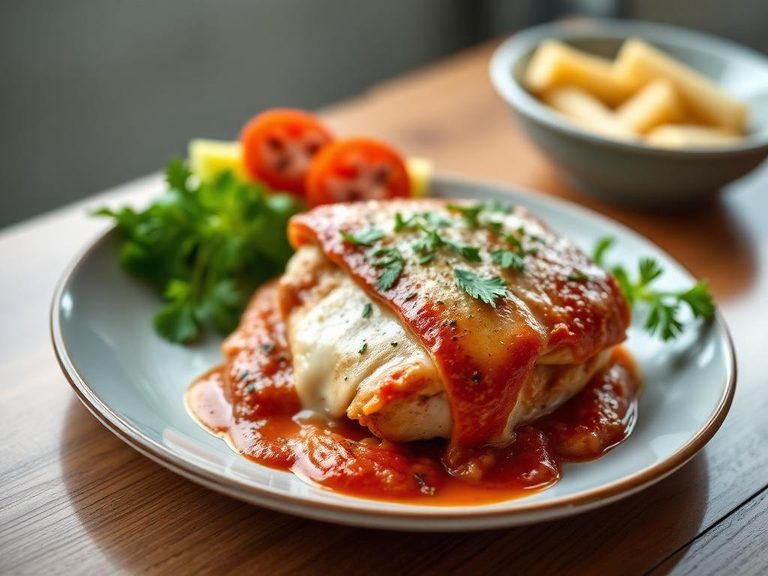
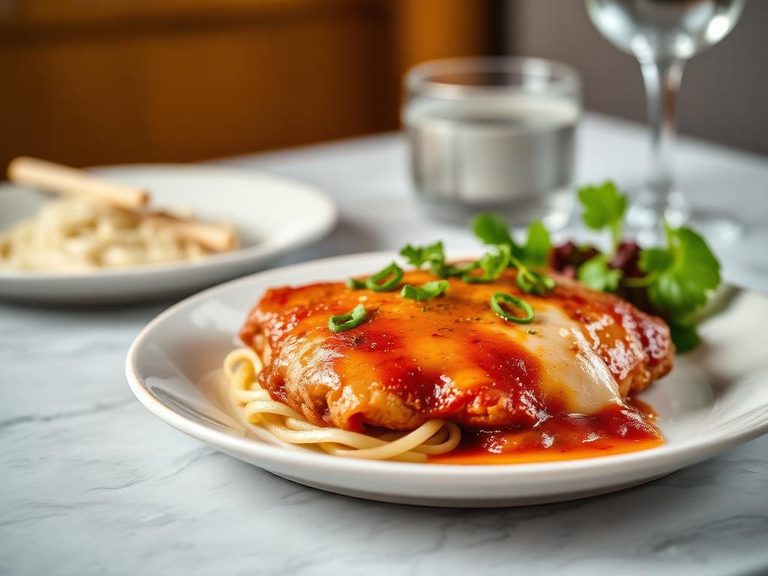
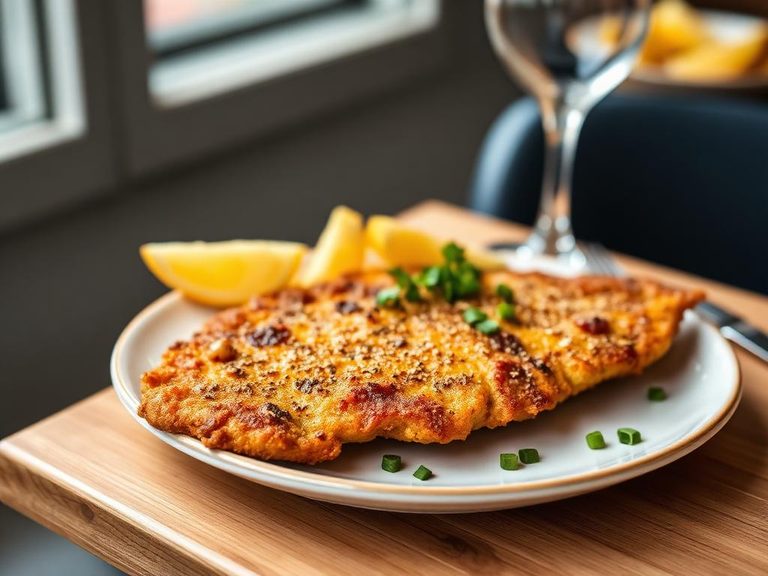
Veal parmigiana is a classic Italian-American comfort dish featuring a breaded and fried veal cutlet layered with marinara sauce and melted cheeses, typically mozzarella and Parmesan. The result is a crispy, savory exterior giving way to tender meat, all bound by a rich, tangy tomato sauce and gooey cheese. Nutritionally, it offers a substantial protein punch (over 15g per 100g) alongside a moderate amount of fat from the frying and cheese.
Calorie split: 30% protein · 17% carbs · 53% fat
↓ Full nutrition💚 Why it's loved
People adore it for the irresistible combination of textures—crispy breading, tender veal, and melted cheese—and the deep, savory umami flavor from the tomato sauce and Parmesan. It's a beloved staple of Italian-American cuisine, representing hearty, satisfying comfort food.
⚠️ Watch-outs & how to enjoy it better
The dish can be high in sodium from the cheese and sauce, and the frying method adds significant saturated fat and calories. To counteract this, consider baking the breaded cutlets instead of frying, using a moderate portion of cheese, and pairing it with a large side of steamed or roasted vegetables to add fiber and volume without extra sodium.
Key benefits
- Excellent source of high-quality protein for muscle maintenance.
- Provides essential minerals like iron and zinc from the veal.
- Contains calcium from the cheese topping for bone health.
- Offers lycopene, an antioxidant from the cooked tomato sauce.
🍽️ Popular dishes
🌍 Where it's eaten
💡 Did you know?
The 'parmigiana' in the name does not refer to Parmesan cheese, but likely comes from the Italian word 'parmigiana,' meaning 'in the style of Parma' or possibly from 'per mezzana,' referring to the layered arrangement of the slices.
Full nutrition (USDA data · scales with serving)
| Water | 62.7 g |
| Energy | 204 kcal |
| Protein | 15.3 g |
| Total lipid (fat) | 11.9 g |
| Carbohydrate, by difference | 8.3 g |
| Fiber, total dietary | 0.80 g |
| Total Sugars | 1.7 g |
| Calcium, Ca | 122 mg |
| Iron, Fe | 1.3 mg |
| Magnesium, Mg | 33.0 mg |
| Phosphorus, P | 215 mg |
| Potassium, K | 248 mg |
| Sodium, Na | 436 mg |
| Zinc, Zn | 1.7 mg |
| Copper, Cu | 0.10 mg |
| Selenium, Se | 15.8 ug |
| Vitamin C, total ascorbic acid | 2.0 mg |
| Thiamin | 0.10 mg |
| Riboflavin | 0.26 mg |
| Niacin | 3.8 mg |
| Vitamin B-6 | 0.24 mg |
| Folate, total | 16.0 ug |
| Folic acid | 5.0 ug |
| Folate, food | 11.0 ug |
| Folate, DFE | 20.0 ug |
| Choline, total | 68.9 mg |
| Vitamin B-12 | 1.0 ug |
| Vitamin B-12, added | 0.00 ug |
| Vitamin A, RAE | 47.0 ug |
| Retinol | 41.0 ug |
| Carotene, beta | 75.0 ug |
| Carotene, alpha | 0.00 ug |
| Cryptoxanthin, beta | 2.0 ug |
| Lycopene | 4020 ug |
| Lutein + zeaxanthin | 43.0 ug |
| Vitamin E (alpha-tocopherol) | 1.3 mg |
| Vitamin E, added | 0.00 mg |
| Vitamin D (D2 + D3) | 1.1 ug |
| Vitamin K (phylloquinone) | 5.1 ug |
| Alcohol, ethyl | 0.00 g |
| Caffeine | 0.00 mg |
| Theobromine | 0.00 mg |
Fat & fatty acid profile (per 100g)
| Fatty acids, total saturated | 4.1 g |
| SFA 4:0 | 0.06 g |
| SFA 6:0 | 0.05 g |
| SFA 8:0 | 0.03 g |
| SFA 10:0 | 0.07 g |
| SFA 12:0 | 0.08 g |
| SFA 14:0 | 0.39 g |
| SFA 16:0 | 2.3 g |
| SFA 18:0 | 1.0 g |
| Fatty acids, total monounsaturated | 4.6 g |
| MUFA 16:1 | 0.24 g |
| MUFA 18:1 | 4.3 g |
| MUFA 20:1 | 0.03 g |
| MUFA 22:1 | 0.00 g |
| Fatty acids, total polyunsaturated | 1.8 g |
| PUFA 18:2 | 1.6 g |
| PUFA 18:3 | 0.16 g |
| PUFA 18:4 | 0.00 g |
| PUFA 20:4 | 0.02 g |
| PUFA 20:5 n-3 (EPA) | 0.00 g |
| PUFA 22:5 n-3 (DPA) | 0.00 g |
| PUFA 22:6 n-3 (DHA) | 0.00 g |
| Cholesterol | 67.0 mg |
FAQ
Is veal parmigiana the same as chicken parmigiana?
The preparation is very similar—both involve a breaded, fried cutlet topped with tomato sauce and cheese. The primary difference is the protein: veal (young beef) versus chicken breast, which affects flavor, texture, and nutritional profile (veal is typically richer in iron).
Can I make a lighter version at home?
Absolutely. You can bake the breaded cutlets on a wire rack instead of frying, use part-skim mozzarella, and choose a low-sodium marinara sauce. Serving it over zucchini noodles or a salad instead of pasta also reduces carbohydrates.
What wine pairs well with veal parmigiana?
A medium-bodied Italian red wine like Chianti or Sangiovese complements the tomato sauce and cheese beautifully. The wine's acidity cuts through the richness of the cheese and fried coating.
Nutrient density (calculated · NRF9.3)
Nutrient Rich Foods index: beneficial nutrients (protein, fiber, vitamins, minerals) minus saturated fat, added sugar & sodium, per 100 kcal.
NRF9.3 index — Fulgoni, Keast & Drewnowski, 2009. Computed from USDA nutrients.
Weight-loss friendliness (composite index)
Energy density 2.04 kcal/g · 30% calories from protein · 0.8 g fiber · 1.7 g sugar per 100 g.
Composite of energy density (Rolls et al., 1999), protein & fiber satiety, minus sugar. A calculated heuristic — ranks satiety-per-calorie, not a clinical measure.
Dietary load (calculated from USDA values)
Potential renal acid load. Positive = acid-forming, negative = alkaline-forming.
Sodium-to-potassium ratio: 1.76 (lower is better — aim for ≤ 1)
Sodium:potassium per WHO potassium guidance. Computed from USDA nutrients.