

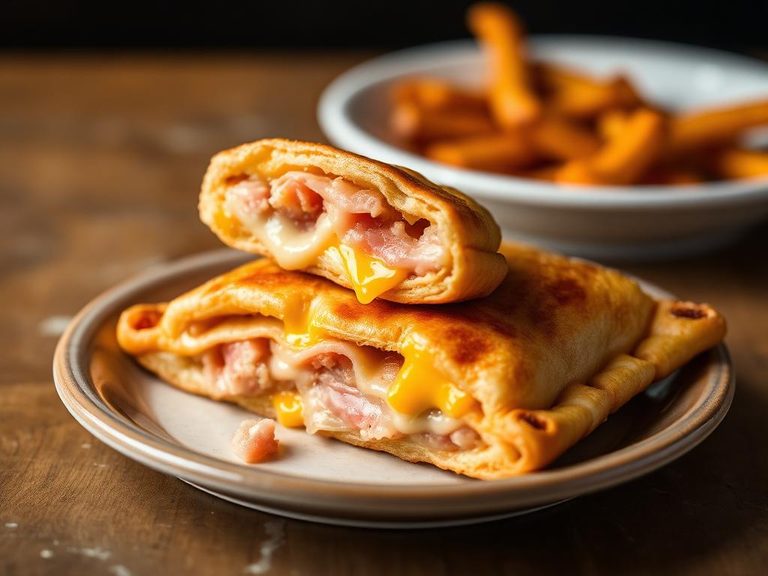
Turnover or hot pocket, ham
Common food
A savory, flaky pastry pocket filled with diced ham and often a mild cheese or gravy, baked or microwaved to a golden, steamy finish. The texture contrasts a crisp, buttery crust with a soft, salty interior. It delivers a concentrated hit of protein and fat for its size, making it a surprisingly filling snack.
Calorie split: 15% protein · 44% carbs · 42% fat
↓ Full nutrition💚 Why it's loved
People adore its perfect handheld format and the comforting, salty-savory ham filling encased in a flaky crust. It's a nostalgic, reliable staple for busy lunches, late-night snacks, and school cafeterias.
⚠️ Watch-outs & how to enjoy it better
The high sodium content and refined carbs can contribute to blood pressure spikes and subsequent energy crashes. To counteract, pair with a large side of leafy greens or a piece of fruit to add fiber and slow digestion. Always check labels for common allergens like wheat, soy, and milk derivatives.
Key benefits
- High protein density per calorie
- Convenient portable meal or snack
- Provides quick energy from carbohydrates
- Shelf-stable and long-lasting
- Satisfying savory flavor profile
🍽️ Popular dishes
🌍 Where it's eaten
💡 Did you know?
The 'Hot Pocket' brand was inspired by the French calzone and was originally named 'Tastywich' before its 1983 launch.
Full nutrition (USDA data · scales with serving)
| Water | 48.9 g |
| Energy | 256 kcal |
| Protein | 9.3 g |
| Total lipid (fat) | 11.8 g |
| Carbohydrate, by difference | 27.9 g |
| Fiber, total dietary | 1.5 g |
| Total Sugars | 3.0 g |
| Calcium, Ca | 98.0 mg |
| Iron, Fe | 1.9 mg |
| Magnesium, Mg | 19.0 mg |
| Phosphorus, P | 115 mg |
| Potassium, K | 160 mg |
| Sodium, Na | 562 mg |
| Zinc, Zn | 0.88 mg |
| Copper, Cu | 0.09 mg |
| Selenium, Se | 16.4 ug |
| Vitamin C, total ascorbic acid | 2.4 mg |
| Thiamin | 0.32 mg |
| Riboflavin | 0.16 mg |
| Niacin | 3.7 mg |
| Vitamin B-6 | 0.12 mg |
| Folate, total | 55.0 ug |
| Folic acid | 41.0 ug |
| Folate, food | 14.0 ug |
| Folate, DFE | 83.0 ug |
| Choline, total | 19.8 mg |
| Vitamin B-12 | 0.15 ug |
| Vitamin B-12, added | 0.00 ug |
| Vitamin A, RAE | 10.0 ug |
| Retinol | 5.0 ug |
| Carotene, beta | 58.0 ug |
| Carotene, alpha | 13.0 ug |
| Cryptoxanthin, beta | 0.00 ug |
| Lycopene | 325 ug |
| Lutein + zeaxanthin | 35.0 ug |
| Vitamin E (alpha-tocopherol) | 0.65 mg |
| Vitamin E, added | 0.00 mg |
| Vitamin D (D2 + D3) | 0.10 ug |
| Vitamin K (phylloquinone) | 4.1 ug |
| Alcohol, ethyl | 0.00 g |
| Caffeine | 0.00 mg |
| Theobromine | 0.00 mg |
Fat & fatty acid profile (per 100g)
| Fatty acids, total saturated | 3.5 g |
| SFA 4:0 | 0.02 g |
| SFA 6:0 | 0.00 g |
| SFA 8:0 | 0.01 g |
| SFA 10:0 | 0.01 g |
| SFA 12:0 | 0.02 g |
| SFA 14:0 | 0.14 g |
| SFA 16:0 | 2.2 g |
| SFA 18:0 | 1.1 g |
| Fatty acids, total monounsaturated | 4.8 g |
| MUFA 16:1 | 0.18 g |
| MUFA 18:1 | 4.6 g |
| MUFA 20:1 | 0.07 g |
| MUFA 22:1 | 0.00 g |
| Fatty acids, total polyunsaturated | 2.7 g |
| PUFA 18:2 | 2.4 g |
| PUFA 18:3 | 0.21 g |
| PUFA 18:4 | 0.00 g |
| PUFA 20:4 | 0.02 g |
| PUFA 20:5 n-3 (EPA) | 0.00 g |
| PUFA 22:5 n-3 (DPA) | 0.00 g |
| PUFA 22:6 n-3 (DHA) | 0.00 g |
| Cholesterol | 14.0 mg |
FAQ
Is a ham turnover a good source of protein?
Yes, it's relatively protein-dense for a convenience food, providing about 9-10 grams of protein per 100 grams, which helps with satiety.
Why does it have so much sodium?
Sodium is used for flavor enhancement, preservation, and food safety in the processed ham filling and the dough itself.
Can I make a healthier version at home?
Absolutely. Use whole-wheat pastry dough, low-sodium ham, add vegetables like spinach, and bake instead of microwaving for a better texture.
Nutrient density (calculated · NRF9.3)
Nutrient Rich Foods index: beneficial nutrients (protein, fiber, vitamins, minerals) minus saturated fat, added sugar & sodium, per 100 kcal.
NRF9.3 index — Fulgoni, Keast & Drewnowski, 2009. Computed from USDA nutrients.
Weight-loss friendliness (composite index)
Energy density 2.56 kcal/g · 15% calories from protein · 1.5 g fiber · 3.0 g sugar per 100 g.
Composite of energy density (Rolls et al., 1999), protein & fiber satiety, minus sugar. A calculated heuristic — ranks satiety-per-calorie, not a clinical measure.
Dietary load (calculated from USDA values)
Potential renal acid load. Positive = acid-forming, negative = alkaline-forming.
Sodium-to-potassium ratio: 3.51 (lower is better — aim for ≤ 1)
Sodium:potassium per WHO potassium guidance. Computed from USDA nutrients.