

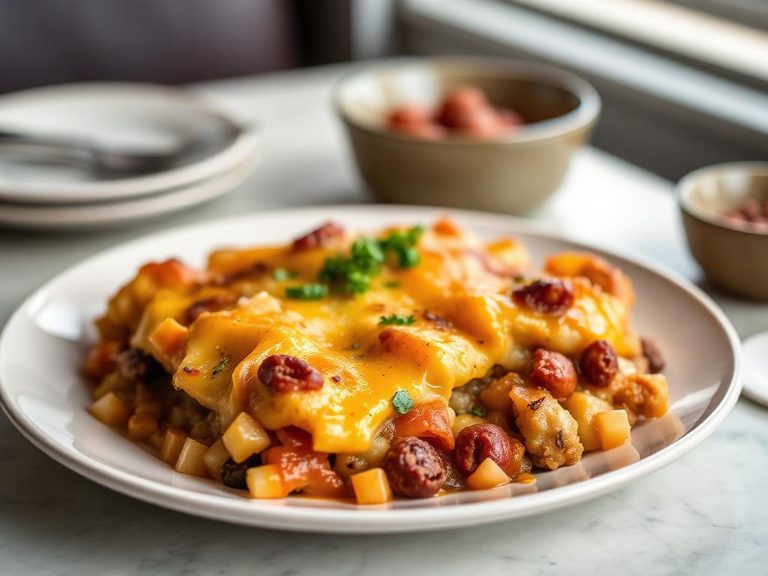
Tuna noodle casserole with cream or white sauce
Common food

Photo: Wikipedia
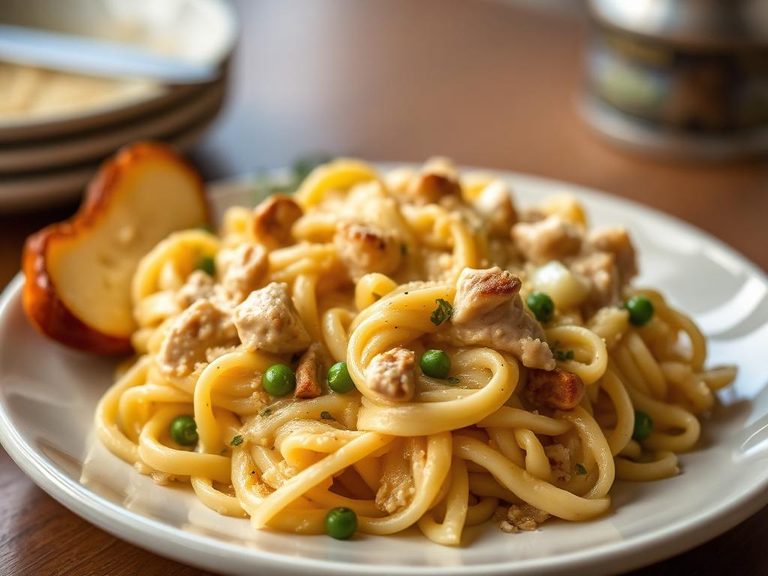
Tuna noodle casserole is a creamy, comforting American classic where tender egg noodles and flaked tuna are bound in a rich white sauce, often topped with a crunchy breadcrumb or potato chip crust. The texture is soft and cohesive, with the mild, savory flavor of the tuna complemented by the velvety sauce. For a dish often considered indulgent, it provides a solid protein boost of over 10 grams per 100-gram serving.
Calorie split: 24% protein · 37% carbs · 39% fat
↓ Full nutrition💚 Why it's loved
People love it for its nostalgic, hearty comfort—a warm, creamy, and satisfying meal that feels like a hug. Its versatility is key, as it's a beloved canvas for adding vegetables like peas or broccoli, and it's a staple at potlucks and family dinners across the United States.
⚠️ Watch-outs & how to enjoy it better
The traditional cream-based sauce and refined noodle carbs can lead to a heavy, blood-sugar-spiking meal if not balanced. To counteract this, serve a smaller portion alongside a large, vinegar-dressed green salad, and consider using whole-wheat noodles or adding extra vegetables like spinach or mushrooms to boost fiber. Also, be mindful of sodium content from canned tuna and condensed soup, choosing low-sodium versions when possible.
Key benefits
- Good source of lean protein from tuna
- Provides quick energy from carbohydrate-rich noodles
- Contains omega-3 fatty acids from the tuna
- A classic, cost-effective comfort food
- Easy to prepare as a one-dish meal
🍽️ Popular dishes
🌍 Where it's eaten
💡 Did you know?
The dish's iconic use of canned tuna and condensed soup skyrocketed in popularity during and after World War II, thanks to government food rationing and the post-war boom in convenient, shelf-stable ingredients.
Full nutrition (USDA data · scales with serving)
| Water | 66.0 g |
| Energy | 168 kcal |
| Protein | 10.1 g |
| Total lipid (fat) | 7.3 g |
| Carbohydrate, by difference | 15.4 g |
| Fiber, total dietary | 0.70 g |
| Total Sugars | 2.2 g |
| Calcium, Ca | 64.0 mg |
| Iron, Fe | 1.4 mg |
| Magnesium, Mg | 22.0 mg |
| Phosphorus, P | 119 mg |
| Potassium, K | 141 mg |
| Sodium, Na | 249 mg |
| Zinc, Zn | 0.68 mg |
| Copper, Cu | 0.07 mg |
| Selenium, Se | 33.3 ug |
| Vitamin C, total ascorbic acid | 0.00 mg |
| Thiamin | 0.18 mg |
| Riboflavin | 0.15 mg |
| Niacin | 4.6 mg |
| Vitamin B-6 | 0.20 mg |
| Folate, total | 36.0 ug |
| Folic acid | 30.0 ug |
| Folate, food | 6.0 ug |
| Folate, DFE | 57.0 ug |
| Choline, total | 26.0 mg |
| Vitamin B-12 | 1.1 ug |
| Vitamin B-12, added | 0.00 ug |
| Vitamin A, RAE | 79.0 ug |
| Retinol | 78.0 ug |
| Carotene, beta | 20.0 ug |
| Carotene, alpha | 0.00 ug |
| Cryptoxanthin, beta | 0.00 ug |
| Lycopene | 0.00 ug |
| Lutein + zeaxanthin | 13.0 ug |
| Vitamin E (alpha-tocopherol) | 0.47 mg |
| Vitamin E, added | 0.00 mg |
| Vitamin D (D2 + D3) | 0.90 ug |
| Vitamin K (phylloquinone) | 2.4 ug |
| Alcohol, ethyl | 0.00 g |
| Caffeine | 0.00 mg |
| Theobromine | 0.00 mg |
Fat & fatty acid profile (per 100g)
| Fatty acids, total saturated | 3.3 g |
| SFA 4:0 | 0.12 g |
| SFA 6:0 | 0.09 g |
| SFA 8:0 | 0.05 g |
| SFA 10:0 | 0.12 g |
| SFA 12:0 | 0.14 g |
| SFA 14:0 | 0.45 g |
| SFA 16:0 | 1.6 g |
| SFA 18:0 | 0.60 g |
| Fatty acids, total monounsaturated | 1.7 g |
| MUFA 16:1 | 0.08 g |
| MUFA 18:1 | 1.6 g |
| MUFA 20:1 | 0.01 g |
| MUFA 22:1 | 0.00 g |
| Fatty acids, total polyunsaturated | 0.95 g |
| PUFA 18:2 | 0.79 g |
| PUFA 18:3 | 0.08 g |
| PUFA 18:4 | 0.00 g |
| PUFA 20:4 | 0.01 g |
| PUFA 20:5 n-3 (EPA) | 0.01 g |
| PUFA 22:5 n-3 (DPA) | 0.00 g |
| PUFA 22:6 n-3 (DHA) | 0.07 g |
| Cholesterol | 37.0 mg |
FAQ
Can I make tuna noodle casserole without condensed soup?
Absolutely. You can make a simple béchamel sauce from butter, flour, and milk, then season it with mustard, garlic powder, and black pepper for a from-scratch version with more control over sodium and flavor.
What's the best way to keep the topping crispy?
Add the breadcrumb or crushed chip topping only during the last 10-15 minutes of baking, or broil it for 1-2 minutes at the end. You can also mix the crumbs with melted butter before sprinkling to help them brown and crisp up.
Is it safe to use the liquid from the canned tuna?
Yes, the liquid (either water or oil) is safe and can add flavor and moisture to the casserole. If you're watching sodium or fat, you can drain it off, but it's not necessary for food safety.
Nutrient density (calculated · NRF9.3)
Nutrient Rich Foods index: beneficial nutrients (protein, fiber, vitamins, minerals) minus saturated fat, added sugar & sodium, per 100 kcal.
NRF9.3 index — Fulgoni, Keast & Drewnowski, 2009. Computed from USDA nutrients.
Weight-loss friendliness (composite index)
Energy density 1.68 kcal/g · 24% calories from protein · 0.7 g fiber · 2.2 g sugar per 100 g.
Composite of energy density (Rolls et al., 1999), protein & fiber satiety, minus sugar. A calculated heuristic — ranks satiety-per-calorie, not a clinical measure.
Dietary load (calculated from USDA values)
Potential renal acid load. Positive = acid-forming, negative = alkaline-forming.
Sodium-to-potassium ratio: 1.77 (lower is better — aim for ≤ 1)
Sodium:potassium per WHO potassium guidance. Computed from USDA nutrients.