

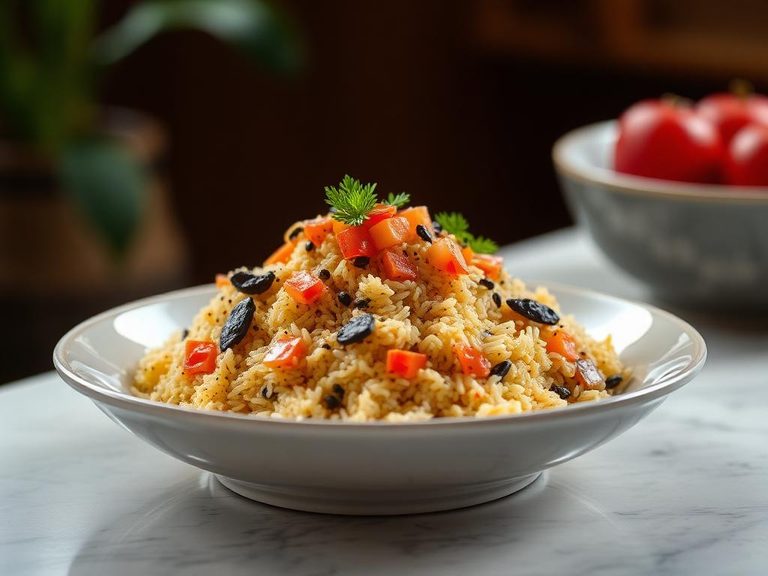
Soupy rice with chicken, Puerto Rican style
Common food

Photo: Wikipedia
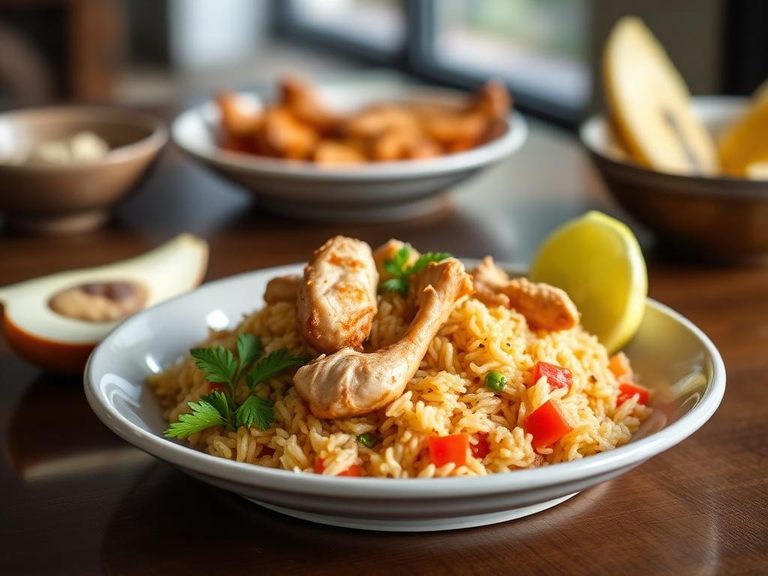
Soupy rice with chicken, Puerto Rican style, known as Arroz con Pollo, is a comforting one-pot dish where tender chicken simmers with rice in a savory, tomato-based broth infused with sofrito and annatto. The rice absorbs the rich, aromatic liquid, creating a hearty, slightly saucy texture that is both tender and flavorful. Nutritionally, it provides a balanced mix of protein and carbohydrates in each warm, satisfying spoonful.
Calorie split: 32% protein · 44% carbs · 24% fat
↓ Full nutrition💚 Why it's loved
People adore this dish for its deep, savory flavor that comes from the slow melding of chicken, rice, and the holy trinity of sofrito. It's a beloved staple that represents the heart of Puerto Rican home cooking and family gatherings.
⚠️ Watch-outs & how to enjoy it better
The dish can be high in sodium, especially if made with a lot of added salt or bouillon, which may be a concern for those watching their intake. To counteract this, use low-sodium broth and season generously with herbs like cilantro and oregano instead of extra salt. Also, be mindful of portion sizes if managing blood sugar, as the refined white rice can cause spikes; pairing it with extra vegetables or a side salad can help.
Key benefits
- Excellent source of lean protein from chicken for muscle maintenance
- Provides complex carbohydrates for sustained energy
- Contains fiber from rice and vegetables for digestive health
- Rich in flavor from herbs and spices without excessive fat
- A complete, balanced meal in a single dish
🍽️ Popular dishes
🌍 Where it's eaten
💡 Did you know?
The signature orange-yellow color in many Puerto Rican rice dishes often comes from achiote (annatto) seeds, which are steeped in oil to create 'aceite de achiote,' a natural food coloring and flavor base.
Full nutrition (USDA data · scales with serving)
| Water | 65.1 g |
| Energy | 151 kcal |
| Protein | 12.1 g |
| Total lipid (fat) | 4.0 g |
| Carbohydrate, by difference | 16.5 g |
| Fiber, total dietary | 1.4 g |
| Total Sugars | 1.2 g |
| Calcium, Ca | 21.0 mg |
| Iron, Fe | 1.4 mg |
| Magnesium, Mg | 19.0 mg |
| Phosphorus, P | 123 mg |
| Potassium, K | 191 mg |
| Sodium, Na | 754 mg |
| Zinc, Zn | 0.94 mg |
| Copper, Cu | 0.10 mg |
| Selenium, Se | 11.8 ug |
| Vitamin C, total ascorbic acid | 6.9 mg |
| Thiamin | 0.13 mg |
| Riboflavin | 0.10 mg |
| Niacin | 3.8 mg |
| Vitamin B-6 | 0.16 mg |
| Folate, total | 38.0 ug |
| Folic acid | 26.0 ug |
| Folate, food | 11.0 ug |
| Folate, DFE | 56.0 ug |
| Choline, total | 32.4 mg |
| Vitamin B-12 | 0.14 ug |
| Vitamin B-12, added | 0.00 ug |
| Vitamin A, RAE | 20.0 ug |
| Retinol | 3.0 ug |
| Carotene, beta | 199 ug |
| Carotene, alpha | 17.0 ug |
| Cryptoxanthin, beta | 1.0 ug |
| Lycopene | 1276 ug |
| Lutein + zeaxanthin | 256 ug |
| Vitamin E (alpha-tocopherol) | 0.66 mg |
| Vitamin E, added | 0.00 mg |
| Vitamin D (D2 + D3) | 0.00 ug |
| Vitamin K (phylloquinone) | 7.8 ug |
| Alcohol, ethyl | 0.00 g |
| Caffeine | 0.00 mg |
| Theobromine | 0.00 mg |
Fat & fatty acid profile (per 100g)
| Fatty acids, total saturated | 0.93 g |
| SFA 4:0 | 0.00 g |
| SFA 6:0 | 0.00 g |
| SFA 8:0 | 0.00 g |
| SFA 10:0 | 0.00 g |
| SFA 12:0 | 0.00 g |
| SFA 14:0 | 0.02 g |
| SFA 16:0 | 0.72 g |
| SFA 18:0 | 0.18 g |
| Fatty acids, total monounsaturated | 2.0 g |
| MUFA 16:1 | 0.19 g |
| MUFA 18:1 | 1.8 g |
| MUFA 20:1 | 0.01 g |
| MUFA 22:1 | 0.00 g |
| Fatty acids, total polyunsaturated | 0.60 g |
| PUFA 18:2 | 0.54 g |
| PUFA 18:3 | 0.05 g |
| PUFA 18:4 | 0.00 g |
| PUFA 20:4 | 0.01 g |
| PUFA 20:5 n-3 (EPA) | 0.00 g |
| PUFA 22:5 n-3 (DPA) | 0.00 g |
| PUFA 22:6 n-3 (DHA) | 0.00 g |
| Cholesterol | 42.0 mg |
FAQ
What is the difference between Arroz con Pollo and Arroz con Gandules?
Arroz con Pollo is rice cooked with chicken, while Arroz con Gandules is rice cooked with pigeon peas (gandules) and often includes pork. Both are foundational Puerto Rican rice dishes but feature different primary proteins.
Can I make this dish with brown rice?
Yes, but the cooking time and liquid ratio will need adjustment. Brown rice requires more liquid and a longer simmer to become tender, and the final texture will be chewier than the traditional version made with medium-grain white rice.
What is sofrito, and is it essential?
Sofrito is a aromatic base of blended peppers, onions, garlic, cilantro, and culantro. It is absolutely essential for the authentic, deep flavor profile of this dish. Store-bought or homemade versions are widely available.
Nutrient density (calculated · NRF9.3)
Nutrient Rich Foods index: beneficial nutrients (protein, fiber, vitamins, minerals) minus saturated fat, added sugar & sodium, per 100 kcal.
NRF9.3 index — Fulgoni, Keast & Drewnowski, 2009. Computed from USDA nutrients.
Weight-loss friendliness (composite index)
Energy density 1.51 kcal/g · 32% calories from protein · 1.4 g fiber · 1.2 g sugar per 100 g.
Composite of energy density (Rolls et al., 1999), protein & fiber satiety, minus sugar. A calculated heuristic — ranks satiety-per-calorie, not a clinical measure.
Dietary load (calculated from USDA values)
Potential renal acid load. Positive = acid-forming, negative = alkaline-forming.
Sodium-to-potassium ratio: 3.95 (lower is better — aim for ≤ 1)
Sodium:potassium per WHO potassium guidance. Computed from USDA nutrients.