

Stewed rice, Puerto Rican style
Common food

Photo: Wikipedia
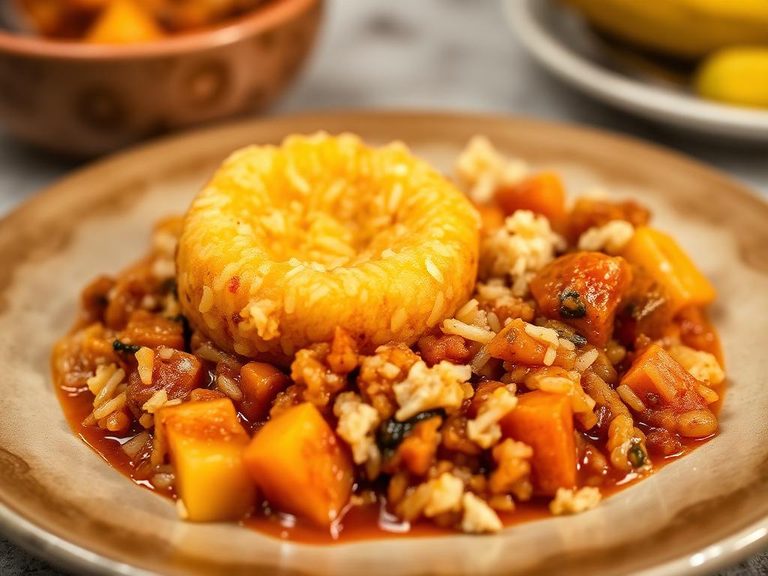
Arroz guisado is a savory Puerto Rican staple where long-grain rice is stewed in a seasoned tomato-based broth, often with sofrito, olives, and capers. The result is tender, fluffy grains with a rich, slightly tangy flavor and a beautiful orange-red hue. It's a carbohydrate-rich dish that provides quick energy, with a moderate amount of fat from the cooking oil and optional additions.
Calorie split: 7% protein · 61% carbs · 32% fat
↓ Full nutrition💚 Why it's loved
People love it for its comforting, savory depth and its role as the essential, flavorful foundation for countless Puerto Rican meals. Its versatility allows it to pair perfectly with everything from roasted pork to simple beans.
⚠️ Watch-outs & how to enjoy it better
The refined white rice can cause blood-sugar spikes and is low in fiber. To counteract this, pair it with a source of protein (like chicken or beans) and non-starchy vegetables, or use a smaller portion as a side. Some traditional recipes can be high in sodium from olives and capers; rinsing these ingredients or using low-sodium broth can help.
Key benefits
- Provides quick energy from complex carbohydrates.
- Contains essential B vitamins for metabolism.
- The sofrito base adds antioxidants from peppers and tomatoes.
- A versatile base that absorbs flavors from added proteins and vegetables.
🍽️ Popular dishes
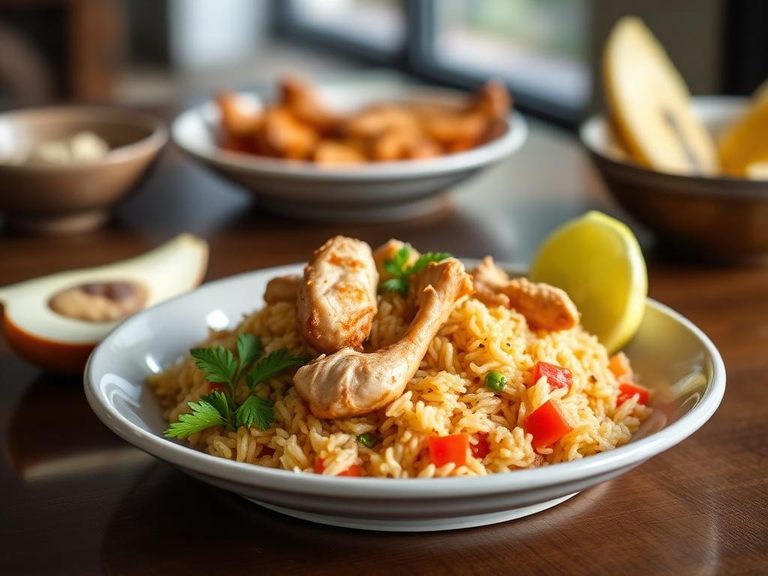
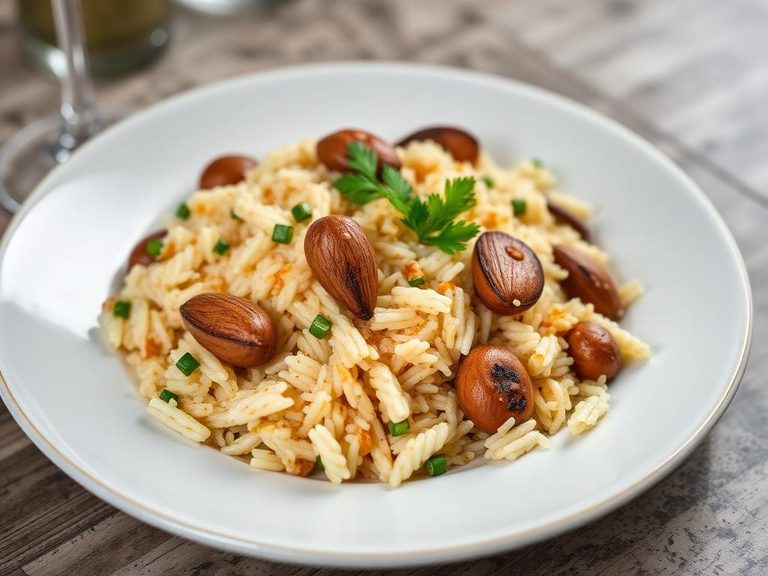
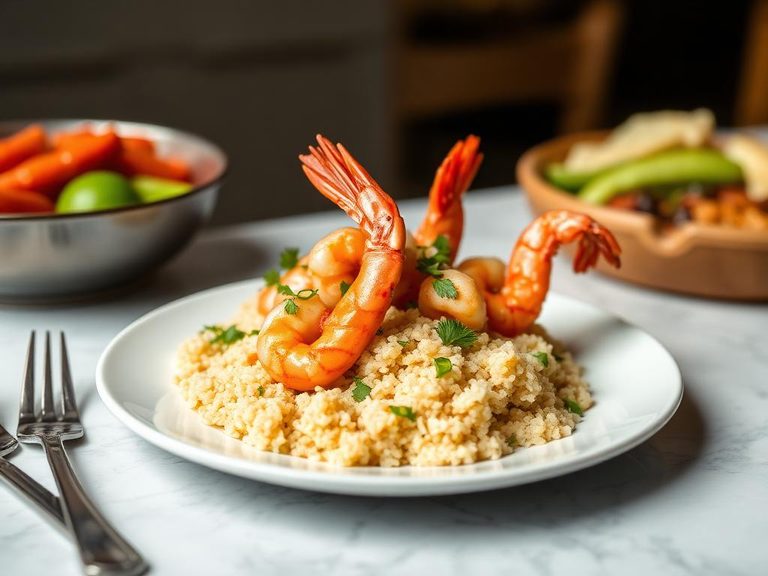
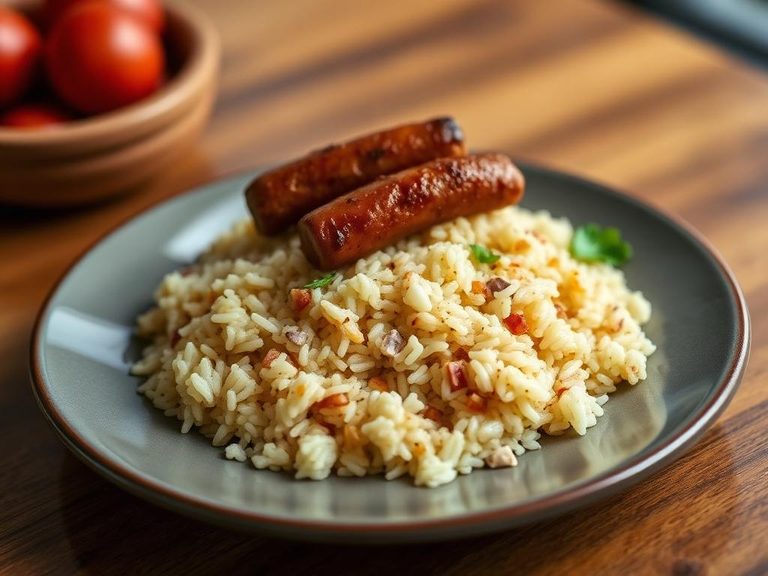
🌍 Where it's eaten
💡 Did you know?
The signature orange-red color of arroz guisado often comes from achiote (annatto) seeds, which were used by the Taíno people long before Spanish colonization.
Full nutrition (USDA data · scales with serving)
| Water | 52.9 g |
| Energy | 224 kcal |
| Protein | 4.0 g |
| Total lipid (fat) | 7.8 g |
| Carbohydrate, by difference | 33.4 g |
| Fiber, total dietary | 0.70 g |
| Total Sugars | 0.34 g |
| Calcium, Ca | 17.0 mg |
| Iron, Fe | 1.8 mg |
| Magnesium, Mg | 13.0 mg |
| Phosphorus, P | 58.0 mg |
| Potassium, K | 81.0 mg |
| Sodium, Na | 654 mg |
| Zinc, Zn | 0.57 mg |
| Copper, Cu | 0.10 mg |
| Selenium, Se | 7.1 ug |
| Vitamin C, total ascorbic acid | 3.1 mg |
| Thiamin | 0.20 mg |
| Riboflavin | 0.03 mg |
| Niacin | 1.9 mg |
| Vitamin B-6 | 0.09 mg |
| Folate, total | 68.0 ug |
| Folic acid | 64.0 ug |
| Folate, food | 4.0 ug |
| Folate, DFE | 113 ug |
| Choline, total | 6.8 mg |
| Vitamin B-12 | 0.02 ug |
| Vitamin B-12, added | 0.00 ug |
| Vitamin A, RAE | 2.0 ug |
| Retinol | 0.00 ug |
| Carotene, beta | 28.0 ug |
| Carotene, alpha | 1.0 ug |
| Cryptoxanthin, beta | 1.0 ug |
| Lycopene | 418 ug |
| Lutein + zeaxanthin | 23.0 ug |
| Vitamin E (alpha-tocopherol) | 1.1 mg |
| Vitamin E, added | 0.00 mg |
| Vitamin D (D2 + D3) | 0.00 ug |
| Vitamin K (phylloquinone) | 6.0 ug |
| Alcohol, ethyl | 0.00 g |
| Caffeine | 0.00 mg |
| Theobromine | 0.00 mg |
Fat & fatty acid profile (per 100g)
| Fatty acids, total saturated | 1.6 g |
| SFA 4:0 | 0.00 g |
| SFA 6:0 | 0.00 g |
| SFA 8:0 | 0.00 g |
| SFA 10:0 | 0.00 g |
| SFA 12:0 | 0.01 g |
| SFA 14:0 | 0.04 g |
| SFA 16:0 | 1.1 g |
| SFA 18:0 | 0.46 g |
| Fatty acids, total monounsaturated | 3.5 g |
| MUFA 16:1 | 0.10 g |
| MUFA 18:1 | 3.3 g |
| MUFA 20:1 | 0.03 g |
| MUFA 22:1 | 0.00 g |
| Fatty acids, total polyunsaturated | 2.2 g |
| PUFA 18:2 | 2.0 g |
| PUFA 18:3 | 0.24 g |
| PUFA 18:4 | 0.00 g |
| PUFA 20:4 | 0.01 g |
| PUFA 20:5 n-3 (EPA) | 0.00 g |
| PUFA 22:5 n-3 (DPA) | 0.00 g |
| PUFA 22:6 n-3 (DHA) | 0.00 g |
| Cholesterol | 4.0 mg |
FAQ
What makes it different from Mexican rice?
Puerto Rican arroz guisado is typically stewed in broth with a sofrito base and often includes olives and capers for a briny, savory note. Mexican rice is usually toasted first and simmered with tomatoes, onions, and garlic, with a different spice profile.
Can I make it with brown rice?
Yes, but the cooking time and liquid ratio will need to be increased significantly. The texture will be chewier and the flavor nuttier, which is a healthy but distinct variation.
Why is my rice mushy or sticky?
The most common causes are too much liquid, stirring the rice while it cooks (which releases starch), or using a short-grain variety. Use long-grain rice, measure liquid carefully, and avoid stirring once it's simmering.
Nutrient density (calculated · NRF9.3)
Nutrient Rich Foods index: beneficial nutrients (protein, fiber, vitamins, minerals) minus saturated fat, added sugar & sodium, per 100 kcal.
NRF9.3 index — Fulgoni, Keast & Drewnowski, 2009. Computed from USDA nutrients.
Weight-loss friendliness (composite index)
Energy density 2.24 kcal/g · 7% calories from protein · 0.7 g fiber · 0.3 g sugar per 100 g.
Composite of energy density (Rolls et al., 1999), protein & fiber satiety, minus sugar. A calculated heuristic — ranks satiety-per-calorie, not a clinical measure.
Dietary load (calculated from USDA values)
Potential renal acid load. Positive = acid-forming, negative = alkaline-forming.
Sodium-to-potassium ratio: 8.07 (lower is better — aim for ≤ 1)
Sodium:potassium per WHO potassium guidance. Computed from USDA nutrients.