

Soft drink, NFS
Common food
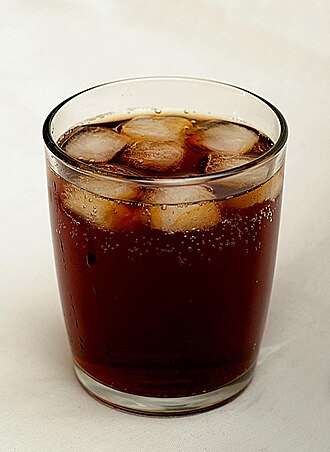
Photo: Wikipedia
Soft drink, NFS (Not Further Specified) is the generic term for a wide range of carbonated, sweetened beverages, from colas to lemon-limes. It delivers a sharp, effervescent fizz and a burst of sweetness, typically from high-fructose corn syrup or sugar. Nutritionally, it's a source of quick energy from its 10.36g of carbohydrates, almost entirely from sugar, with negligible protein, fat, or fiber.
Calorie split: 0% protein · 95% carbs · 5% fat
↓ Full nutrition💚 Why it's loved
People love the immediate, satisfying burst of sweetness and carbonation that can cut through thirst or complement a meal. Its vast variety of flavors and cultural ubiquity make it a familiar, go-to choice for a quick pick-me-up or social beverage.
⚠️ Watch-outs & how to enjoy it better
The high sugar content can lead to rapid blood-sugar spikes and crashes, offering no satiety. For those monitoring calorie or sugar intake, it provides 'empty calories' without beneficial nutrients. To counteract, practice strict portion control, opt for a small can, or pair it with a meal containing protein and fiber to slow sugar absorption.
Key benefits
- Provides quick energy from simple carbohydrates.
- Offers immediate hydration and refreshment.
- Serves as a common mixer in cocktails and mocktails.
- Can be a source of comfort or nostalgia.
🍽️ Popular dishes





🌍 Where it's eaten
💡 Did you know?
The 'NFS' in the database entry stands for 'Not Further Specified,' a catch-all category used by nutrition databases when the exact brand or flavor of a soft drink isn't identified, highlighting how ubiquitous yet variable this beverage category is.
Full nutrition (USDA data · scales with serving)
| Water | 89.4 g |
| Energy | 42.0 kcal |
| Protein | 0.00 g |
| Total lipid (fat) | 0.25 g |
| Carbohydrate, by difference | 10.4 g |
| Fiber, total dietary | 0.00 g |
| Total Sugars | 9.9 g |
| Calcium, Ca | 1.0 mg |
| Iron, Fe | 0.02 mg |
| Magnesium, Mg | 0.00 mg |
| Phosphorus, P | 9.0 mg |
| Potassium, K | 5.0 mg |
| Sodium, Na | 3.0 mg |
| Zinc, Zn | 0.09 mg |
| Copper, Cu | 0.01 mg |
| Selenium, Se | 0.10 ug |
| Vitamin C, total ascorbic acid | 0.00 mg |
| Thiamin | 0.00 mg |
| Riboflavin | 0.00 mg |
| Niacin | 0.00 mg |
| Vitamin B-6 | 0.00 mg |
| Folate, total | 0.00 ug |
| Folic acid | 0.00 ug |
| Folate, food | 0.00 ug |
| Folate, DFE | 0.00 ug |
| Choline, total | 0.30 mg |
| Vitamin B-12 | 0.00 ug |
| Vitamin B-12, added | 0.00 ug |
| Vitamin A, RAE | 0.00 ug |
| Retinol | 0.00 ug |
| Carotene, beta | 0.00 ug |
| Carotene, alpha | 0.00 ug |
| Cryptoxanthin, beta | 0.00 ug |
| Lycopene | 0.00 ug |
| Lutein + zeaxanthin | 0.00 ug |
| Vitamin E (alpha-tocopherol) | 0.00 mg |
| Vitamin E, added | 0.00 mg |
| Vitamin D (D2 + D3) | 0.00 ug |
| Vitamin K (phylloquinone) | 0.00 ug |
| Alcohol, ethyl | 0.00 g |
| Caffeine | 9.0 mg |
| Theobromine | 0.00 mg |
Fat & fatty acid profile (per 100g)
| Fatty acids, total saturated | 0.00 g |
| SFA 4:0 | 0.00 g |
| SFA 6:0 | 0.00 g |
| SFA 8:0 | 0.00 g |
| SFA 10:0 | 0.00 g |
| SFA 12:0 | 0.00 g |
| SFA 14:0 | 0.00 g |
| SFA 16:0 | 0.00 g |
| SFA 18:0 | 0.00 g |
| Fatty acids, total monounsaturated | 0.00 g |
| MUFA 16:1 | 0.00 g |
| MUFA 18:1 | 0.00 g |
| MUFA 20:1 | 0.00 g |
| MUFA 22:1 | 0.00 g |
| Fatty acids, total polyunsaturated | 0.00 g |
| PUFA 18:2 | 0.00 g |
| PUFA 18:3 | 0.00 g |
| PUFA 18:4 | 0.00 g |
| PUFA 20:4 | 0.00 g |
| PUFA 20:5 n-3 (EPA) | 0.00 g |
| PUFA 22:5 n-3 (DPA) | 0.00 g |
| PUFA 22:6 n-3 (DHA) | 0.00 g |
| Cholesterol | 0.00 mg |
FAQ
What does 'NFS' mean in 'Soft drink, NFS'?
It stands for 'Not Further Specified.' It's a generic entry used in nutrition databases to represent the average nutritional profile of a typical sweetened, carbonated soft drink when the exact brand or flavor isn't known.
Is soft drink a source of any vitamins or minerals?
No. Standard soft drinks like this are not a significant source of any vitamins, minerals, fiber, or protein. Their primary nutritional contribution is calories from sugar.
Why does it have 0g of fat but 42 kcal per 100g?
The calories come entirely from carbohydrates (sugars). Since 1 gram of carbohydrate provides 4 kcal, 10.36g of carbs yields approximately 41.4 kcal, which rounds to the listed 42 kcal. Fat is a more energy-dense nutrient at 9 kcal per gram, but it is absent here.
Nutrient density (calculated · NRF9.3)
Nutrient Rich Foods index: beneficial nutrients (protein, fiber, vitamins, minerals) minus saturated fat, added sugar & sodium, per 100 kcal.
NRF9.3 index — Fulgoni, Keast & Drewnowski, 2009. Computed from USDA nutrients.
Weight-loss friendliness (composite index)
Energy density 0.42 kcal/g · 0% calories from protein · 0.0 g fiber · 9.9 g sugar per 100 g.
Composite of energy density (Rolls et al., 1999), protein & fiber satiety, minus sugar. A calculated heuristic — ranks satiety-per-calorie, not a clinical measure.
Dietary load (calculated from USDA values)
Potential renal acid load. Positive = acid-forming, negative = alkaline-forming.
Sodium-to-potassium ratio: 0.60 (lower is better — aim for ≤ 1)
Sodium:potassium per WHO potassium guidance. Computed from USDA nutrients.