

Rice dressing
Common food

Photo: Wikipedia
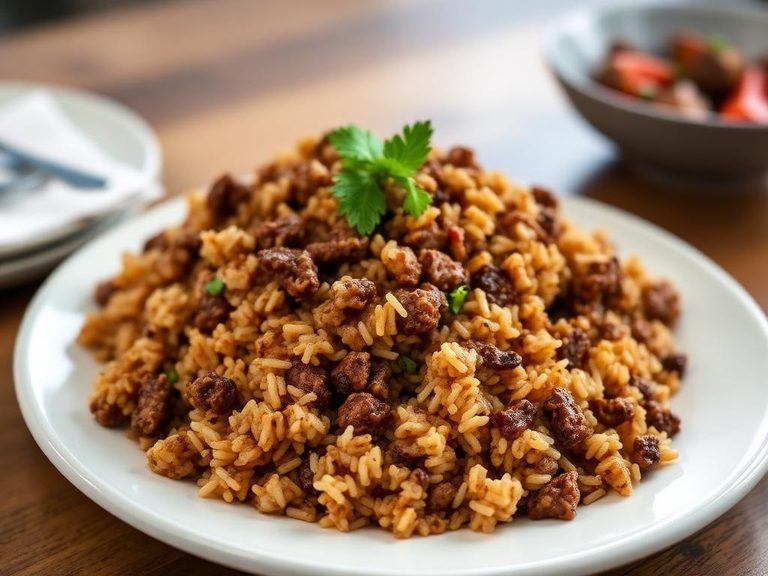
Rice dressing is a savory, often meaty mixture of cooked rice, ground meat (typically pork or beef), and the 'holy trinity' of onion, celery, and bell pepper, all simmered together. It boasts a hearty, moist texture and a deeply savory, slightly peppery flavor profile, often enriched with broth and herbs. Nutritionally, it's a carb-forward dish with a moderate fat content, providing a quick energy source.
Calorie split: 7% protein · 65% carbs · 27% fat
↓ Full nutrition💚 Why it's loved
People love rice dressing for its comforting, savory depth and its role as a beloved staple in Southern and Cajun cuisine, often served as a side or main dish. Its versatility allows it to be paired with everything from fried chicken to simple roasted vegetables, making it a crowd-pleasing, nostalgic comfort food.
⚠️ Watch-outs & how to enjoy it better
The dish can be high in sodium and saturated fat, depending on the meat and broth used, which may be a concern for those monitoring blood pressure or heart health. To mitigate this, opt for lean ground meat, use low-sodium broth, and pair the dressing with a fiber-rich vegetable like steamed broccoli to help stabilize blood sugar response.
Key benefits
- Provides quick energy from carbohydrates
- Contains protein from ground meat
- Good source of iron from meat and rice
- Versatile base for one-pot meals
- Can be prepared in large batches for convenience
🍽️ Popular dishes
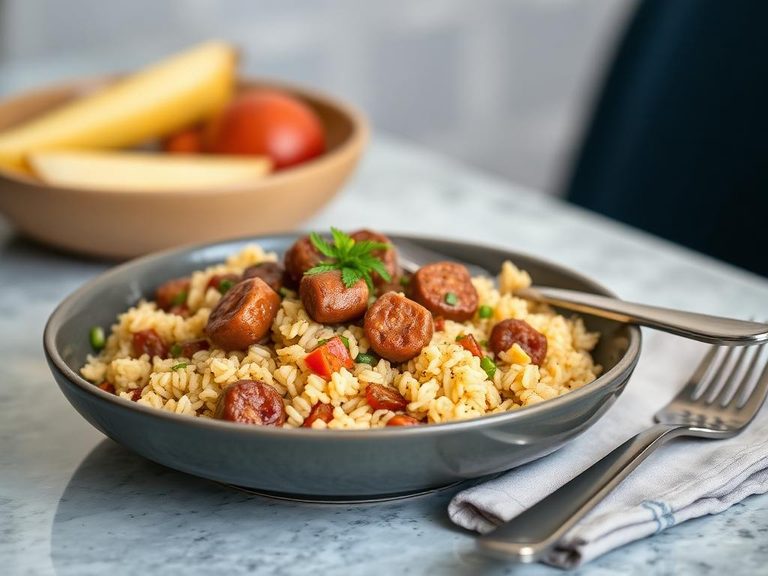
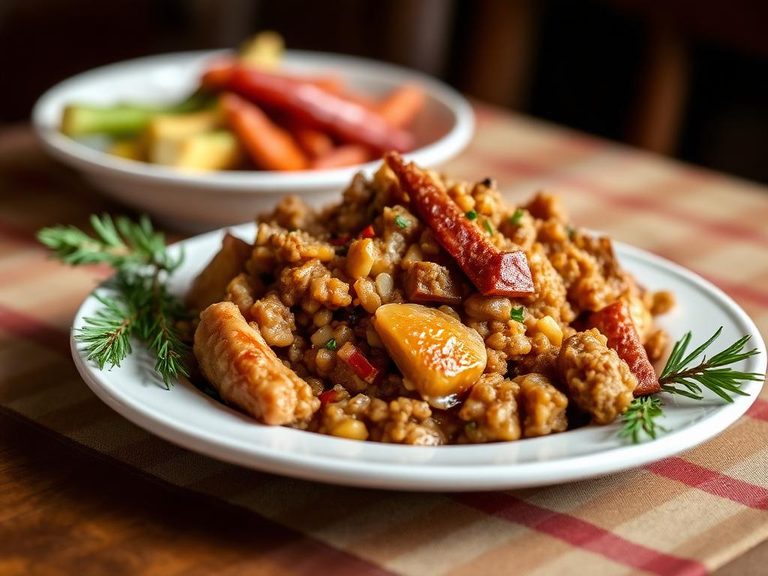
🌍 Where it's eaten
💡 Did you know?
In Louisiana, 'dirty rice' gets its name from the dark, speckled appearance of the rice after it's cooked with finely chopped chicken livers and gizzards, which also give it a rich, earthy flavor.
Full nutrition (USDA data · scales with serving)
| Water | 75.4 g |
| Energy | 110 kcal |
| Protein | 2.0 g |
| Total lipid (fat) | 3.3 g |
| Carbohydrate, by difference | 17.6 g |
| Fiber, total dietary | 0.60 g |
| Total Sugars | 0.71 g |
| Calcium, Ca | 19.0 mg |
| Iron, Fe | 0.92 mg |
| Magnesium, Mg | 8.0 mg |
| Phosphorus, P | 31.0 mg |
| Potassium, K | 59.0 mg |
| Sodium, Na | 600 mg |
| Zinc, Zn | 0.26 mg |
| Copper, Cu | 0.05 mg |
| Selenium, Se | 3.8 ug |
| Vitamin C, total ascorbic acid | 0.50 mg |
| Thiamin | 0.12 mg |
| Riboflavin | 0.03 mg |
| Niacin | 1.0 mg |
| Vitamin B-6 | 0.04 mg |
| Folate, total | 36.0 ug |
| Folic acid | 31.0 ug |
| Folate, food | 5.0 ug |
| Folate, DFE | 57.0 ug |
| Choline, total | 3.8 mg |
| Vitamin B-12 | 0.02 ug |
| Vitamin B-12, added | 0.00 ug |
| Vitamin A, RAE | 31.0 ug |
| Retinol | 28.0 ug |
| Carotene, beta | 41.0 ug |
| Carotene, alpha | 0.00 ug |
| Cryptoxanthin, beta | 0.00 ug |
| Lycopene | 0.00 ug |
| Lutein + zeaxanthin | 20.0 ug |
| Vitamin E (alpha-tocopherol) | 0.39 mg |
| Vitamin E, added | 0.00 mg |
| Vitamin D (D2 + D3) | 0.10 ug |
| Vitamin K (phylloquinone) | 5.9 ug |
| Alcohol, ethyl | 0.00 g |
| Caffeine | 0.00 mg |
| Theobromine | 0.00 mg |
Fat & fatty acid profile (per 100g)
| Fatty acids, total saturated | 0.66 g |
| SFA 4:0 | 0.00 g |
| SFA 6:0 | 0.00 g |
| SFA 8:0 | 0.00 g |
| SFA 10:0 | 0.00 g |
| SFA 12:0 | 0.00 g |
| SFA 14:0 | 0.01 g |
| SFA 16:0 | 0.38 g |
| SFA 18:0 | 0.26 g |
| Fatty acids, total monounsaturated | 1.5 g |
| MUFA 16:1 | 0.01 g |
| MUFA 18:1 | 1.5 g |
| MUFA 20:1 | 0.01 g |
| MUFA 22:1 | 0.00 g |
| Fatty acids, total polyunsaturated | 0.98 g |
| PUFA 18:2 | 0.90 g |
| PUFA 18:3 | 0.09 g |
| PUFA 18:4 | 0.00 g |
| PUFA 20:4 | 0.00 g |
| PUFA 20:5 n-3 (EPA) | 0.00 g |
| PUFA 22:5 n-3 (DPA) | 0.00 g |
| PUFA 22:6 n-3 (DHA) | 0.00 g |
| Cholesterol | 0.00 mg |
FAQ
What is the difference between rice dressing and dirty rice?
Rice dressing is a broader term for a cooked rice dish with meat and vegetables, while dirty rice is a specific Cajun version that prominently features chicken livers and gizzards, giving it a darker, more intense flavor.
Can rice dressing be made vegetarian?
Yes, you can substitute the meat with plant-based crumbles or mushrooms and use vegetable broth, though the texture and flavor will be different from the traditional version.
How should I store leftover rice dressing?
Store it in an airtight container in the refrigerator for up to 3-4 days, or freeze it for up to 3 months. Reheat thoroughly to an internal temperature of 165°F (74°C) before serving.
Nutrient density (calculated · NRF9.3)
Nutrient Rich Foods index: beneficial nutrients (protein, fiber, vitamins, minerals) minus saturated fat, added sugar & sodium, per 100 kcal.
NRF9.3 index — Fulgoni, Keast & Drewnowski, 2009. Computed from USDA nutrients.
Weight-loss friendliness (composite index)
Energy density 1.10 kcal/g · 7% calories from protein · 0.6 g fiber · 0.7 g sugar per 100 g.
Composite of energy density (Rolls et al., 1999), protein & fiber satiety, minus sugar. A calculated heuristic — ranks satiety-per-calorie, not a clinical measure.
Dietary load (calculated from USDA values)
Potential renal acid load. Positive = acid-forming, negative = alkaline-forming.
Sodium-to-potassium ratio: 10.17 (lower is better — aim for ≤ 1)
Sodium:potassium per WHO potassium guidance. Computed from USDA nutrients.