

Potato skins, with cheese and bacon
Common food

Photo: Wikipedia
Potato skins are the crispy, savory shells of baked potatoes, loaded with melted cheese and smoky bacon bits. They offer a satisfying crunch followed by a rich, salty, and comforting flavor profile. Nutritionally, they are a calorie-dense snack, with over 60% of their calories coming from fat.
Calorie split: 14% protein · 29% carbs · 57% fat
↓ Full nutrition💚 Why it's loved
People love potato skins for their irresistible combination of textures—crispy skin, fluffy potato, gooey cheese, and crunchy bacon. They are a classic, crowd-pleasing comfort food that's deeply embedded in American bar and party culture.
⚠️ Watch-outs & how to enjoy it better
The high fat, sodium, and calorie content can be a concern for those monitoring heart health or blood pressure. To counteract this, practice portion control, pair with a fresh, vinegar-based salad to cut the richness, and opt for lower-sodium bacon or cheese if possible.
Key benefits
- Provides a quick source of energy from carbohydrates and fats.
- Contains protein from cheese and bacon for muscle maintenance.
- Offers dietary fiber, especially if the skin is well-cooked.
- Can be a satisfying, shareable appetizer for social gatherings.
🍽️ Popular dishes
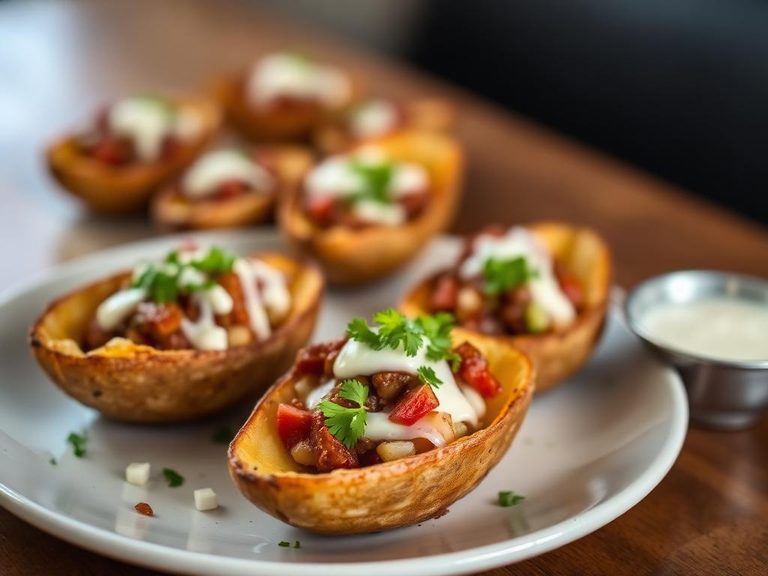

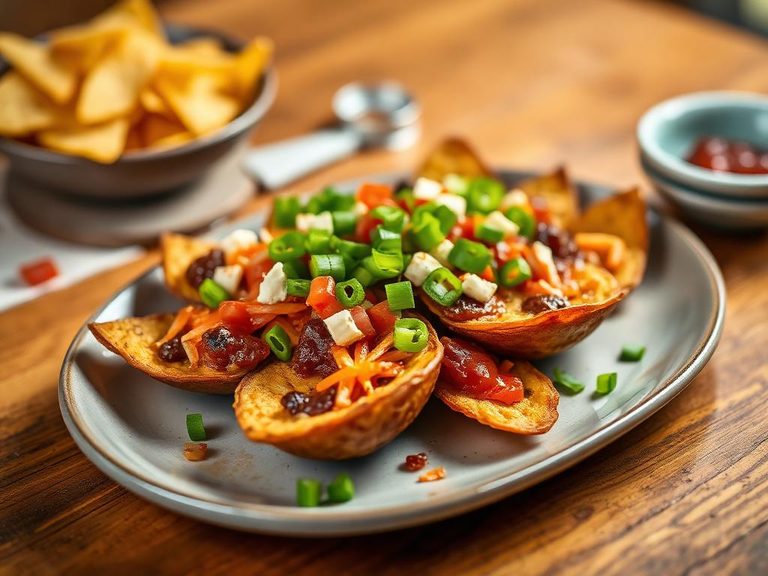

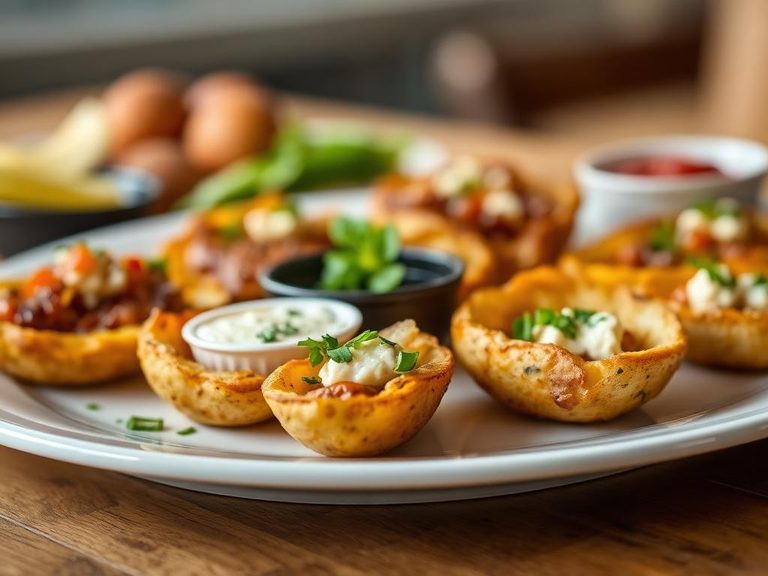
🌍 Where it's eaten
💡 Did you know?
The popularization of potato skins as an appetizer in the 1970s is often credited to a Chicago steakhouse, which began serving them as a way to reduce food waste from their baked potato service.
Full nutrition (USDA data · scales with serving)
| Water | 60.6 g |
| Energy | 215 kcal |
| Protein | 7.6 g |
| Total lipid (fat) | 13.7 g |
| Carbohydrate, by difference | 15.5 g |
| Fiber, total dietary | 1.4 g |
| Total Sugars | 1.0 g |
| Calcium, Ca | 134 mg |
| Iron, Fe | 0.67 mg |
| Magnesium, Mg | 25.0 mg |
| Phosphorus, P | 147 mg |
| Potassium, K | 383 mg |
| Sodium, Na | 488 mg |
| Zinc, Zn | 1.1 mg |
| Copper, Cu | 0.12 mg |
| Selenium, Se | 8.1 ug |
| Vitamin C, total ascorbic acid | 7.5 mg |
| Thiamin | 0.09 mg |
| Riboflavin | 0.12 mg |
| Niacin | 1.6 mg |
| Vitamin B-6 | 0.26 mg |
| Folate, total | 18.0 ug |
| Folic acid | 0.00 ug |
| Folate, food | 18.0 ug |
| Folate, DFE | 18.0 ug |
| Choline, total | 17.6 mg |
| Vitamin B-12 | 0.16 ug |
| Vitamin B-12, added | 0.00 ug |
| Vitamin A, RAE | 57.0 ug |
| Retinol | 56.0 ug |
| Carotene, beta | 3.0 ug |
| Carotene, alpha | 0.00 ug |
| Cryptoxanthin, beta | 0.00 ug |
| Lycopene | 0.00 ug |
| Lutein + zeaxanthin | 14.0 ug |
| Vitamin E (alpha-tocopherol) | 1.3 mg |
| Vitamin E, added | 0.00 mg |
| Vitamin D (D2 + D3) | 0.10 ug |
| Vitamin K (phylloquinone) | 7.1 ug |
| Alcohol, ethyl | 0.00 g |
| Caffeine | 0.00 mg |
| Theobromine | 0.00 mg |
Fat & fatty acid profile (per 100g)
| Fatty acids, total saturated | 4.8 g |
| SFA 4:0 | 0.12 g |
| SFA 6:0 | 0.10 g |
| SFA 8:0 | 0.06 g |
| SFA 10:0 | 0.15 g |
| SFA 12:0 | 0.17 g |
| SFA 14:0 | 0.57 g |
| SFA 16:0 | 2.5 g |
| SFA 18:0 | 0.97 g |
| Fatty acids, total monounsaturated | 4.6 g |
| MUFA 16:1 | 0.15 g |
| MUFA 18:1 | 4.4 g |
| MUFA 20:1 | 0.07 g |
| MUFA 22:1 | 0.00 g |
| Fatty acids, total polyunsaturated | 2.8 g |
| PUFA 18:2 | 2.4 g |
| PUFA 18:3 | 0.29 g |
| PUFA 18:4 | 0.00 g |
| PUFA 20:4 | 0.02 g |
| PUFA 20:5 n-3 (EPA) | 0.00 g |
| PUFA 22:5 n-3 (DPA) | 0.01 g |
| PUFA 22:6 n-3 (DHA) | 0.00 g |
| Cholesterol | 23.0 mg |
FAQ
Are potato skins healthy?
They are a high-fat, high-calorie food, making them more of an occasional indulgence than a health food. The skin itself contains fiber and nutrients, but the added cheese, bacon, and oil significantly increase the calorie and sodium content.
How do you get potato skins crispy?
The key is to bake the potato first, scoop out the flesh leaving a thin layer, then brush the skins with oil or butter and bake or broil them again until golden and crisp before adding toppings.
What is the difference between potato skins and loaded baked potatoes?
Potato skins are the hollowed-out, crispy shells of the potato, served as a finger food appetizer. A loaded baked potato is a whole potato, split open and filled with toppings like cheese, sour cream, and bacon.
Nutrient density (calculated · NRF9.3)
Nutrient Rich Foods index: beneficial nutrients (protein, fiber, vitamins, minerals) minus saturated fat, added sugar & sodium, per 100 kcal.
NRF9.3 index — Fulgoni, Keast & Drewnowski, 2009. Computed from USDA nutrients.
Weight-loss friendliness (composite index)
Energy density 2.15 kcal/g · 14% calories from protein · 1.4 g fiber · 1.0 g sugar per 100 g.
Composite of energy density (Rolls et al., 1999), protein & fiber satiety, minus sugar. A calculated heuristic — ranks satiety-per-calorie, not a clinical measure.
Dietary load (calculated from USDA values)
Potential renal acid load. Positive = acid-forming, negative = alkaline-forming.
Sodium-to-potassium ratio: 1.27 (lower is better — aim for ≤ 1)
Sodium:potassium per WHO potassium guidance. Computed from USDA nutrients.