

Pork and vegetables excluding carrots, broccoli, and dark- green leafy; no potatoes, soy-based sauce
Common food
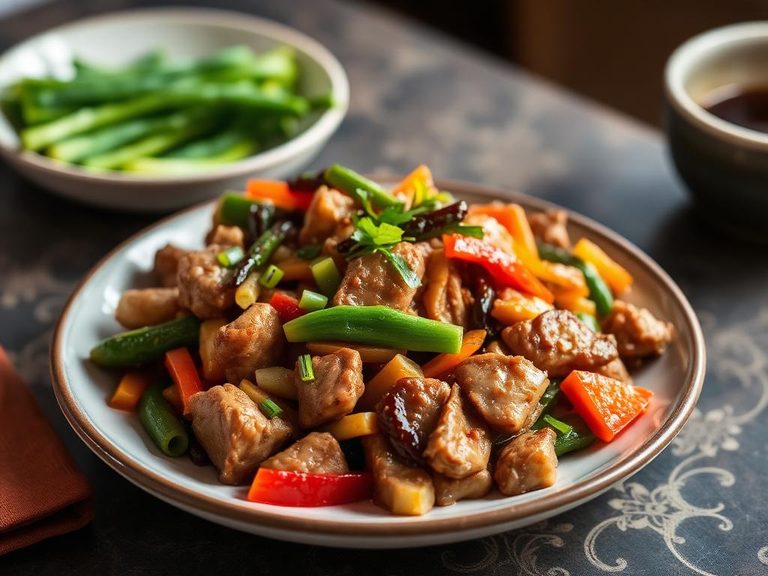
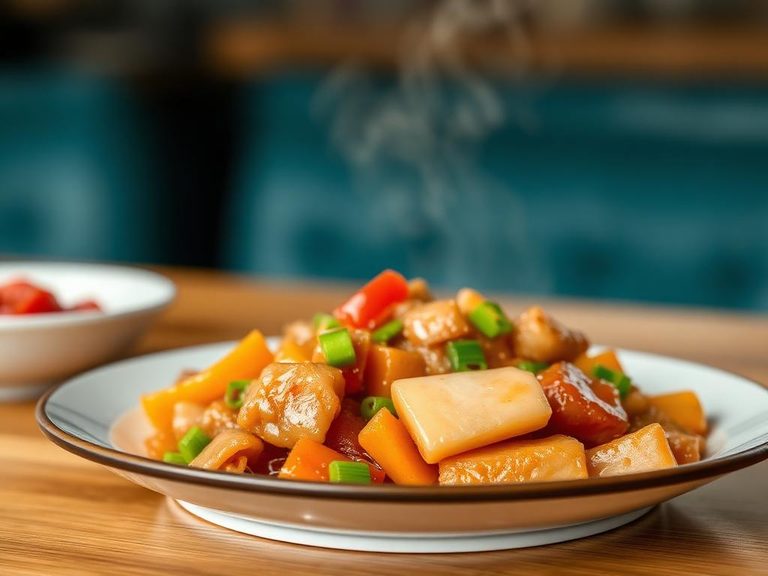
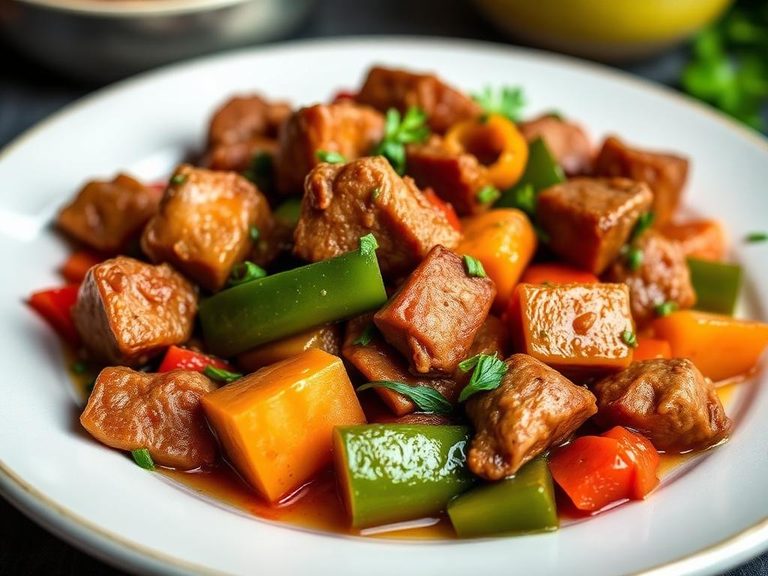
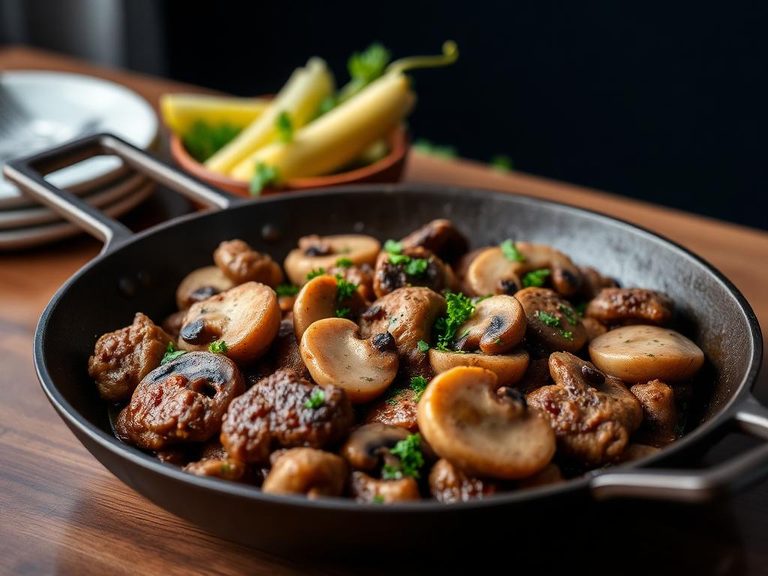
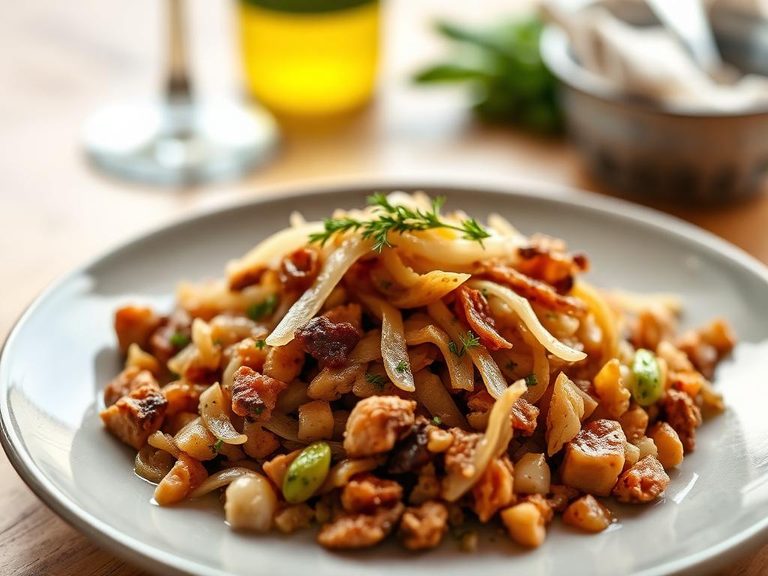
This is a savory, stir-fried or sautéed dish featuring tender pork pieces mingled with a medley of vegetables like bell peppers, onions, and mushrooms, all coated in a light, savory sauce. The texture is a satisfying contrast between the soft, juicy meat and the crisp-tender vegetables, offering a clean, umami-forward flavor without the heaviness of soy sauce. Nutritionally, it's a lean, high-protein option with moderate fat, making it a balanced and flavorful choice for a light meal.
Calorie split: 31% protein · 12% carbs · 57% fat
↓ Full nutrition💚 Why it's loved
People love this dish for its comforting, savory flavor and the satisfying texture of tender pork with crisp vegetables. It's incredibly versatile, easily adapted to whatever vegetables are on hand, and represents a classic home-cooked meal in many cultures.
⚠️ Watch-outs & how to enjoy it better
The dish can be high in sodium if seasoned heavily, and the fat content, while moderate, might be a concern for those on strict low-fat diets. To counteract, use low-sodium seasonings or herbs, and opt for leaner cuts of pork like loin; pairing with a side of steamed greens can also help balance the meal.
Key benefits
- High in protein (11.4g per 100g) for muscle maintenance.
- Low in carbohydrates (4.34g per 100g), suitable for low-carb diets.
- Provides dietary fiber (1g per 100g) from the vegetable mix.
- Contains essential vitamins and minerals from the vegetable medley.
- Relatively low in calories (149 kcal per 100g) for a balanced meal.
🍽️ Popular dishes
🌍 Where it's eaten
💡 Did you know?
The absence of soy-based sauce in this dish is a deliberate choice, often to accommodate soy allergies or to create a lighter, cleaner flavor profile that lets the natural tastes of the pork and vegetables shine through.
Full nutrition (USDA data · scales with serving)
| Water | 73.7 g |
| Energy | 149 kcal |
| Protein | 11.4 g |
| Total lipid (fat) | 9.4 g |
| Carbohydrate, by difference | 4.3 g |
| Fiber, total dietary | 1.0 g |
| Total Sugars | 1.6 g |
| Calcium, Ca | 23.0 mg |
| Iron, Fe | 0.74 mg |
| Magnesium, Mg | 20.0 mg |
| Phosphorus, P | 117 mg |
| Potassium, K | 290 mg |
| Sodium, Na | 251 mg |
| Zinc, Zn | 1.1 mg |
| Copper, Cu | 0.08 mg |
| Selenium, Se | 14.1 ug |
| Vitamin C, total ascorbic acid | 13.4 mg |
| Thiamin | 0.39 mg |
| Riboflavin | 0.17 mg |
| Niacin | 2.7 mg |
| Vitamin B-6 | 0.29 mg |
| Folate, total | 12.0 ug |
| Folic acid | 0.00 ug |
| Folate, food | 12.0 ug |
| Folate, DFE | 12.0 ug |
| Choline, total | 41.0 mg |
| Vitamin B-12 | 0.27 ug |
| Vitamin B-12, added | 0.00 ug |
| Vitamin A, RAE | 9.0 ug |
| Retinol | 1.0 ug |
| Carotene, beta | 97.0 ug |
| Carotene, alpha | 10.0 ug |
| Cryptoxanthin, beta | 1.0 ug |
| Lycopene | 0.00 ug |
| Lutein + zeaxanthin | 167 ug |
| Vitamin E (alpha-tocopherol) | 1.3 mg |
| Vitamin E, added | 0.00 mg |
| Vitamin D (D2 + D3) | 0.20 ug |
| Vitamin K (phylloquinone) | 21.6 ug |
| Alcohol, ethyl | 0.00 g |
| Caffeine | 0.00 mg |
| Theobromine | 0.00 mg |
Fat & fatty acid profile (per 100g)
| Fatty acids, total saturated | 2.1 g |
| SFA 4:0 | 0.00 g |
| SFA 6:0 | 0.00 g |
| SFA 8:0 | 0.00 g |
| SFA 10:0 | 0.00 g |
| SFA 12:0 | 0.00 g |
| SFA 14:0 | 0.05 g |
| SFA 16:0 | 1.3 g |
| SFA 18:0 | 0.57 g |
| Fatty acids, total monounsaturated | 4.0 g |
| MUFA 16:1 | 0.13 g |
| MUFA 18:1 | 3.8 g |
| MUFA 20:1 | 0.07 g |
| MUFA 22:1 | 0.00 g |
| Fatty acids, total polyunsaturated | 2.6 g |
| PUFA 18:2 | 2.3 g |
| PUFA 18:3 | 0.27 g |
| PUFA 18:4 | 0.00 g |
| PUFA 20:4 | 0.01 g |
| PUFA 20:5 n-3 (EPA) | 0.00 g |
| PUFA 22:5 n-3 (DPA) | 0.00 g |
| PUFA 22:6 n-3 (DHA) | 0.00 g |
| Cholesterol | 29.0 mg |
FAQ
What vegetables are typically included in this dish?
Common vegetables include bell peppers, onions, mushrooms, zucchini, and celery, excluding carrots, broccoli, and dark-green leafy vegetables as specified.
Is this dish suitable for a low-carb diet?
Yes, with only 4.34g of carbohydrates per 100g, it fits well into a low-carb or ketogenic diet, especially when paired with non-starchy vegetables.
How can I reduce the fat content in this dish?
Use lean pork cuts like loin or tenderloin, trim visible fat, and cook with minimal oil or use a non-stick pan. You can also add more vegetables to increase volume without adding fat.
Nutrient density (calculated · NRF9.3)
Nutrient Rich Foods index: beneficial nutrients (protein, fiber, vitamins, minerals) minus saturated fat, added sugar & sodium, per 100 kcal.
NRF9.3 index — Fulgoni, Keast & Drewnowski, 2009. Computed from USDA nutrients.
Weight-loss friendliness (composite index)
Energy density 1.49 kcal/g · 31% calories from protein · 1.0 g fiber · 1.6 g sugar per 100 g.
Composite of energy density (Rolls et al., 1999), protein & fiber satiety, minus sugar. A calculated heuristic — ranks satiety-per-calorie, not a clinical measure.
Dietary load (calculated from USDA values)
Potential renal acid load. Positive = acid-forming, negative = alkaline-forming.
Sodium-to-potassium ratio: 0.87 (lower is better — aim for ≤ 1)
Sodium:potassium per WHO potassium guidance. Computed from USDA nutrients.