

Pork and onions with soy-based sauce
Common food
A savory stir-fry of tender pork slices and caramelized onions, coated in a rich, umami-laden soy-based sauce. The dish offers a satisfying balance of savory, sweet, and salty notes with a tender, slightly chewy texture. It's a protein-rich, moderate-fat option, providing a solid 11g of protein per 100g with a relatively low carbohydrate count.
Calorie split: 30% protein · 15% carbs · 55% fat
↓ Full nutrition💚 Why it's loved
People love this dish for its deep, savory umami flavor and the satisfying contrast between tender pork and sweet, caramelized onions. It's a versatile comfort food that pairs perfectly with rice or noodles, embodying the heartiness of home-style Asian cooking.
⚠️ Watch-outs & how to enjoy it better
The soy-based sauce is typically high in sodium, which can be a concern for those monitoring blood pressure. To counteract this, use low-sodium soy sauce or tamari, and balance the dish with fresh vegetables or a side of plain rice to dilute the saltiness. Additionally, the dish may contain common allergens like soy and wheat (if using regular soy sauce).
Key benefits
- High-quality protein source for muscle maintenance and satiety.
- Low carbohydrate content makes it suitable for low-carb diets.
- Rich in umami flavor from soy sauce, reducing the need for added sugars.
- Onions provide antioxidants and prebiotic fiber for gut health.
- Quick and versatile base for many Asian-inspired meals.
🍽️ Popular dishes
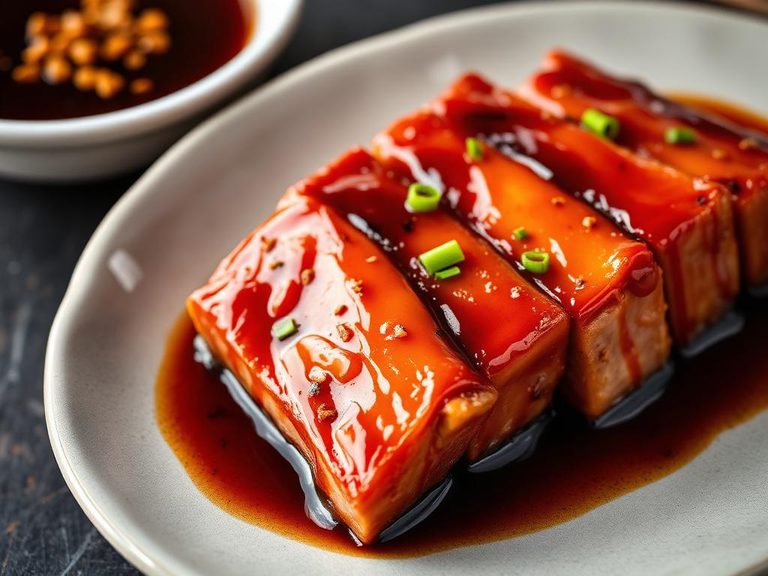
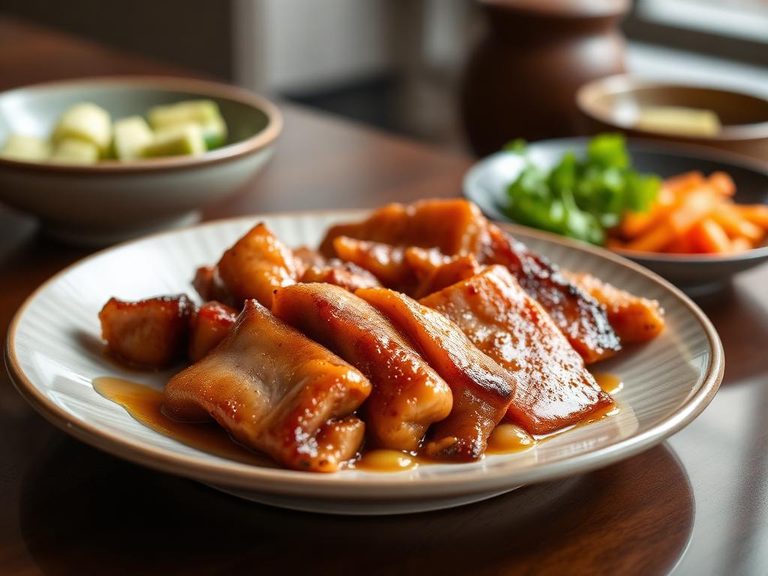

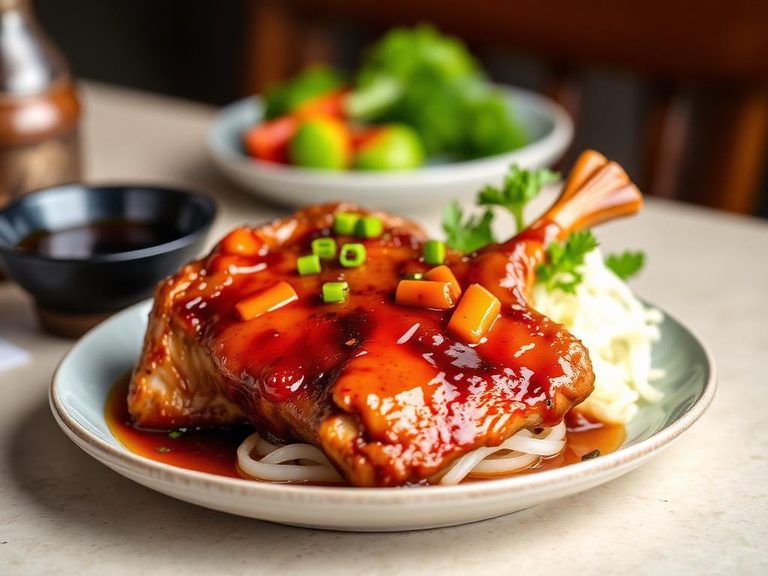
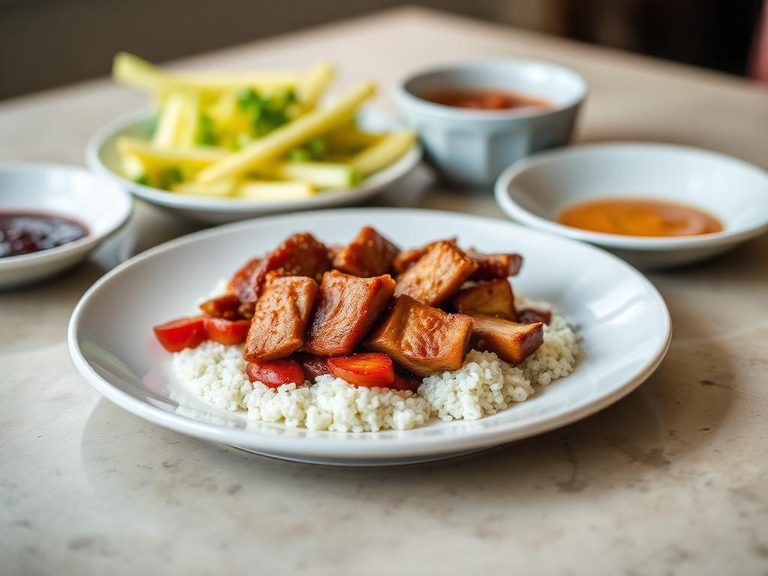
🌍 Where it's eaten
💡 Did you know?
The caramelization of onions in this dish isn't just for flavor—it's a chemical reaction called the Maillard reaction, which creates hundreds of new flavor compounds, making the onions taste sweeter and more complex than when raw.
Full nutrition (USDA data · scales with serving)
| Water | 73.2 g |
| Energy | 149 kcal |
| Protein | 11.1 g |
| Total lipid (fat) | 9.1 g |
| Carbohydrate, by difference | 5.4 g |
| Fiber, total dietary | 0.80 g |
| Total Sugars | 2.2 g |
| Calcium, Ca | 24.0 mg |
| Iron, Fe | 0.66 mg |
| Magnesium, Mg | 19.0 mg |
| Phosphorus, P | 112 mg |
| Potassium, K | 261 mg |
| Sodium, Na | 245 mg |
| Zinc, Zn | 1.0 mg |
| Copper, Cu | 0.06 mg |
| Selenium, Se | 12.7 ug |
| Vitamin C, total ascorbic acid | 3.4 mg |
| Thiamin | 0.38 mg |
| Riboflavin | 0.14 mg |
| Niacin | 2.3 mg |
| Vitamin B-6 | 0.28 mg |
| Folate, total | 10.0 ug |
| Folic acid | 0.00 ug |
| Folate, food | 10.0 ug |
| Folate, DFE | 10.0 ug |
| Choline, total | 38.6 mg |
| Vitamin B-12 | 0.26 ug |
| Vitamin B-12, added | 0.00 ug |
| Vitamin A, RAE | 3.0 ug |
| Retinol | 1.0 ug |
| Carotene, beta | 27.0 ug |
| Carotene, alpha | 0.00 ug |
| Cryptoxanthin, beta | 0.00 ug |
| Lycopene | 0.00 ug |
| Lutein + zeaxanthin | 52.0 ug |
| Vitamin E (alpha-tocopherol) | 1.2 mg |
| Vitamin E, added | 0.00 mg |
| Vitamin D (D2 + D3) | 0.20 ug |
| Vitamin K (phylloquinone) | 16.0 ug |
| Alcohol, ethyl | 0.00 g |
| Caffeine | 0.00 mg |
| Theobromine | 0.00 mg |
Fat & fatty acid profile (per 100g)
| Fatty acids, total saturated | 2.0 g |
| SFA 4:0 | 0.00 g |
| SFA 6:0 | 0.00 g |
| SFA 8:0 | 0.00 g |
| SFA 10:0 | 0.00 g |
| SFA 12:0 | 0.00 g |
| SFA 14:0 | 0.05 g |
| SFA 16:0 | 1.3 g |
| SFA 18:0 | 0.56 g |
| Fatty acids, total monounsaturated | 3.9 g |
| MUFA 16:1 | 0.13 g |
| MUFA 18:1 | 3.7 g |
| MUFA 20:1 | 0.07 g |
| MUFA 22:1 | 0.00 g |
| Fatty acids, total polyunsaturated | 2.5 g |
| PUFA 18:2 | 2.2 g |
| PUFA 18:3 | 0.26 g |
| PUFA 18:4 | 0.00 g |
| PUFA 20:4 | 0.01 g |
| PUFA 20:5 n-3 (EPA) | 0.00 g |
| PUFA 22:5 n-3 (DPA) | 0.00 g |
| PUFA 22:6 n-3 (DHA) | 0.00 g |
| Cholesterol | 28.0 mg |
FAQ
Is this dish suitable for a low-sodium diet?
Traditional soy sauce is high in sodium, but you can use low-sodium soy sauce or tamari to reduce the salt content significantly. Also, rinsing the pork after marinating can help lower sodium levels.
Can I make this dish with other meats?
Yes, this recipe is highly adaptable. Chicken, beef, or even tofu can be used as substitutes for pork, though cooking times may vary.
How do I prevent the pork from becoming tough?
Slice the pork against the grain and marinate it briefly with a bit of cornstarch or baking soda to tenderize. Cook over high heat for a short time to keep it juicy.
Nutrient density (calculated · NRF9.3)
Nutrient Rich Foods index: beneficial nutrients (protein, fiber, vitamins, minerals) minus saturated fat, added sugar & sodium, per 100 kcal.
NRF9.3 index — Fulgoni, Keast & Drewnowski, 2009. Computed from USDA nutrients.
Weight-loss friendliness (composite index)
Energy density 1.49 kcal/g · 30% calories from protein · 0.8 g fiber · 2.2 g sugar per 100 g.
Composite of energy density (Rolls et al., 1999), protein & fiber satiety, minus sugar. A calculated heuristic — ranks satiety-per-calorie, not a clinical measure.
Dietary load (calculated from USDA values)
Potential renal acid load. Positive = acid-forming, negative = alkaline-forming.
Sodium-to-potassium ratio: 0.94 (lower is better — aim for ≤ 1)
Sodium:potassium per WHO potassium guidance. Computed from USDA nutrients.