

Pina Colada
Common food

Photo: Wikipedia
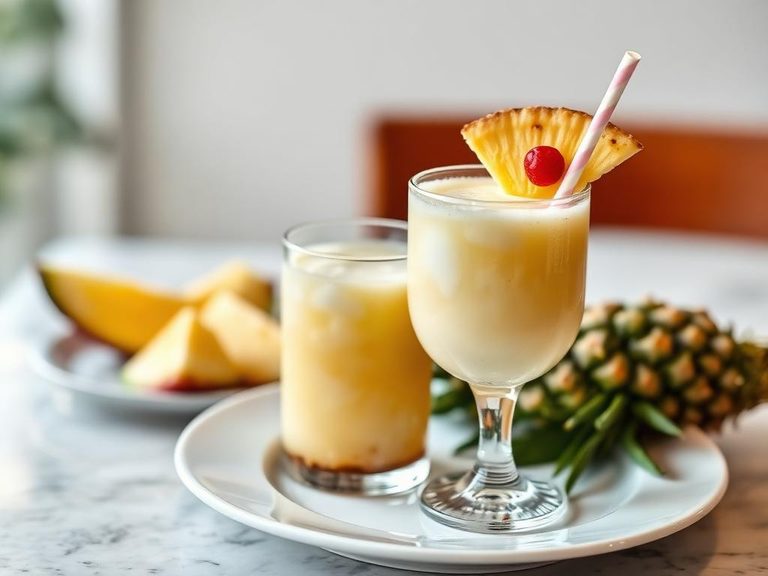
A Piña Colada is a tropical cocktail blending rum, coconut cream, and pineapple juice into a rich, creamy, and sweet drink. Its velvety texture and balanced sweetness of tropical fruit and coconut make it a quintessential vacation treat. Nutritionally, it is primarily a source of quick energy from carbohydrates and sugars, with minimal protein or fiber.
Calorie split: 1% protein · 79% carbs · 20% fat
↓ Full nutrition💚 Why it's loved
People love the Piña Colada for its iconic, indulgent flavor that instantly evokes a sense of tropical relaxation and celebration. Its creamy, smoothie-like texture and sweet, balanced taste make it a universally appealing dessert drink or vacation staple.
⚠️ Watch-outs & how to enjoy it better
The high sugar and calorie content can cause rapid blood-sugar spikes and is a concern for those managing diabetes or calorie intake. To counteract this, opt for a smaller portion, request light coconut cream, or ask for it blended with ice to increase volume without added sugar. Those with coconut allergies should avoid it entirely.
Key benefits
- Provides quick energy from carbohydrates
- Contains small amounts of manganese from pineapple
- Offers a source of medium-chain triglycerides (MCTs) from coconut
- Can be a refreshing source of hydration in hot climates
- May provide a small amount of vitamin C from pineapple juice
🍽️ Popular dishes

🌍 Where it's eaten
💡 Did you know?
The Piña Colada was declared the official drink of Puerto Rico in 1978, and its invention is claimed by multiple bartenders in San Juan from the 1950s and 1960s.
Full nutrition (USDA data · scales with serving)
| Water | 70.0 g |
| Energy | 151 kcal |
| Protein | 0.36 g |
| Total lipid (fat) | 2.1 g |
| Carbohydrate, by difference | 19.5 g |
| Fiber, total dietary | 0.10 g |
| Total Sugars | 17.6 g |
| Calcium, Ca | 8.0 mg |
| Iron, Fe | 0.21 mg |
| Magnesium, Mg | 9.0 mg |
| Phosphorus, P | 8.0 mg |
| Potassium, K | 90.0 mg |
| Sodium, Na | 6.0 mg |
| Zinc, Zn | 0.15 mg |
| Copper, Cu | 0.08 mg |
| Selenium, Se | 0.80 ug |
| Vitamin C, total ascorbic acid | 5.9 mg |
| Thiamin | 0.04 mg |
| Riboflavin | 0.02 mg |
| Niacin | 0.12 mg |
| Vitamin B-6 | 0.06 mg |
| Folate, total | 12.0 ug |
| Folic acid | 0.00 ug |
| Folate, food | 12.0 ug |
| Folate, DFE | 12.0 ug |
| Choline, total | 2.8 mg |
| Vitamin B-12 | 0.00 ug |
| Vitamin B-12, added | 0.00 ug |
| Vitamin A, RAE | 0.00 ug |
| Retinol | 0.00 ug |
| Carotene, beta | 2.0 ug |
| Carotene, alpha | 0.00 ug |
| Cryptoxanthin, beta | 0.00 ug |
| Lycopene | 0.00 ug |
| Lutein + zeaxanthin | 0.00 ug |
| Vitamin E (alpha-tocopherol) | 0.03 mg |
| Vitamin E, added | 0.00 mg |
| Vitamin D (D2 + D3) | 0.00 ug |
| Vitamin K (phylloquinone) | 0.20 ug |
| Alcohol, ethyl | 7.9 g |
| Caffeine | 0.00 mg |
| Theobromine | 0.00 mg |
Fat & fatty acid profile (per 100g)
| Fatty acids, total saturated | 2.0 g |
| SFA 4:0 | 0.00 g |
| SFA 6:0 | 0.01 g |
| SFA 8:0 | 0.18 g |
| SFA 10:0 | 0.14 g |
| SFA 12:0 | 1.1 g |
| SFA 14:0 | 0.38 g |
| SFA 16:0 | 0.14 g |
| SFA 18:0 | 0.04 g |
| Fatty acids, total monounsaturated | 0.09 g |
| MUFA 16:1 | 0.00 g |
| MUFA 18:1 | 0.09 g |
| MUFA 20:1 | 0.00 g |
| MUFA 22:1 | 0.00 g |
| Fatty acids, total polyunsaturated | 0.04 g |
| PUFA 18:2 | 0.03 g |
| PUFA 18:3 | 0.01 g |
| PUFA 18:4 | 0.00 g |
| PUFA 20:4 | 0.00 g |
| PUFA 20:5 n-3 (EPA) | 0.00 g |
| PUFA 22:5 n-3 (DPA) | 0.00 g |
| PUFA 22:6 n-3 (DHA) | 0.00 g |
| Cholesterol | 0.00 mg |
FAQ
Is a Piña Colada gluten-free?
Generally, yes. The base ingredients (rum, coconut cream, pineapple juice) are naturally gluten-free. However, always check for added syrups or mixes that might contain gluten, and be mindful of cross-contamination if prepared in a bar setting.
Can I make a non-alcoholic version?
Absolutely. A 'Virgin Piña Colada' simply omits the rum and increases the pineapple juice or adds a splash of coconut water. It retains the signature tropical flavor without the alcohol.
Why is my Piña Colada separating?
Separation is common due to the fat in coconut cream. To prevent it, blend the drink very thoroughly until completely emulsified. Serving it immediately in a chilled glass also helps maintain its creamy consistency.
Nutrient density (calculated · NRF9.3)
Nutrient Rich Foods index: beneficial nutrients (protein, fiber, vitamins, minerals) minus saturated fat, added sugar & sodium, per 100 kcal.
NRF9.3 index — Fulgoni, Keast & Drewnowski, 2009. Computed from USDA nutrients.
Weight-loss friendliness (composite index)
Energy density 1.51 kcal/g · 1% calories from protein · 0.1 g fiber · 17.6 g sugar per 100 g.
Composite of energy density (Rolls et al., 1999), protein & fiber satiety, minus sugar. A calculated heuristic — ranks satiety-per-calorie, not a clinical measure.
Dietary load (calculated from USDA values)
Potential renal acid load. Positive = acid-forming, negative = alkaline-forming.
Sodium-to-potassium ratio: 0.07 (lower is better — aim for ≤ 1)
Sodium:potassium per WHO potassium guidance. Computed from USDA nutrients.