

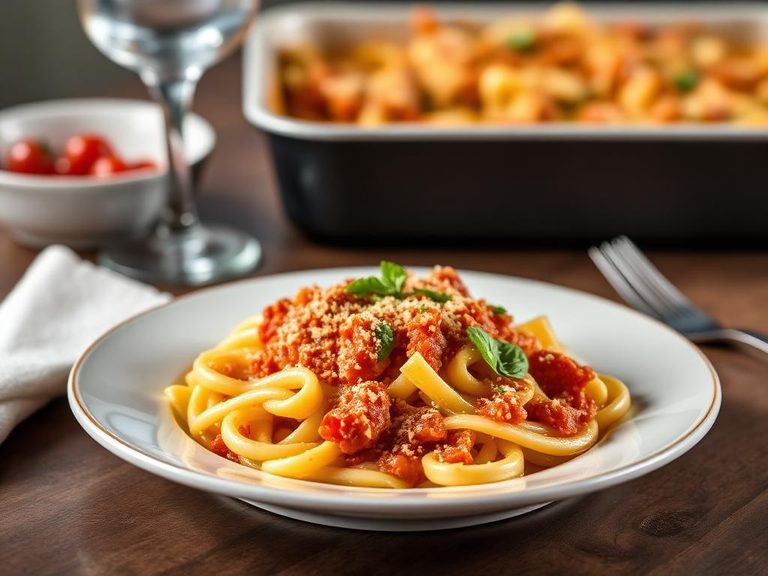
Pasta with tomato-based sauce, home recipe
Common food
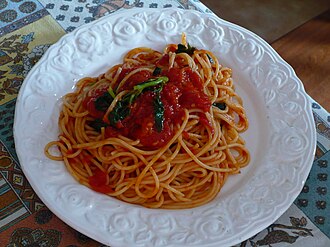
Photo: Wikipedia
A comforting bowl of pasta tossed in a vibrant, home-cooked tomato sauce, where the al dente bite of the noodle meets the bright, tangy sweetness of simmered tomatoes. This dish is a light yet satisfying staple, offering a good source of complex carbohydrates for energy with a surprisingly low fat content.
Calorie split: 14% protein · 76% carbs · 10% fat
↓ Full nutrition💚 Why it's loved
People adore it for its simple, nostalgic comfort and the way the tangy tomato sauce perfectly coats each strand of pasta. It's a universally loved canvas that can be dressed up with countless herbs, cheeses, or proteins to suit any mood or meal.
⚠️ Watch-outs & how to enjoy it better
A standard serving can cause a rapid blood-sugar spike due to its high-glycemic refined pasta base. To counteract this, pair it with a lean protein (like grilled chicken) and a side of non-starchy vegetables, or choose whole-wheat pasta to increase fiber and slow digestion.
Key benefits
- Low in fat and calories per serving.
- Good source of complex carbohydrates for sustained energy.
- Contains dietary fiber from tomatoes and pasta.
- Provides vitamins like Vitamin C and lycopene from tomatoes.
- A versatile base for adding protein and vegetables.
🍽️ Popular dishes

🌍 Where it's eaten
💡 Did you know?
The tomato, now iconic in Italian cuisine, was actually brought to Europe from the Americas in the 16th century and was initially grown as an ornamental plant before being accepted as food.
Full nutrition (USDA data · scales with serving)
| Water | 74.3 g |
| Energy | 106 kcal |
| Protein | 3.7 g |
| Total lipid (fat) | 1.2 g |
| Carbohydrate, by difference | 19.9 g |
| Fiber, total dietary | 1.8 g |
| Total Sugars | 2.9 g |
| Calcium, Ca | 17.0 mg |
| Iron, Fe | 1.0 mg |
| Magnesium, Mg | 18.0 mg |
| Phosphorus, P | 46.0 mg |
| Potassium, K | 176 mg |
| Sodium, Na | 202 mg |
| Zinc, Zn | 0.36 mg |
| Copper, Cu | 0.09 mg |
| Selenium, Se | 14.4 ug |
| Vitamin C, total ascorbic acid | 1.0 mg |
| Thiamin | 0.15 mg |
| Riboflavin | 0.10 mg |
| Niacin | 2.8 mg |
| Vitamin B-6 | 0.11 mg |
| Folate, total | 44.0 ug |
| Folic acid | 34.0 ug |
| Folate, food | 10.0 ug |
| Folate, DFE | 68.0 ug |
| Choline, total | 9.9 mg |
| Vitamin B-12 | 0.00 ug |
| Vitamin B-12, added | 0.00 ug |
| Vitamin A, RAE | 15.0 ug |
| Retinol | 0.00 ug |
| Carotene, beta | 188 ug |
| Carotene, alpha | 0.00 ug |
| Cryptoxanthin, beta | 0.00 ug |
| Lycopene | 6115 ug |
| Lutein + zeaxanthin | 95.0 ug |
| Vitamin E (alpha-tocopherol) | 1.2 mg |
| Vitamin E, added | 0.00 mg |
| Vitamin D (D2 + D3) | 0.00 ug |
| Vitamin K (phylloquinone) | 6.7 ug |
| Alcohol, ethyl | 0.00 g |
| Caffeine | 0.00 mg |
| Theobromine | 0.00 mg |
Fat & fatty acid profile (per 100g)
| Fatty acids, total saturated | 0.17 g |
| SFA 4:0 | 0.00 g |
| SFA 6:0 | 0.00 g |
| SFA 8:0 | 0.00 g |
| SFA 10:0 | 0.00 g |
| SFA 12:0 | 0.00 g |
| SFA 14:0 | 0.00 g |
| SFA 16:0 | 0.13 g |
| SFA 18:0 | 0.03 g |
| Fatty acids, total monounsaturated | 0.25 g |
| MUFA 16:1 | 0.00 g |
| MUFA 18:1 | 0.24 g |
| MUFA 20:1 | 0.00 g |
| MUFA 22:1 | 0.00 g |
| Fatty acids, total polyunsaturated | 0.41 g |
| PUFA 18:2 | 0.36 g |
| PUFA 18:3 | 0.05 g |
| PUFA 18:4 | 0.00 g |
| PUFA 20:4 | 0.00 g |
| PUFA 20:5 n-3 (EPA) | 0.00 g |
| PUFA 22:5 n-3 (DPA) | 0.00 g |
| PUFA 22:6 n-3 (DHA) | 0.00 g |
| Cholesterol | 1.0 mg |
FAQ
How can I make the sauce richer without adding fat?
Simmer the tomatoes longer to concentrate their natural sugars and umami, or add a splash of pasta cooking water to create a silky, emulsified sauce without extra oil.
Is this dish suitable for a gluten-free diet?
Traditional pasta contains gluten. To make it gluten-free, use pasta made from rice, corn, or legumes and ensure your tomato sauce has no thickeners containing wheat.
How do I prevent the sauce from tasting bland?
Season generously with salt at the end of cooking, add a pinch of sugar to balance acidity, and use fresh herbs like basil or oregano for a burst of flavor.
Nutrient density (calculated · NRF9.3)
Nutrient Rich Foods index: beneficial nutrients (protein, fiber, vitamins, minerals) minus saturated fat, added sugar & sodium, per 100 kcal.
NRF9.3 index — Fulgoni, Keast & Drewnowski, 2009. Computed from USDA nutrients.
Weight-loss friendliness (composite index)
Energy density 1.06 kcal/g · 14% calories from protein · 1.8 g fiber · 2.9 g sugar per 100 g.
Composite of energy density (Rolls et al., 1999), protein & fiber satiety, minus sugar. A calculated heuristic — ranks satiety-per-calorie, not a clinical measure.
Dietary load (calculated from USDA values)
Potential renal acid load. Positive = acid-forming, negative = alkaline-forming.
Sodium-to-potassium ratio: 1.15 (lower is better — aim for ≤ 1)
Sodium:potassium per WHO potassium guidance. Computed from USDA nutrients.