

Manicotti, cheese-filled, with tomato sauce, meatless
Common food

Photo: Wikipedia
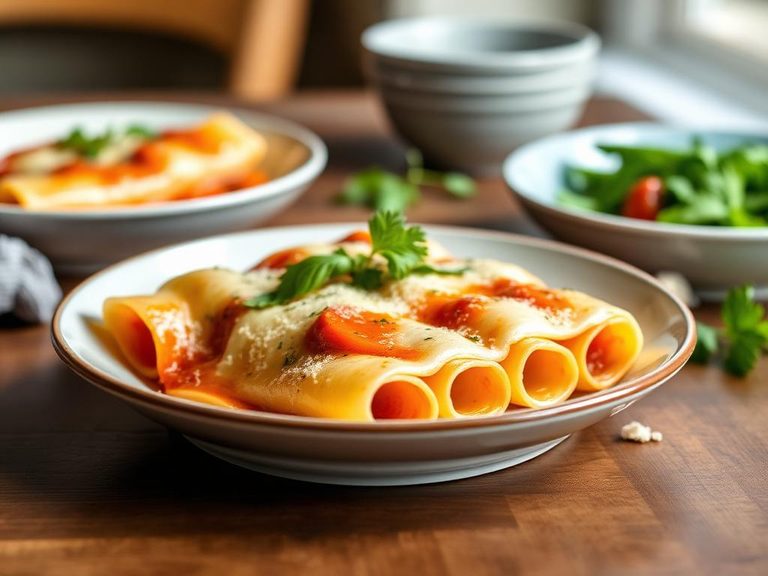
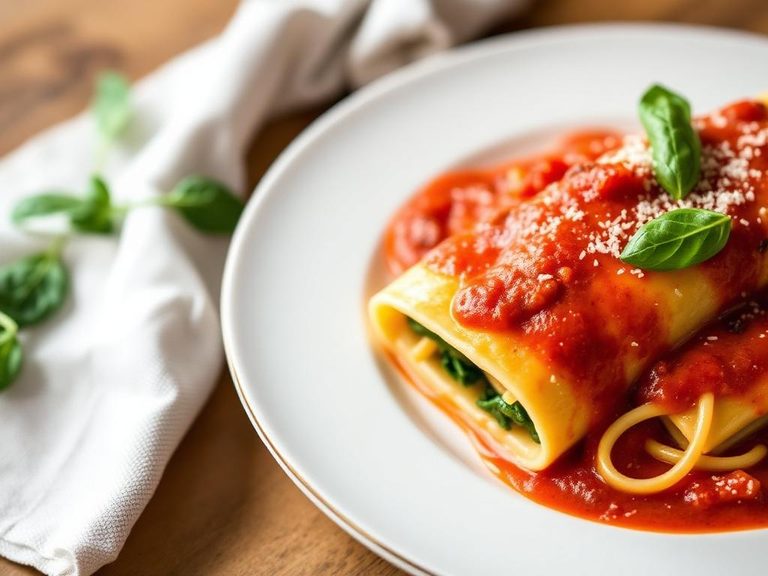
Manicotti are large, ridged pasta tubes generously stuffed with a creamy ricotta cheese filling and baked under a blanket of vibrant tomato sauce. The texture is a delightful contrast between the tender, sauce-soaked pasta, the smooth, rich cheese center, and the slightly caramelized top. Nutritionally, it offers a balanced mix of protein and carbohydrates, making it a satisfying vegetarian centerpiece.
Calorie split: 20% protein · 42% carbs · 38% fat
↓ Full nutrition💚 Why it's loved
People adore it for the comforting, hearty combination of soft pasta, rich cheese, and tangy tomato sauce. It's a beloved staple of Italian-American cuisine, offering a sense of warmth and home-cooked tradition.
⚠️ Watch-outs & how to enjoy it better
The dish can be high in sodium from the pasta, cheese, and sauce, and the refined carbohydrates may cause blood sugar spikes. To counteract this, pair it with a large, leafy green salad dressed with olive oil to add fiber and healthy fats, which slow digestion. Be mindful of portion size, as the calorie density can be high.
Key benefits
- Good source of protein from cheese filling
- Provides energy from complex carbohydrates
- Can be a meatless main dish
- Contains calcium from dairy components
- Often includes tomato sauce with lycopene
🍽️ Popular dishes
🌍 Where it's eaten
💡 Did you know?
The name 'manicotti' comes from the Italian word for 'sleeves,' referring to the tube shape of the pasta, which is traditionally made from a crepe-like batter rather than a dough.
Full nutrition (USDA data · scales with serving)
| Water | 67.6 g |
| Energy | 153 kcal |
| Protein | 7.6 g |
| Total lipid (fat) | 6.6 g |
| Carbohydrate, by difference | 16.2 g |
| Fiber, total dietary | 0.90 g |
| Total Sugars | 1.6 g |
| Calcium, Ca | 147 mg |
| Iron, Fe | 1.3 mg |
| Magnesium, Mg | 18.0 mg |
| Phosphorus, P | 139 mg |
| Potassium, K | 193 mg |
| Sodium, Na | 436 mg |
| Zinc, Zn | 0.81 mg |
| Copper, Cu | 0.06 mg |
| Selenium, Se | 9.6 ug |
| Vitamin C, total ascorbic acid | 1.9 mg |
| Thiamin | 0.14 mg |
| Riboflavin | 0.23 mg |
| Niacin | 1.2 mg |
| Vitamin B-6 | 0.08 mg |
| Folate, total | 26.0 ug |
| Folic acid | 14.0 ug |
| Folate, food | 11.0 ug |
| Folate, DFE | 36.0 ug |
| Choline, total | 33.4 mg |
| Vitamin B-12 | 0.40 ug |
| Vitamin B-12, added | 0.00 ug |
| Vitamin A, RAE | 78.0 ug |
| Retinol | 72.0 ug |
| Carotene, beta | 67.0 ug |
| Carotene, alpha | 0.00 ug |
| Cryptoxanthin, beta | 2.0 ug |
| Lycopene | 3494 ug |
| Lutein + zeaxanthin | 53.0 ug |
| Vitamin E (alpha-tocopherol) | 0.63 mg |
| Vitamin E, added | 0.00 mg |
| Vitamin D (D2 + D3) | 0.40 ug |
| Vitamin K (phylloquinone) | 2.0 ug |
| Alcohol, ethyl | 0.00 g |
| Caffeine | 0.00 mg |
| Theobromine | 0.00 mg |
Fat & fatty acid profile (per 100g)
| Fatty acids, total saturated | 3.5 g |
| SFA 4:0 | 0.11 g |
| SFA 6:0 | 0.09 g |
| SFA 8:0 | 0.06 g |
| SFA 10:0 | 0.14 g |
| SFA 12:0 | 0.16 g |
| SFA 14:0 | 0.52 g |
| SFA 16:0 | 1.8 g |
| SFA 18:0 | 0.58 g |
| Fatty acids, total monounsaturated | 1.6 g |
| MUFA 16:1 | 0.11 g |
| MUFA 18:1 | 1.6 g |
| MUFA 20:1 | 0.01 g |
| MUFA 22:1 | 0.00 g |
| Fatty acids, total polyunsaturated | 0.49 g |
| PUFA 18:2 | 0.45 g |
| PUFA 18:3 | 0.03 g |
| PUFA 18:4 | 0.00 g |
| PUFA 20:4 | 0.01 g |
| PUFA 20:5 n-3 (EPA) | 0.00 g |
| PUFA 22:5 n-3 (DPA) | 0.00 g |
| PUFA 22:6 n-3 (DHA) | 0.00 g |
| Cholesterol | 56.0 mg |
FAQ
Is manicotti gluten-free?
Traditional manicotti pasta is made from wheat flour and is not gluten-free. However, gluten-free versions made from rice or corn flour are increasingly available.
Can I make manicotti ahead of time?
Yes, you can assemble the stuffed manicotti, cover it, and refrigerate it for up to 24 hours before baking. You may need to add a few extra minutes to the baking time.
What's the difference between manicotti and cannelloni?
Manicotti is an Italian-American pasta, while cannelloni is a traditional Italian pasta. Cannelloni are smooth pasta tubes, whereas manicotti often have ridges. The fillings and sauces are often similar.
Nutrient density (calculated · NRF9.3)
Nutrient Rich Foods index: beneficial nutrients (protein, fiber, vitamins, minerals) minus saturated fat, added sugar & sodium, per 100 kcal.
NRF9.3 index — Fulgoni, Keast & Drewnowski, 2009. Computed from USDA nutrients.
Weight-loss friendliness (composite index)
Energy density 1.53 kcal/g · 20% calories from protein · 0.9 g fiber · 1.6 g sugar per 100 g.
Composite of energy density (Rolls et al., 1999), protein & fiber satiety, minus sugar. A calculated heuristic — ranks satiety-per-calorie, not a clinical measure.
Dietary load (calculated from USDA values)
Potential renal acid load. Positive = acid-forming, negative = alkaline-forming.
Sodium-to-potassium ratio: 2.26 (lower is better — aim for ≤ 1)
Sodium:potassium per WHO potassium guidance. Computed from USDA nutrients.