

Macaroni or noodles with cheese, from restaurant
Common food
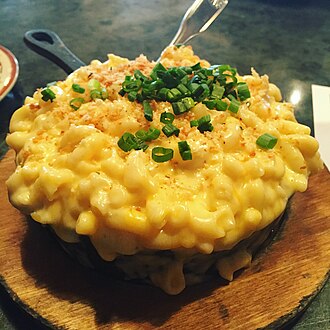
Photo: Wikipedia
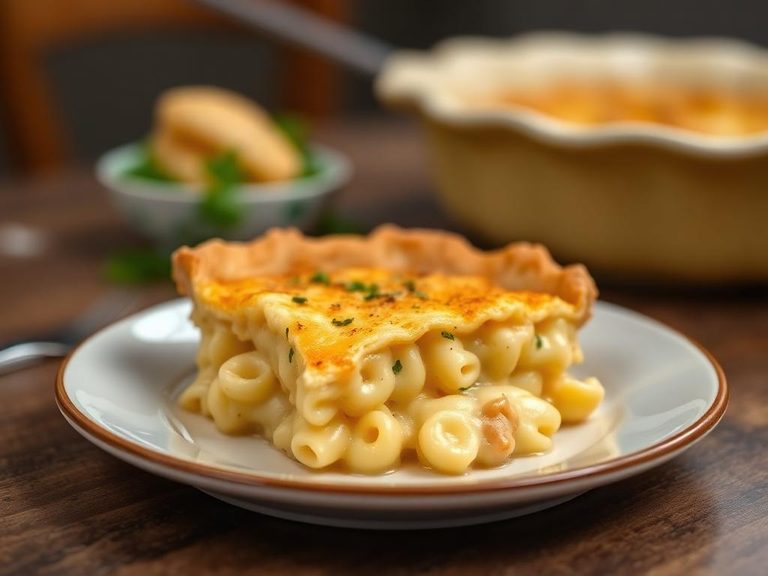
This is the classic comfort dish of macaroni pasta coated in a smooth, creamy cheese sauce, often served as a side or main course. The texture is soft and yielding, with the sauce clinging to each curve of the pasta, delivering a rich, savory, and slightly salty flavor. Nutritionally, it's a calorie-dense dish primarily from carbohydrates and fats, with a moderate amount of protein.
Calorie split: 14% protein · 50% carbs · 36% fat
↓ Full nutrition💚 Why it's loved
People adore its simple, savory, umami-rich flavor and the comforting, creamy texture that feels like a warm hug. It's a nostalgic staple in many Western cultures, beloved for its versatility as both a standalone meal and a side dish that pairs with almost anything.
⚠️ Watch-outs & how to enjoy it better
Its high carbohydrate and fat content can lead to blood sugar spikes and isn't ideal for low-carb or low-fat diets. The cheese sauce is often high in sodium and saturated fat, and it contains common allergens like wheat (gluten) and dairy. To counteract, pair it with a fiber-rich vegetable (like steamed broccoli) and lean protein (like grilled chicken) to slow digestion and balance the meal, and practice portion control.
Key benefits
- Quick source of energy from carbohydrates
- Provides calcium and protein from cheese
- Highly palatable, encouraging food intake
- Versatile base for adding vegetables or protein
- A familiar comfort food that can boost mood
🍽️ Popular dishes
🌍 Where it's eaten
💡 Did you know?
The first known recipe for a pasta and cheese casserole appeared in a 1391 Italian cookbook, but the dish we know today was popularized in the US after Kraft introduced its boxed version in 1937.
Full nutrition (USDA data · scales with serving)
| Water | 68.2 g |
| Energy | 151 kcal |
| Protein | 5.4 g |
| Total lipid (fat) | 6.1 g |
| Carbohydrate, by difference | 18.8 g |
| Fiber, total dietary | 1.1 g |
| Total Sugars | 3.1 g |
| Calcium, Ca | 99.0 mg |
| Iron, Fe | 0.68 mg |
| Magnesium, Mg | 19.0 mg |
| Phosphorus, P | 137 mg |
| Potassium, K | 135 mg |
| Sodium, Na | 361 mg |
| Zinc, Zn | 0.64 mg |
| Copper, Cu | 0.06 mg |
| Selenium, Se | 19.4 ug |
| Vitamin C, total ascorbic acid | 0.00 mg |
| Thiamin | 0.10 mg |
| Riboflavin | 0.25 mg |
| Niacin | 0.78 mg |
| Vitamin B-6 | 0.06 mg |
| Folate, total | 34.0 ug |
| Folic acid | 12.0 ug |
| Folate, food | 22.0 ug |
| Folate, DFE | 42.0 ug |
| Choline, total | 3.9 mg |
| Vitamin B-12 | 0.18 ug |
| Vitamin B-12, added | 0.00 ug |
| Vitamin A, RAE | 31.0 ug |
| Retinol | 30.0 ug |
| Carotene, beta | 9.0 ug |
| Carotene, alpha | 1.0 ug |
| Cryptoxanthin, beta | 0.00 ug |
| Lycopene | 0.00 ug |
| Lutein + zeaxanthin | 77.0 ug |
| Vitamin E (alpha-tocopherol) | 0.75 mg |
| Vitamin E, added | 0.00 mg |
| Vitamin D (D2 + D3) | 0.10 ug |
| Vitamin K (phylloquinone) | 0.50 ug |
| Alcohol, ethyl | 0.00 g |
| Caffeine | 0.00 mg |
| Theobromine | 0.00 mg |
Fat & fatty acid profile (per 100g)
| Fatty acids, total saturated | 2.1 g |
| SFA 4:0 | 0.06 g |
| SFA 6:0 | 0.05 g |
| SFA 8:0 | 0.03 g |
| SFA 10:0 | 0.07 g |
| SFA 12:0 | 0.08 g |
| SFA 14:0 | 0.27 g |
| SFA 16:0 | 1.1 g |
| SFA 18:0 | 0.43 g |
| Fatty acids, total monounsaturated | 2.0 g |
| MUFA 16:1 | 0.05 g |
| MUFA 18:1 | 1.8 g |
| MUFA 20:1 | 0.04 g |
| MUFA 22:1 | 0.00 g |
| Fatty acids, total polyunsaturated | 1.7 g |
| PUFA 18:2 | 1.4 g |
| PUFA 18:3 | 0.25 g |
| PUFA 18:4 | 0.00 g |
| PUFA 20:4 | 0.01 g |
| PUFA 20:5 n-3 (EPA) | 0.00 g |
| PUFA 22:5 n-3 (DPA) | 0.00 g |
| PUFA 22:6 n-3 (DHA) | 0.00 g |
| Cholesterol | 10.0 mg |
FAQ
Is macaroni and cheese a good source of protein?
It provides a moderate amount of protein (about 5-7g per 100g) from the cheese and pasta, but it's not a high-protein dish. For a protein boost, add meat, beans, or legumes.
Why is restaurant mac and cheese often higher in calories than homemade?
Restaurants typically use richer cheese blends, more butter, heavy cream, and larger portions, significantly increasing the fat and calorie content compared to a standard homemade version.
Can I make it healthier?
Yes. Use whole-grain or legume-based pasta for more fiber, reduce cheese and use stronger-flavored varieties like sharp cheddar, incorporate pureed vegetables like butternut squash into the sauce, and add lean protein.
Nutrient density (calculated · NRF9.3)
Nutrient Rich Foods index: beneficial nutrients (protein, fiber, vitamins, minerals) minus saturated fat, added sugar & sodium, per 100 kcal.
NRF9.3 index — Fulgoni, Keast & Drewnowski, 2009. Computed from USDA nutrients.
Weight-loss friendliness (composite index)
Energy density 1.51 kcal/g · 14% calories from protein · 1.1 g fiber · 3.1 g sugar per 100 g.
Composite of energy density (Rolls et al., 1999), protein & fiber satiety, minus sugar. A calculated heuristic — ranks satiety-per-calorie, not a clinical measure.
Dietary load (calculated from USDA values)
Potential renal acid load. Positive = acid-forming, negative = alkaline-forming.
Sodium-to-potassium ratio: 2.67 (lower is better — aim for ≤ 1)
Sodium:potassium per WHO potassium guidance. Computed from USDA nutrients.