

Infant formula, Enfamil ProSobee, powder, made with tap water
Common food

Photo: Wikipedia
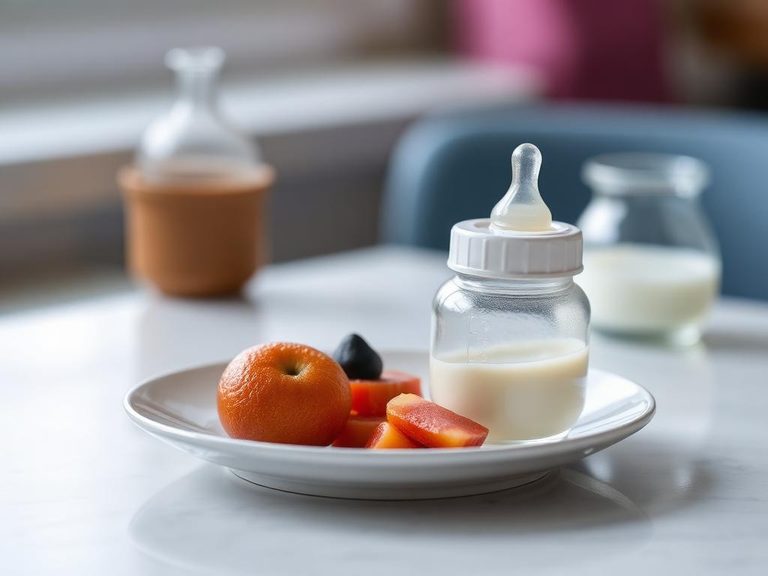
This is a soy-based infant formula powder, designed to be mixed with water to create a complete, hypoallergenic nutritional drink for babies. The prepared formula has a mild, slightly sweet taste with a smooth, milky texture, and is nutritionally fortified to support infant growth without using cow's milk proteins.
Calorie split: 10% protein · 43% carbs · 47% fat
↓ Full nutrition💚 Why it's loved
Parents of infants with cow's milk protein allergy or lactose intolerance rely on it as a safe, nutritionally complete alternative that allows their baby to thrive. It's valued for providing peace of mind and a familiar feeding routine.
⚠️ Watch-outs & how to enjoy it better
Some infants may find the soy-based taste less palatable than standard formulas, and there are ongoing discussions about phytoestrogens in soy for very young infants. To mitigate any taste aversion, ensure proper mixing temperature and consistency, and consult a pediatrician if you have concerns about soy isoflavones.
Key benefits
- Soy-based protein for cow's milk allergy
- Complete nutrition for infant development
- Lactose-free carbohydrate source
- Fortified with essential vitamins and minerals
- Hypoallergenic for sensitive digestive systems
🍽️ Popular dishes



🌍 Where it's eaten
💡 Did you know?
ProSobee was one of the first major commercial soy-based formulas introduced in the United States, developed specifically for infants who couldn't tolerate the proteins or sugars in cow's milk-based formulas.
Full nutrition (USDA data · scales with serving)
| Water | 87.3 g |
| Energy | 66.0 kcal |
| Protein | 1.6 g |
| Total lipid (fat) | 3.5 g |
| Carbohydrate, by difference | 7.1 g |
| Fiber, total dietary | 0.00 g |
| Total Sugars | 6.9 g |
| Calcium, Ca | 71.0 mg |
| Iron, Fe | 1.2 mg |
| Magnesium, Mg | 6.0 mg |
| Phosphorus, P | 45.0 mg |
| Potassium, K | 79.0 mg |
| Sodium, Na | 27.0 mg |
| Zinc, Zn | 0.80 mg |
| Copper, Cu | 0.06 mg |
| Selenium, Se | 1.8 ug |
| Vitamin C, total ascorbic acid | 7.9 mg |
| Thiamin | 0.05 mg |
| Riboflavin | 0.06 mg |
| Niacin | 0.66 mg |
| Vitamin B-6 | 0.04 mg |
| Folate, total | 10.0 ug |
| Folic acid | 10.0 ug |
| Folate, food | 0.00 ug |
| Folate, DFE | 18.0 ug |
| Choline, total | 15.8 mg |
| Vitamin B-12 | 0.20 ug |
| Vitamin B-12, added | 0.20 ug |
| Vitamin A, RAE | 60.0 ug |
| Retinol | 60.0 ug |
| Carotene, beta | 0.00 ug |
| Carotene, alpha | 0.00 ug |
| Cryptoxanthin, beta | 0.00 ug |
| Lycopene | 0.00 ug |
| Lutein + zeaxanthin | 0.00 ug |
| Vitamin E (alpha-tocopherol) | 0.60 mg |
| Vitamin E, added | 0.60 mg |
| Vitamin D (D2 + D3) | 1.0 ug |
| Vitamin K (phylloquinone) | 6.0 ug |
| Alcohol, ethyl | 0.00 g |
| Caffeine | 0.00 mg |
| Theobromine | 0.00 mg |
Fat & fatty acid profile (per 100g)
| Fatty acids, total saturated | 1.5 g |
| SFA 4:0 | 0.00 g |
| SFA 6:0 | 0.01 g |
| SFA 8:0 | 0.06 g |
| SFA 10:0 | 0.04 g |
| SFA 12:0 | 0.31 g |
| SFA 14:0 | 0.14 g |
| SFA 16:0 | 0.76 g |
| SFA 18:0 | 0.13 g |
| Fatty acids, total monounsaturated | 1.2 g |
| MUFA 16:1 | 0.01 g |
| MUFA 18:1 | 1.2 g |
| MUFA 20:1 | 0.01 g |
| MUFA 22:1 | 0.00 g |
| Fatty acids, total polyunsaturated | 0.66 g |
| PUFA 18:2 | 0.53 g |
| PUFA 18:3 | 0.05 g |
| PUFA 18:4 | 0.00 g |
| PUFA 20:4 | 0.02 g |
| PUFA 20:5 n-3 (EPA) | 0.00 g |
| PUFA 22:5 n-3 (DPA) | 0.00 g |
| PUFA 22:6 n-3 (DHA) | 0.01 g |
| Cholesterol | 0.00 mg |
FAQ
What is the main difference between this and regular infant formula?
The primary difference is the protein source. This formula uses soy protein isolate instead of cow's milk proteins (whey and casein), making it suitable for infants with confirmed cow's milk protein allergy or galactosemia.
Is it safe to use tap water to mix the formula?
The FDA and CDC recommend using safe drinking water. If your tap water is municipally treated and safe to drink, it is generally acceptable. However, some parents prefer to use boiled, cooled water or nursery water for added caution, especially for very young infants.
At what age can my baby start using this formula?
Soy-based formulas like ProSobee are approved for use from birth onward, but they are typically recommended by a pediatrician specifically for infants with diagnosed cow's milk protein allergy or certain metabolic conditions, not as a first-choice formula for healthy, full-term infants.
Nutrient density (calculated · NRF9.3)
Nutrient Rich Foods index: beneficial nutrients (protein, fiber, vitamins, minerals) minus saturated fat, added sugar & sodium, per 100 kcal.
NRF9.3 index — Fulgoni, Keast & Drewnowski, 2009. Computed from USDA nutrients.
Weight-loss friendliness (composite index)
Energy density 0.66 kcal/g · 10% calories from protein · 0.0 g fiber · 6.9 g sugar per 100 g.
Composite of energy density (Rolls et al., 1999), protein & fiber satiety, minus sugar. A calculated heuristic — ranks satiety-per-calorie, not a clinical measure.
Dietary load (calculated from USDA values)
Potential renal acid load. Positive = acid-forming, negative = alkaline-forming.
Sodium-to-potassium ratio: 0.34 (lower is better — aim for ≤ 1)
Sodium:potassium per WHO potassium guidance. Computed from USDA nutrients.