

Iced Coffee, brewed
Common food

Photo: Wikipedia
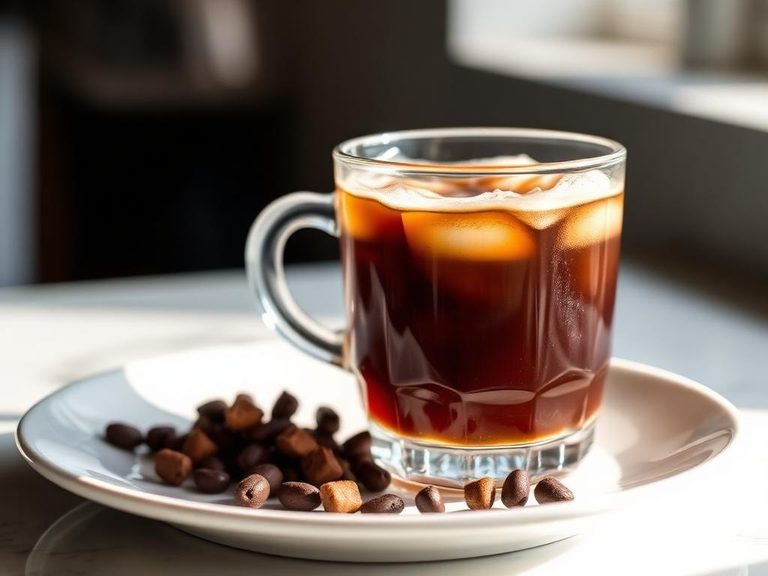
Iced coffee is brewed coffee served chilled, often over ice, delivering a crisp, refreshing jolt with a smooth, slightly bitter flavor profile. Its near-zero calorie count makes it a guilt-free indulgence, offering the full aromatic experience of coffee without the warmth. The texture is light and fluid, perfect for sipping on a hot day.
Calorie split: 67% protein · 0% carbs · 33% fat
↓ Full nutrition💚 Why it's loved
People adore iced coffee for its ability to deliver the complex, roasted notes of coffee in a refreshing, thirst-quenching format. It's a cultural staple for productivity and social gatherings, offering a cool ritual that fits any time of day.
⚠️ Watch-outs & how to enjoy it better
The primary concern is the high caffeine content, which can cause jitters or disrupt sleep in sensitive individuals. To mitigate this, opt for decaf versions or limit consumption to mornings. For those with sensitive teeth, the cold temperature can cause discomfort; drinking through a straw can help.
Key benefits
- Zero sugar and negligible calories support calorie-conscious diets
- Provides a quick mental alertness boost from caffeine
- Hydrating alternative to sugary cold beverages
- Can be customized endlessly with spices or extracts
🍽️ Popular dishes


🌍 Where it's eaten
💡 Did you know?
The world record for the largest iced coffee was set in 2014 in South Africa, with a single cup holding over 2,000 liters.
Full nutrition (USDA data · scales with serving)
| Water | 99.5 g |
| Energy | 1.0 kcal |
| Protein | 0.09 g |
| Total lipid (fat) | 0.02 g |
| Carbohydrate, by difference | 0.00 g |
| Fiber, total dietary | 0.00 g |
| Total Sugars | 0.00 g |
| Calcium, Ca | 2.0 mg |
| Iron, Fe | 0.01 mg |
| Magnesium, Mg | 3.0 mg |
| Phosphorus, P | 2.0 mg |
| Potassium, K | 38.0 mg |
| Sodium, Na | 2.0 mg |
| Zinc, Zn | 0.02 mg |
| Copper, Cu | 0.00 mg |
| Selenium, Se | 0.00 ug |
| Vitamin C, total ascorbic acid | 0.00 mg |
| Thiamin | 0.01 mg |
| Riboflavin | 0.06 mg |
| Niacin | 0.15 mg |
| Vitamin B-6 | 0.00 mg |
| Folate, total | 2.0 ug |
| Folic acid | 0.00 ug |
| Folate, food | 2.0 ug |
| Folate, DFE | 2.0 ug |
| Choline, total | 2.0 mg |
| Vitamin B-12 | 0.00 ug |
| Vitamin B-12, added | 0.00 ug |
| Vitamin A, RAE | 0.00 ug |
| Retinol | 0.00 ug |
| Carotene, beta | 0.00 ug |
| Carotene, alpha | 0.00 ug |
| Cryptoxanthin, beta | 0.00 ug |
| Lycopene | 0.00 ug |
| Lutein + zeaxanthin | 0.00 ug |
| Vitamin E (alpha-tocopherol) | 0.01 mg |
| Vitamin E, added | 0.00 mg |
| Vitamin D (D2 + D3) | 0.00 ug |
| Vitamin K (phylloquinone) | 0.10 ug |
| Alcohol, ethyl | 0.00 g |
| Caffeine | 31.0 mg |
| Theobromine | 0.00 mg |
Fat & fatty acid profile (per 100g)
| Fatty acids, total saturated | 0.00 g |
| SFA 4:0 | 0.00 g |
| SFA 6:0 | 0.00 g |
| SFA 8:0 | 0.00 g |
| SFA 10:0 | 0.00 g |
| SFA 12:0 | 0.00 g |
| SFA 14:0 | 0.00 g |
| SFA 16:0 | 0.00 g |
| SFA 18:0 | 0.00 g |
| Fatty acids, total monounsaturated | 0.01 g |
| MUFA 16:1 | 0.00 g |
| MUFA 18:1 | 0.00 g |
| MUFA 20:1 | 0.00 g |
| MUFA 22:1 | 0.00 g |
| Fatty acids, total polyunsaturated | 0.00 g |
| PUFA 18:2 | 0.00 g |
| PUFA 18:3 | 0.00 g |
| PUFA 18:4 | 0.00 g |
| PUFA 20:4 | 0.00 g |
| PUFA 20:5 n-3 (EPA) | 0.00 g |
| PUFA 22:5 n-3 (DPA) | 0.00 g |
| PUFA 22:6 n-3 (DHA) | 0.00 g |
| Cholesterol | 0.00 mg |
FAQ
Is iced coffee just cold hot coffee?
Not exactly. While some is brewed hot and chilled, methods like cold brew involve steeping grounds in cold water for 12-24 hours, resulting in a smoother, less acidic flavor.
Does iced coffee have less caffeine than hot coffee?
Generally, yes. Hot water extracts caffeine more efficiently. A cold brew concentrate can be strong, but a standard iced coffee typically has about 20% less caffeine than its hot counterpart of the same volume.
Can I make good iced coffee at home?
Absolutely. The key is to brew coffee at double strength to account for ice dilution, or make a cold brew concentrate. Always chill the coffee before pouring over ice to prevent a watery drink.
Nutrient density (calculated · NRF9.3)
Nutrient Rich Foods index: beneficial nutrients (protein, fiber, vitamins, minerals) minus saturated fat, added sugar & sodium, per 100 kcal.
NRF9.3 index — Fulgoni, Keast & Drewnowski, 2009. Computed from USDA nutrients.
Weight-loss friendliness (composite index)
Energy density 0.01 kcal/g · 36% calories from protein · 0.0 g fiber · 0.0 g sugar per 100 g.
Composite of energy density (Rolls et al., 1999), protein & fiber satiety, minus sugar. A calculated heuristic — ranks satiety-per-calorie, not a clinical measure.
Dietary load (calculated from USDA values)
Potential renal acid load. Positive = acid-forming, negative = alkaline-forming.
Sodium-to-potassium ratio: 0.05 (lower is better — aim for ≤ 1)
Sodium:potassium per WHO potassium guidance. Computed from USDA nutrients.