Honey
Common food
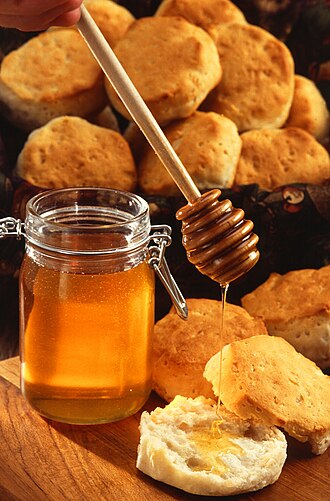
Photo: Wikipedia
Honey is a thick, golden syrup produced by bees from flower nectar, renowned for its complex floral sweetness that ranges from light and floral to deep and earthy. With 304 kcal per 100g and an almost pure carbohydrate profile (82.4g carbs, 82.12g sugar), it is one of the most energy-dense natural sweeteners available. Its viscous, sticky texture and unique enzymatic composition distinguish it from refined sugars.
💚 Why it's loved
People love honey for its nuanced, floral sweetness that elevates everything from tea to cheese boards, offering a depth of flavor that plain sugar cannot match. It holds deep cultural and historical significance, symbolizing everything from prosperity to healing across civilizations.
⚠️ Watch-outs & how to enjoy it better
Honey is extremely high in sugar (82.12g per 100g) and can cause rapid blood-sugar spikes, making it unsuitable for diabetics or those on low-glycemic diets. To counteract this, pair it with protein or healthy fats (like nuts or yogurt) and practice strict portion control (limit to 1 tablespoon per serving).
Key benefits
- Rich in antioxidants like flavonoids and phenolic acids
- Contains trace enzymes and minerals not found in refined sugar
- Natural cough suppressant with antimicrobial properties
- Provides quick, easily digestible energy for athletes
- May support gut health through prebiotic oligosaccharides
🍽️ Popular dishes


🌍 Where it's eaten
💡 Did you know?
Archaeologists have found 3,000-year-old honey in Egyptian tombs that was still perfectly edible, thanks to its low moisture content and natural acidity.
Full nutrition (scales with serving)
| Water | 17.1 g |
| Energy | 304 kcal |
| Protein | 0.30 g |
| Total lipid (fat) | 0.00 g |
| Carbohydrate, by difference | 82.4 g |
| Fiber, total dietary | 0.20 g |
| Total Sugars | 82.1 g |
| Calcium, Ca | 6.0 mg |
| Iron, Fe | 0.42 mg |
| Magnesium, Mg | 2.0 mg |
| Phosphorus, P | 4.0 mg |
| Potassium, K | 52.0 mg |
| Sodium, Na | 4.0 mg |
| Zinc, Zn | 0.22 mg |
| Copper, Cu | 0.04 mg |
| Selenium, Se | 0.80 ug |
| Vitamin C, total ascorbic acid | 0.50 mg |
| Thiamin | 0.00 mg |
| Riboflavin | 0.04 mg |
| Niacin | 0.12 mg |
| Vitamin B-6 | 0.02 mg |
| Folate, total | 2.0 ug |
| Folic acid | 0.00 ug |
| Folate, food | 2.0 ug |
| Folate, DFE | 2.0 ug |
| Choline, total | 2.2 mg |
| Vitamin B-12 | 0.00 ug |
| Vitamin B-12, added | 0.00 ug |
| Vitamin A, RAE | 0.00 ug |
| Retinol | 0.00 ug |
| Carotene, beta | 0.00 ug |
| Carotene, alpha | 0.00 ug |
| Cryptoxanthin, beta | 0.00 ug |
| Lycopene | 0.00 ug |
| Lutein + zeaxanthin | 0.00 ug |
| Vitamin E (alpha-tocopherol) | 0.00 mg |
| Vitamin E, added | 0.00 mg |
| Vitamin D (D2 + D3) | 0.00 ug |
| Vitamin K (phylloquinone) | 0.00 ug |
| Fatty acids, total saturated | 0.00 g |
| SFA 4:0 | 0.00 g |
| SFA 6:0 | 0.00 g |
| SFA 8:0 | 0.00 g |
| SFA 10:0 | 0.00 g |
| SFA 12:0 | 0.00 g |
| SFA 14:0 | 0.00 g |
| SFA 16:0 | 0.00 g |
| SFA 18:0 | 0.00 g |
| Fatty acids, total monounsaturated | 0.00 g |
| MUFA 16:1 | 0.00 g |
| MUFA 18:1 | 0.00 g |
| MUFA 20:1 | 0.00 g |
| MUFA 22:1 | 0.00 g |
| Fatty acids, total polyunsaturated | 0.00 g |
| PUFA 18:2 | 0.00 g |
| PUFA 18:3 | 0.00 g |
| PUFA 18:4 | 0.00 g |
| PUFA 20:4 | 0.00 g |
| PUFA 20:5 n-3 (EPA) | 0.00 g |
| PUFA 22:5 n-3 (DPA) | 0.00 g |
| PUFA 22:6 n-3 (DHA) | 0.00 g |
| Cholesterol | 0.00 mg |
| Alcohol, ethyl | 0.00 g |
| Caffeine | 0.00 mg |
| Theobromine | 0.00 mg |
FAQ
Is honey healthier than sugar?
Honey contains trace antioxidants and enzymes absent in refined sugar, but it is still a concentrated sugar with 82.12g of sugar per 100g. It should be used in moderation, not as a 'free' health food.
Can infants eat honey?
No, honey should never be given to infants under 12 months due to the risk of botulism, a rare but serious illness caused by Clostridium botulinum spores that can thrive in an infant's immature digestive system.
How should honey be stored?
Store honey in a sealed container at room temperature. It does not spoil but may crystallize over time; gently warming the jar in warm water will restore its liquid state without destroying its nutrients.