

Hog maws
Common food

Photo: Wikipedia
Hog maws are the cleaned stomach lining of a pig, prized for their uniquely springy, chewy texture and mild, savory flavor that readily absorbs surrounding seasonings. Nutritionally, they are a dense source of protein and fat with virtually no carbohydrates. Their preparation, often slow-cooked or braised, transforms them into a tender, gelatinous delicacy.
Calorie split: 42% protein · 0% carbs · 58% fat
↓ Full nutrition💚 Why it's loved
People love hog maws for their satisfying, toothsome chew and ability to soak up rich, spicy, or smoky flavors from broths and sauces. They are a cornerstone of soul food and Southern U.S. cuisine, representing tradition and resourceful cooking.
⚠️ Watch-outs & how to enjoy it better
The high fat and cholesterol content may be a concern for some diets. To mitigate, practice strict portion control and pair with fiber-rich sides like collard greens or black-eyed peas. Ensure thorough cleaning and long, slow cooking to achieve the best texture and food safety.
Key benefits
- High in complete protein
- Contains connective tissue for collagen
- Zero carbohydrates or sugar
- Source of B vitamins like B12
- Traditional, nose-to-tail ingredient
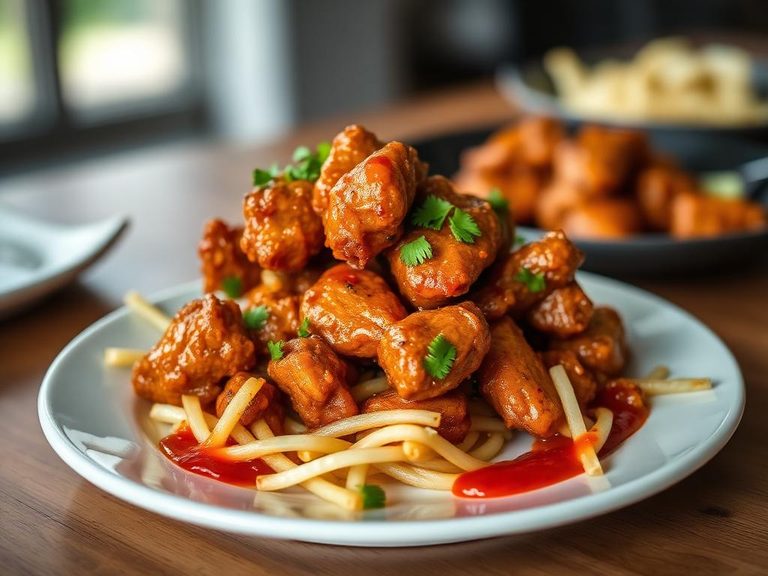
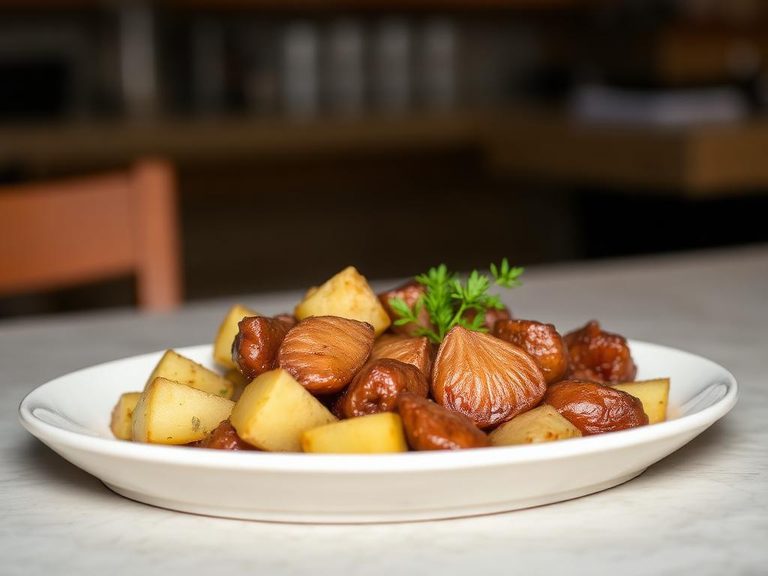
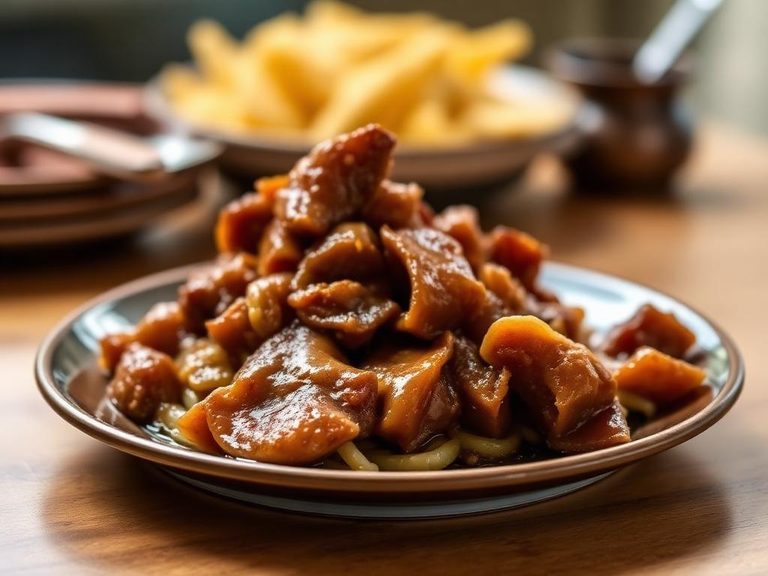
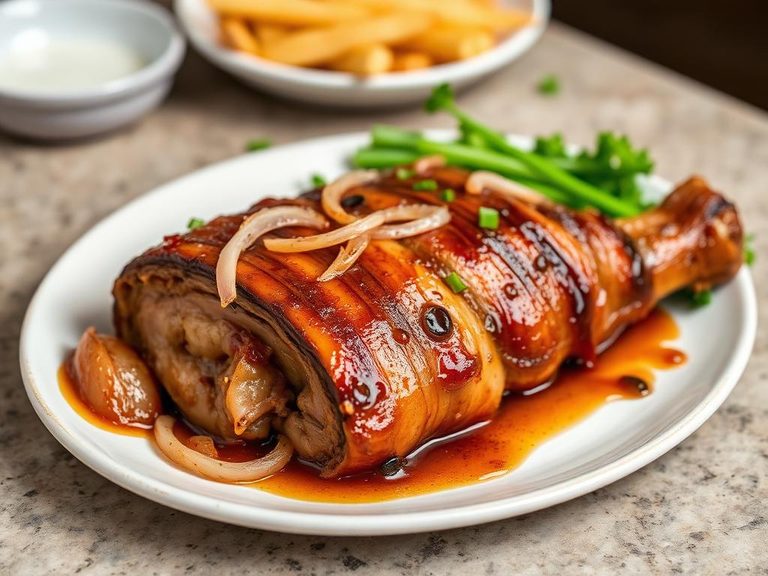
🍽️ Popular dishes
🌍 Where it's eaten
💡 Did you know?
The term 'chitterlings' is believed to derive from the Latin 'chitterlingus,' meaning 'intestine,' and the dish has been documented in England since at least the 14th century.
Full nutrition (USDA data · scales with serving)
| Water | 57.0 g |
| Energy | 250 kcal |
| Protein | 26.5 g |
| Total lipid (fat) | 16.0 g |
| Carbohydrate, by difference | 0.00 g |
| Fiber, total dietary | 0.00 g |
| Total Sugars | 0.00 g |
| Calcium, Ca | 17.0 mg |
| Iron, Fe | 0.95 mg |
| Magnesium, Mg | 10.0 mg |
| Phosphorus, P | 143 mg |
| Potassium, K | 99.0 mg |
| Sodium, Na | 541 mg |
| Zinc, Zn | 2.6 mg |
| Copper, Cu | 0.20 mg |
| Selenium, Se | 49.0 ug |
| Vitamin C, total ascorbic acid | 0.00 mg |
| Thiamin | 0.05 mg |
| Riboflavin | 0.17 mg |
| Niacin | 1.8 mg |
| Vitamin B-6 | 0.02 mg |
| Folate, total | 3.0 ug |
| Folic acid | 0.00 ug |
| Folate, food | 3.0 ug |
| Folate, DFE | 3.0 ug |
| Choline, total | 307 mg |
| Vitamin B-12 | 0.28 ug |
| Vitamin B-12, added | 0.00 ug |
| Vitamin A, RAE | 0.00 ug |
| Retinol | 0.00 ug |
| Carotene, beta | 0.00 ug |
| Carotene, alpha | 0.00 ug |
| Cryptoxanthin, beta | 0.00 ug |
| Lycopene | 0.00 ug |
| Lutein + zeaxanthin | 0.00 ug |
| Vitamin E (alpha-tocopherol) | 0.06 mg |
| Vitamin E, added | 0.00 mg |
| Vitamin D (D2 + D3) | 0.00 ug |
| Vitamin K (phylloquinone) | 0.00 ug |
| Alcohol, ethyl | 0.00 g |
| Caffeine | 0.00 mg |
| Theobromine | 0.00 mg |
Fat & fatty acid profile (per 100g)
| Fatty acids, total saturated | 6.3 g |
| SFA 4:0 | 0.00 g |
| SFA 6:0 | 0.00 g |
| SFA 8:0 | 0.00 g |
| SFA 10:0 | 0.00 g |
| SFA 12:0 | 0.00 g |
| SFA 14:0 | 0.20 g |
| SFA 16:0 | 3.6 g |
| SFA 18:0 | 2.5 g |
| Fatty acids, total monounsaturated | 5.7 g |
| MUFA 16:1 | 0.32 g |
| MUFA 18:1 | 5.2 g |
| MUFA 20:1 | 0.11 g |
| MUFA 22:1 | 0.00 g |
| Fatty acids, total polyunsaturated | 1.4 g |
| PUFA 18:2 | 1.1 g |
| PUFA 18:3 | 0.03 g |
| PUFA 18:4 | 0.00 g |
| PUFA 20:4 | 0.17 g |
| PUFA 20:5 n-3 (EPA) | 0.00 g |
| PUFA 22:5 n-3 (DPA) | 0.00 g |
| PUFA 22:6 n-3 (DHA) | 0.00 g |
| Cholesterol | 351 mg |
FAQ
How do you clean hog maws before cooking?
They require meticulous cleaning: rinse thoroughly, then soak in cold water with vinegar or lemon juice for several hours, scrubbing to remove any residue. Many cooks boil them in a first batch of water with aromatics, then discard that water for a second, longer cook.
What is the texture of hog maws like?
When properly cooked, they have a distinct, springy, and slightly chewy texture, similar to a very tender calamari or a dense, gelatinous noodle. Under-cooked maws will be unpleasantly tough.
Are hog maws the same as chitterlings?
Not exactly. Hog maws are the stomach lining, while chitterlings (or 'chitlins') are the small intestines. Both are offal dishes from the same animal and are often prepared similarly, but they are different parts.
Nutrient density (calculated · NRF9.3)
Nutrient Rich Foods index: beneficial nutrients (protein, fiber, vitamins, minerals) minus saturated fat, added sugar & sodium, per 100 kcal.
NRF9.3 index — Fulgoni, Keast & Drewnowski, 2009. Computed from USDA nutrients.
Weight-loss friendliness (composite index)
Energy density 2.50 kcal/g · 42% calories from protein · 0.0 g fiber · 0.0 g sugar per 100 g.
Composite of energy density (Rolls et al., 1999), protein & fiber satiety, minus sugar. A calculated heuristic — ranks satiety-per-calorie, not a clinical measure.
Dietary load (calculated from USDA values)
Potential renal acid load. Positive = acid-forming, negative = alkaline-forming.
Sodium-to-potassium ratio: 5.46 (lower is better — aim for ≤ 1)
Sodium:potassium per WHO potassium guidance. Computed from USDA nutrients.