

Hamburger wrap sandwich, from fast food
Common food

Photo: Wikipedia
A hamburger wrap sandwich is a fast-food staple where a seasoned beef patty, often with cheese, lettuce, and sauce, is tightly rolled inside a soft flour tortilla instead of being served on a bun. The experience is a satisfying mix of the tortilla's soft chew, the juicy, savory meat, and the cool crunch of fresh toppings. Nutritionally, it delivers a solid protein punch (16.86g per 100g) but is also energy-dense and high in fat.
Calorie split: 23% protein · 28% carbs · 49% fat
↓ Full nutrition💚 Why it's loved
People love it for the familiar, craveable flavors of a classic hamburger in a neater, less messy handheld format. It's a versatile canvas for customization with different sauces, cheeses, and veggies, and represents a globalized take on American fast-food culture.
⚠️ Watch-outs & how to enjoy it better
The wrap can be high in sodium and saturated fat, which may concern those monitoring heart health or blood pressure. The refined flour tortilla and sugary sauces can cause blood-sugar spikes; to counteract, pair it with a side salad, choose mustard or salsa over creamy sauces, and be mindful of portion size.
Key benefits
- High-quality protein source for muscle maintenance.
- Provides quick energy from carbohydrates.
- Portable and convenient for on-the-go meals.
- Contains some dietary fiber and essential minerals.
- Offers a balanced mix of macronutrients in one package.
🍽️ Popular dishes
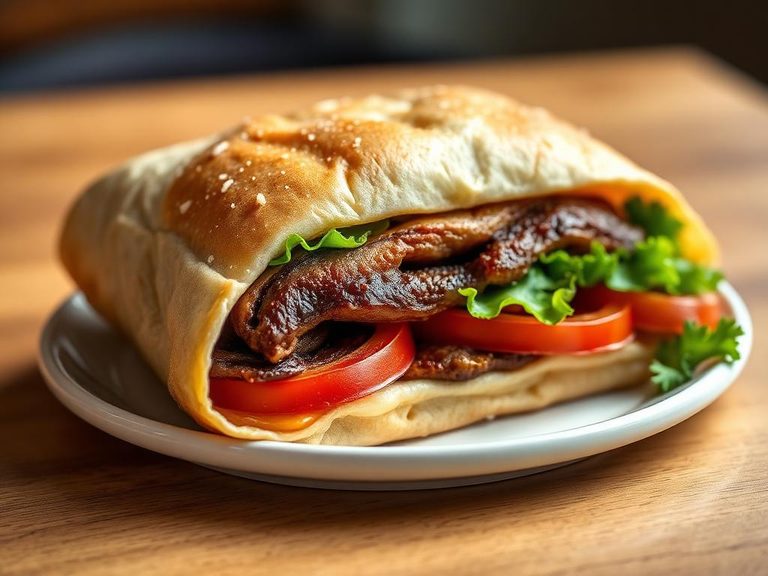
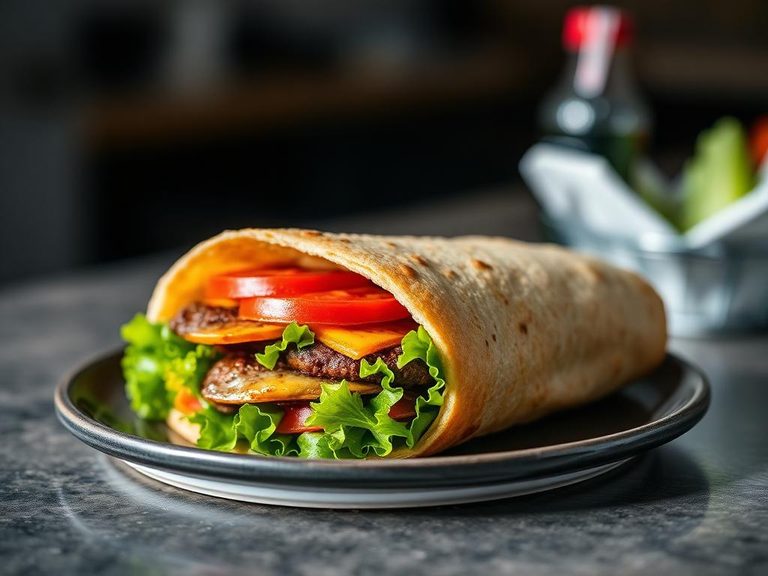
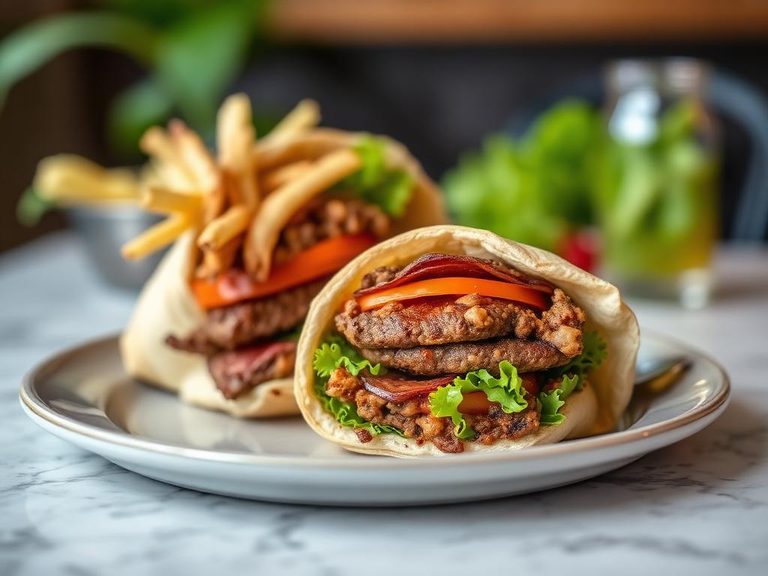


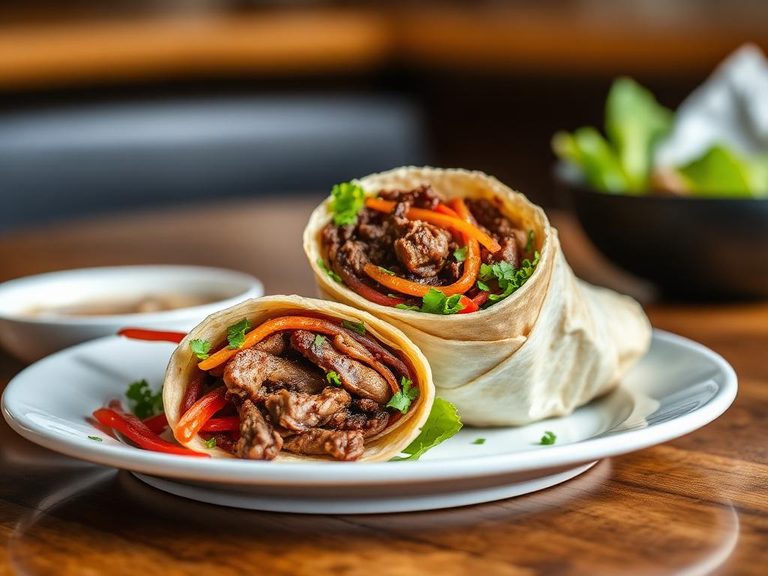
🌍 Where it's eaten
💡 Did you know?
The wrap format was popularized in the U.S. in the 1990s as a 'healthier' fast-food alternative, though many wraps contain more calories and sodium than their burger-in-a-bun counterparts.
Full nutrition (USDA data · scales with serving)
| Water | 44.7 g |
| Energy | 299 kcal |
| Protein | 16.9 g |
| Total lipid (fat) | 16.1 g |
| Carbohydrate, by difference | 20.4 g |
| Fiber, total dietary | 1.4 g |
| Total Sugars | 1.5 g |
| Calcium, Ca | 67.0 mg |
| Iron, Fe | 2.9 mg |
| Magnesium, Mg | 20.0 mg |
| Phosphorus, P | 187 mg |
| Potassium, K | 230 mg |
| Sodium, Na | 440 mg |
| Zinc, Zn | 3.0 mg |
| Copper, Cu | 0.09 mg |
| Selenium, Se | 21.8 ug |
| Vitamin C, total ascorbic acid | 0.00 mg |
| Thiamin | 0.23 mg |
| Riboflavin | 0.22 mg |
| Niacin | 4.9 mg |
| Vitamin B-6 | 0.28 mg |
| Folate, total | 51.0 ug |
| Folic acid | 33.0 ug |
| Folate, food | 18.0 ug |
| Folate, DFE | 74.0 ug |
| Choline, total | 46.9 mg |
| Vitamin B-12 | 1.6 ug |
| Vitamin B-12, added | 0.00 ug |
| Vitamin A, RAE | 0.00 ug |
| Retinol | 0.00 ug |
| Carotene, beta | 0.00 ug |
| Carotene, alpha | 0.00 ug |
| Cryptoxanthin, beta | 0.00 ug |
| Lycopene | 0.00 ug |
| Lutein + zeaxanthin | 4.0 ug |
| Vitamin E (alpha-tocopherol) | 0.00 mg |
| Vitamin E, added | 0.00 mg |
| Vitamin D (D2 + D3) | 0.10 ug |
| Vitamin K (phylloquinone) | 4.3 ug |
| Alcohol, ethyl | 0.00 g |
| Caffeine | 0.00 mg |
| Theobromine | 0.00 mg |
Fat & fatty acid profile (per 100g)
| Fatty acids, total saturated | 6.4 g |
| SFA 4:0 | 0.00 g |
| SFA 6:0 | 0.00 g |
| SFA 8:0 | 0.00 g |
| SFA 10:0 | 0.00 g |
| SFA 12:0 | 0.00 g |
| SFA 14:0 | 0.42 g |
| SFA 16:0 | 3.6 g |
| SFA 18:0 | 2.1 g |
| Fatty acids, total monounsaturated | 6.2 g |
| MUFA 16:1 | 0.41 g |
| MUFA 18:1 | 5.7 g |
| MUFA 20:1 | 0.03 g |
| MUFA 22:1 | 0.00 g |
| Fatty acids, total polyunsaturated | 1.3 g |
| PUFA 18:2 | 1.2 g |
| PUFA 18:3 | 0.12 g |
| PUFA 18:4 | 0.00 g |
| PUFA 20:4 | 0.00 g |
| PUFA 20:5 n-3 (EPA) | 0.00 g |
| PUFA 22:5 n-3 (DPA) | 0.01 g |
| PUFA 22:6 n-3 (DHA) | 0.00 g |
| Cholesterol | 49.0 mg |
FAQ
Is a hamburger wrap healthier than a burger on a bun?
Not necessarily. While the wrap eliminates the top bun, the large flour tortilla can contain comparable or more calories, carbs, and sodium than a standard bun. The overall nutritional profile depends heavily on fillings and sauces.
Why is the protein content so high?
The primary filling is a ground beef patty, which is a dense source of protein. Fast-food versions often use a standard 4-ounce (113g) patty, contributing significantly to the protein count per serving.
Can I make a healthier version at home?
Absolutely. Use a whole-wheat or low-carb tortilla, lean ground turkey or beef, load up on fresh vegetables like spinach, tomatoes, and onions, and opt for Greek yogurt-based sauces or mustard instead of mayonnaise and sugary ketchup.
Nutrient density (calculated · NRF9.3)
Nutrient Rich Foods index: beneficial nutrients (protein, fiber, vitamins, minerals) minus saturated fat, added sugar & sodium, per 100 kcal.
NRF9.3 index — Fulgoni, Keast & Drewnowski, 2009. Computed from USDA nutrients.
Weight-loss friendliness (composite index)
Energy density 2.99 kcal/g · 23% calories from protein · 1.4 g fiber · 1.5 g sugar per 100 g.
Composite of energy density (Rolls et al., 1999), protein & fiber satiety, minus sugar. A calculated heuristic — ranks satiety-per-calorie, not a clinical measure.
Dietary load (calculated from USDA values)
Potential renal acid load. Positive = acid-forming, negative = alkaline-forming.
Sodium-to-potassium ratio: 1.91 (lower is better — aim for ≤ 1)
Sodium:potassium per WHO potassium guidance. Computed from USDA nutrients.