

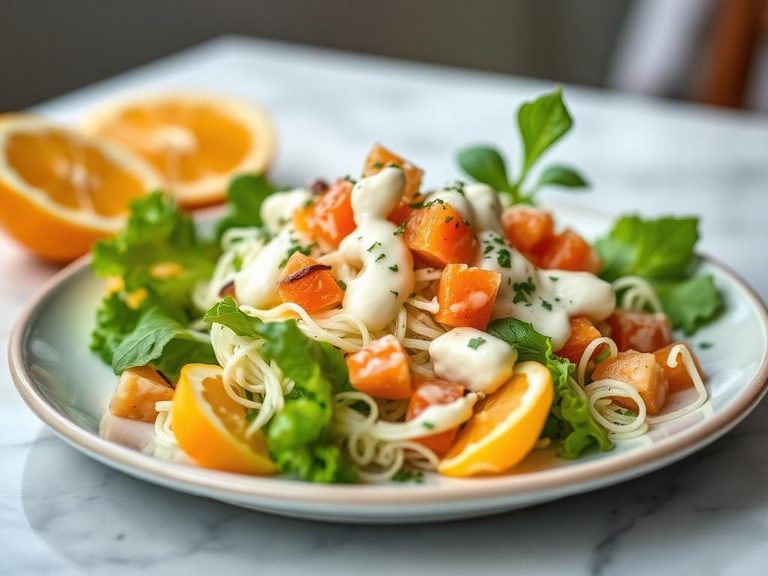
Fruit salad, including citrus fruits, with salad dressing or mayonnaise
Common food

Photo: Wikipedia
A vibrant medley of fresh citrus segments—like orange, grapefruit, and mandarin—tossed in a creamy, tangy dressing or mayonnaise. The texture is a delightful contrast: juicy, fibrous fruit against a smooth, rich coating. Nutritionally, it's a high-fat, moderate-carb side dish, with the dressing providing the bulk of the calories and fat.
Calorie split: 3% protein · 22% carbs · 75% fat
↓ Full nutrition💚 Why it's loved
People love it for the unexpected harmony of sweet, juicy citrus cutting through the rich, savory dressing. It's a nostalgic comfort food in many households, often appearing at potlucks and holiday gatherings as a familiar, creamy counterpoint to heavier main dishes.
⚠️ Watch-outs & how to enjoy it better
The mayonnaise or creamy dressing can be high in saturated fat and calories, making it less suitable for low-fat diets. The natural sugars in the fruit, combined with the dressing, can cause a rapid blood sugar rise. **Tip:** Pair it with a source of protein (like grilled chicken or nuts) and use a light, olive-oil-based vinaigrette or Greek yogurt dressing to improve the glycemic response and reduce saturated fat.
Key benefits
- Provides a quick source of energy from natural sugars and fats.
- Citrus fruits are a good source of Vitamin C and antioxidants.
- The fat in the dressing can aid in the absorption of fat-soluble vitamins.
- Offers a refreshing and hydrating option due to the fruit's water content.
- Can serve as a versatile side dish or light meal component.
🍽️ Popular dishes
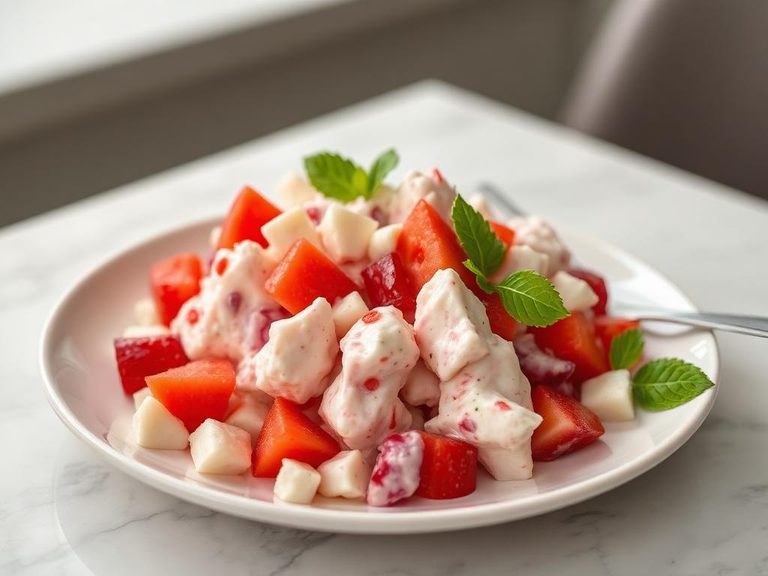
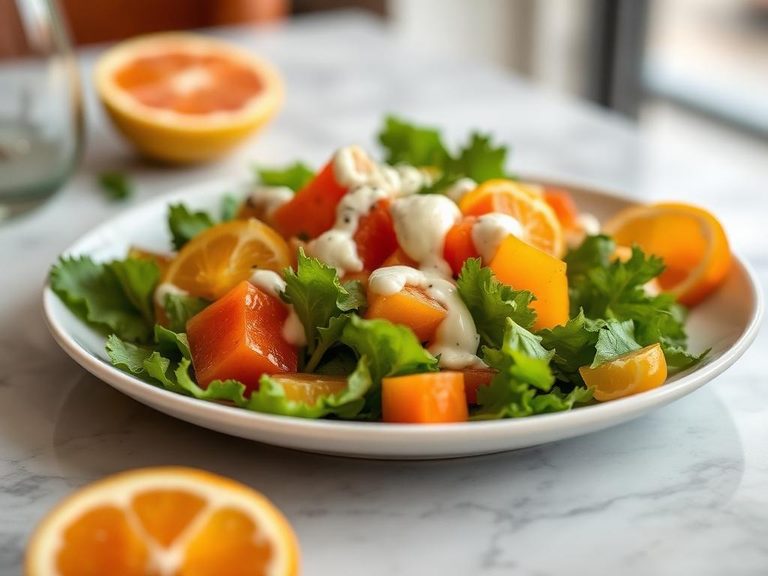
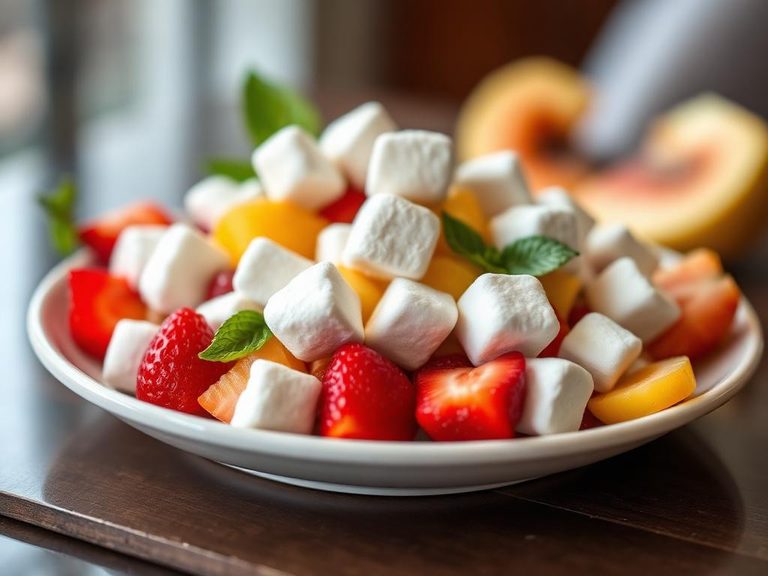
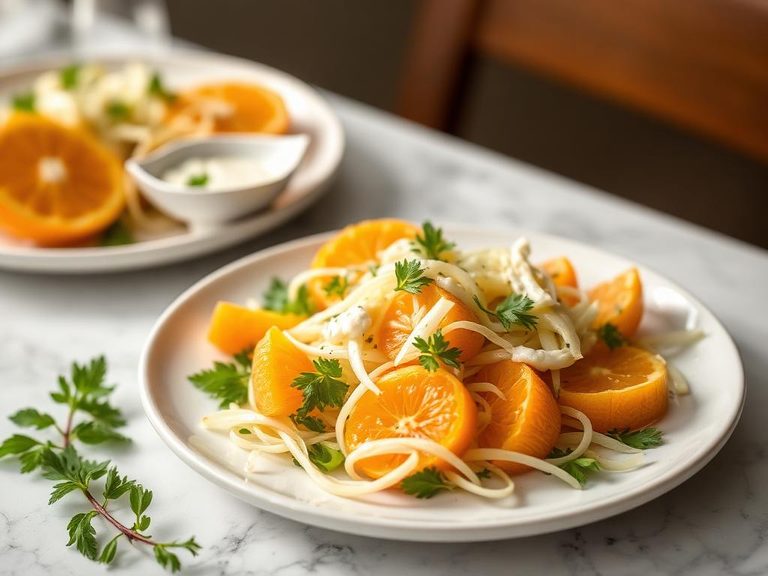
🌍 Where it's eaten
💡 Did you know?
The classic 'Ambrosia' salad, a close relative, was originally made with canned fruit cocktail, coconut, and marshmallows in the late 19th century, reflecting the era's fascination with newly available canned and tropical ingredients.
Full nutrition (USDA data · scales with serving)
| Water | 64.0 g |
| Energy | 240 kcal |
| Protein | 1.9 g |
| Total lipid (fat) | 20.3 g |
| Carbohydrate, by difference | 13.0 g |
| Fiber, total dietary | 1.8 g |
| Total Sugars | 9.5 g |
| Calcium, Ca | 21.0 mg |
| Iron, Fe | 0.28 mg |
| Magnesium, Mg | 21.0 mg |
| Phosphorus, P | 46.0 mg |
| Potassium, K | 191 mg |
| Sodium, Na | 124 mg |
| Zinc, Zn | 0.31 mg |
| Copper, Cu | 0.14 mg |
| Selenium, Se | 1.0 ug |
| Vitamin C, total ascorbic acid | 16.4 mg |
| Thiamin | 0.06 mg |
| Riboflavin | 0.04 mg |
| Niacin | 0.33 mg |
| Vitamin B-6 | 0.13 mg |
| Folate, total | 19.0 ug |
| Folic acid | 0.00 ug |
| Folate, food | 19.0 ug |
| Folate, DFE | 19.0 ug |
| Choline, total | 15.0 mg |
| Vitamin B-12 | 0.02 ug |
| Vitamin B-12, added | 0.00 ug |
| Vitamin A, RAE | 7.0 ug |
| Retinol | 3.0 ug |
| Carotene, beta | 30.0 ug |
| Carotene, alpha | 4.0 ug |
| Cryptoxanthin, beta | 30.0 ug |
| Lycopene | 0.00 ug |
| Lutein + zeaxanthin | 52.0 ug |
| Vitamin E (alpha-tocopherol) | 0.81 mg |
| Vitamin E, added | 0.00 mg |
| Vitamin D (D2 + D3) | 0.00 ug |
| Vitamin K (phylloquinone) | 34.0 ug |
| Alcohol, ethyl | 0.00 g |
| Caffeine | 0.00 mg |
| Theobromine | 0.00 mg |
Fat & fatty acid profile (per 100g)
| Fatty acids, total saturated | 2.8 g |
| SFA 4:0 | 0.00 g |
| SFA 6:0 | 0.00 g |
| SFA 8:0 | 0.00 g |
| SFA 10:0 | 0.00 g |
| SFA 12:0 | 0.00 g |
| SFA 14:0 | 0.01 g |
| SFA 16:0 | 1.9 g |
| SFA 18:0 | 0.74 g |
| Fatty acids, total monounsaturated | 4.1 g |
| MUFA 16:1 | 0.02 g |
| MUFA 18:1 | 3.9 g |
| MUFA 20:1 | 0.06 g |
| MUFA 22:1 | 0.00 g |
| Fatty acids, total polyunsaturated | 12.7 g |
| PUFA 18:2 | 10.7 g |
| PUFA 18:3 | 1.8 g |
| PUFA 18:4 | 0.00 g |
| PUFA 20:4 | 0.01 g |
| PUFA 20:5 n-3 (EPA) | 0.00 g |
| PUFA 22:5 n-3 (DPA) | 0.00 g |
| PUFA 22:6 n-3 (DHA) | 0.00 g |
| Cholesterol | 8.0 mg |
FAQ
Is this fruit salad healthy?
It's a mixed bag. The citrus fruit provides vitamins and fiber, but the creamy dressing (often mayonnaise-based) adds significant calories and fat. A lighter dressing or portion control can make it a more balanced choice.
Can I make a healthier version?
Absolutely. Swap mayonnaise for plain Greek yogurt, add a touch of honey or maple syrup, and mix in other fresh berries or nuts for extra fiber and protein. This boosts nutrition while keeping the creamy texture.
Why is my fruit salad watery?
Citrus fruits release juice, especially when mixed with salt or sugar. To prevent sogginess, drain the fruit segments well before mixing, and consider adding the dressing just before serving.
Nutrient density (calculated · NRF9.3)
Nutrient Rich Foods index: beneficial nutrients (protein, fiber, vitamins, minerals) minus saturated fat, added sugar & sodium, per 100 kcal.
NRF9.3 index — Fulgoni, Keast & Drewnowski, 2009. Computed from USDA nutrients.
Weight-loss friendliness (composite index)
Energy density 2.40 kcal/g · 3% calories from protein · 1.8 g fiber · 9.5 g sugar per 100 g.
Composite of energy density (Rolls et al., 1999), protein & fiber satiety, minus sugar. A calculated heuristic — ranks satiety-per-calorie, not a clinical measure.
Dietary load (calculated from USDA values)
Potential renal acid load. Positive = acid-forming, negative = alkaline-forming.
Sodium-to-potassium ratio: 0.65 (lower is better — aim for ≤ 1)
Sodium:potassium per WHO potassium guidance. Computed from USDA nutrients.