

Fruit salad, excluding citrus fruits, with salad dressing or mayonnaise
Common food

Photo: Wikipedia
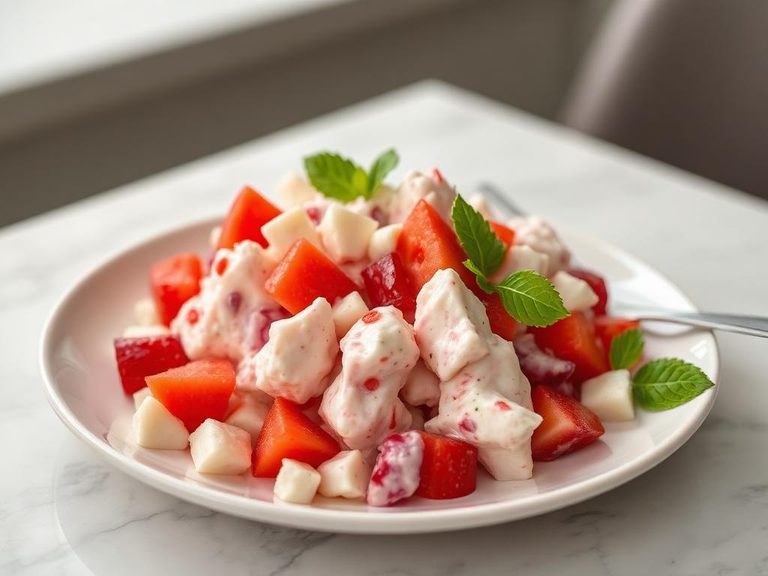
This is a vibrant, creamy fruit salad where sweet, juicy chunks of non-citrus fruits—like melon, berries, grapes, and pineapple—are tossed in a rich, tangy dressing. The texture is a delightful contrast between the crisp, fresh fruit and the smooth, velvety coating. It's a calorie-dense treat, with over 80% of its energy coming from fats in the dressing, making it a surprisingly substantial snack.
Calorie split: 3% protein · 22% carbs · 75% fat
↓ Full nutrition💚 Why it's loved
People adore it for the nostalgic, comforting blend of sweet fruit and creamy dressing, which transforms simple ingredients into a decadent treat. It's a beloved, versatile side dish at picnics, potlucks, and barbecues across many cultures.
⚠️ Watch-outs & how to enjoy it better
The high fat and sugar content can lead to blood sugar spikes and may not suit low-fat or diabetic diets. To counteract this, practice portion control and pair it with a source of protein (like nuts or yogurt) to slow sugar absorption. Opting for a lighter, yogurt-based dressing can also reduce fat and add probiotics.
Key benefits
- Provides quick energy from natural fruit sugars and carbohydrates.
- Contains dietary fiber from whole fruits to support digestion.
- Offers a convenient way to consume a variety of fruit vitamins and minerals.
- The fat in the dressing can help with the absorption of fat-soluble vitamins (like A and E) from the fruit.
🍽️ Popular dishes

🌍 Where it's eaten
💡 Did you know?
Ambrosia, a classic version of this salad, was originally made with just canned pineapple, marshmallows, and coconut in the late 1800s, reflecting the era's fascination with newly available canned tropical fruits.
Full nutrition (USDA data · scales with serving)
| Water | 63.1 g |
| Energy | 247 kcal |
| Protein | 1.8 g |
| Total lipid (fat) | 20.7 g |
| Carbohydrate, by difference | 13.6 g |
| Fiber, total dietary | 1.5 g |
| Total Sugars | 9.9 g |
| Calcium, Ca | 15.0 mg |
| Iron, Fe | 0.28 mg |
| Magnesium, Mg | 22.0 mg |
| Phosphorus, P | 44.0 mg |
| Potassium, K | 181 mg |
| Sodium, Na | 127 mg |
| Zinc, Zn | 0.32 mg |
| Copper, Cu | 0.16 mg |
| Selenium, Se | 0.90 ug |
| Vitamin C, total ascorbic acid | 16.9 mg |
| Thiamin | 0.06 mg |
| Riboflavin | 0.04 mg |
| Niacin | 0.32 mg |
| Vitamin B-6 | 0.14 mg |
| Folate, total | 17.0 ug |
| Folic acid | 0.00 ug |
| Folate, food | 17.0 ug |
| Folate, DFE | 17.0 ug |
| Choline, total | 14.5 mg |
| Vitamin B-12 | 0.02 ug |
| Vitamin B-12, added | 0.00 ug |
| Vitamin A, RAE | 5.0 ug |
| Retinol | 3.0 ug |
| Carotene, beta | 21.0 ug |
| Carotene, alpha | 2.0 ug |
| Cryptoxanthin, beta | 3.0 ug |
| Lycopene | 0.00 ug |
| Lutein + zeaxanthin | 21.0 ug |
| Vitamin E (alpha-tocopherol) | 0.79 mg |
| Vitamin E, added | 0.00 mg |
| Vitamin D (D2 + D3) | 0.00 ug |
| Vitamin K (phylloquinone) | 34.9 ug |
| Alcohol, ethyl | 0.00 g |
| Caffeine | 0.00 mg |
| Theobromine | 0.00 mg |
Fat & fatty acid profile (per 100g)
| Fatty acids, total saturated | 2.9 g |
| SFA 4:0 | 0.00 g |
| SFA 6:0 | 0.00 g |
| SFA 8:0 | 0.00 g |
| SFA 10:0 | 0.00 g |
| SFA 12:0 | 0.00 g |
| SFA 14:0 | 0.01 g |
| SFA 16:0 | 2.0 g |
| SFA 18:0 | 0.75 g |
| Fatty acids, total monounsaturated | 4.1 g |
| MUFA 16:1 | 0.02 g |
| MUFA 18:1 | 4.0 g |
| MUFA 20:1 | 0.06 g |
| MUFA 22:1 | 0.00 g |
| Fatty acids, total polyunsaturated | 12.9 g |
| PUFA 18:2 | 10.9 g |
| PUFA 18:3 | 1.8 g |
| PUFA 18:4 | 0.00 g |
| PUFA 20:4 | 0.01 g |
| PUFA 20:5 n-3 (EPA) | 0.00 g |
| PUFA 22:5 n-3 (DPA) | 0.00 g |
| PUFA 22:6 n-3 (DHA) | 0.00 g |
| Cholesterol | 8.0 mg |
FAQ
What's the difference between this and a regular fruit salad?
The key difference is the dressing. A regular fruit salad is typically just fresh, undressed fruit. This version includes a creamy, often mayonnaise or whipped cream-based dressing, which adds significant calories, fat, and a distinct tangy-sweet flavor profile.
Can I make a healthier version?
Absolutely. You can substitute the mayonnaise or heavy cream dressing with plain Greek yogurt, which adds protein and reduces fat. Using fresh fruit instead of canned in syrup and adding a sprinkle of nuts or seeds can boost fiber and healthy fats.
Why is it called 'salad' if it's sweet?
In American culinary tradition, the term 'salad' is broadly used for any mixture of ingredients, including sweet dishes served as sides or desserts. This follows the pattern of other sweet 'salads' like Jell-O salad or cookie salad.
Nutrient density (calculated · NRF9.3)
Nutrient Rich Foods index: beneficial nutrients (protein, fiber, vitamins, minerals) minus saturated fat, added sugar & sodium, per 100 kcal.
NRF9.3 index — Fulgoni, Keast & Drewnowski, 2009. Computed from USDA nutrients.
Weight-loss friendliness (composite index)
Energy density 2.47 kcal/g · 3% calories from protein · 1.5 g fiber · 9.9 g sugar per 100 g.
Composite of energy density (Rolls et al., 1999), protein & fiber satiety, minus sugar. A calculated heuristic — ranks satiety-per-calorie, not a clinical measure.
Dietary load (calculated from USDA values)
Potential renal acid load. Positive = acid-forming, negative = alkaline-forming.
Sodium-to-potassium ratio: 0.70 (lower is better — aim for ≤ 1)
Sodium:potassium per WHO potassium guidance. Computed from USDA nutrients.