

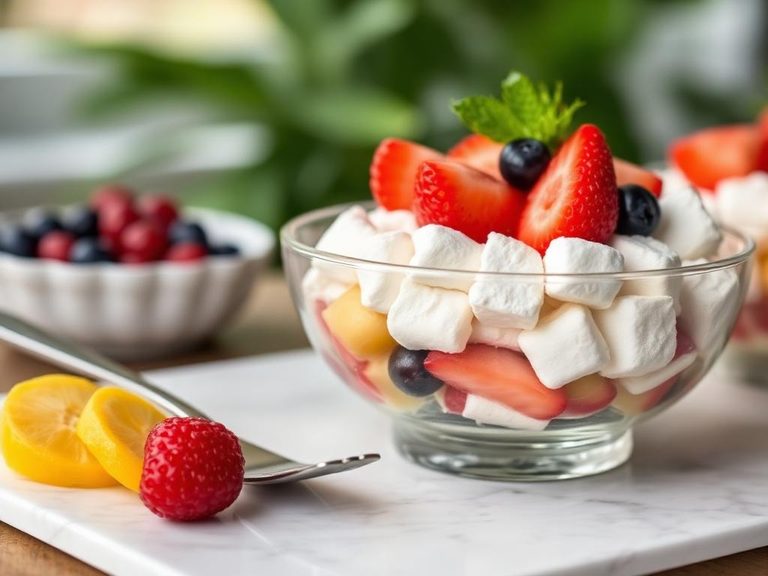
Fruit salad, including citrus fruits, with marshmallows
Common food

Photo: Wikipedia
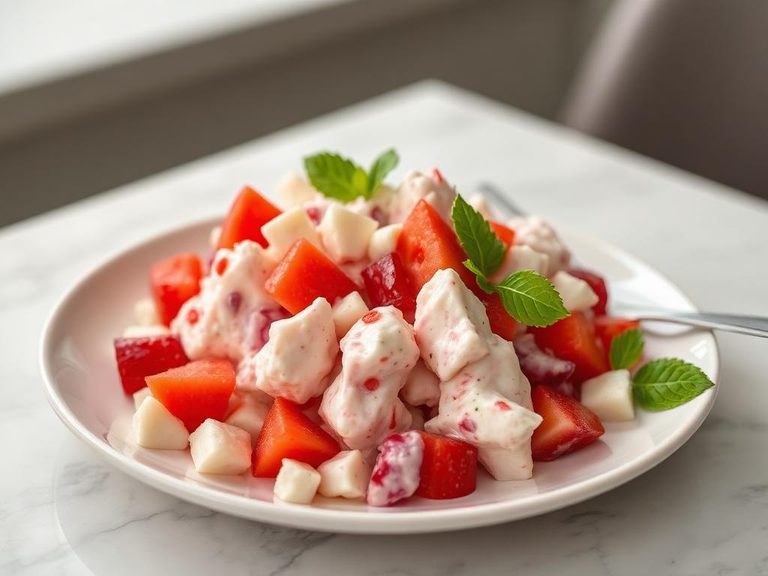
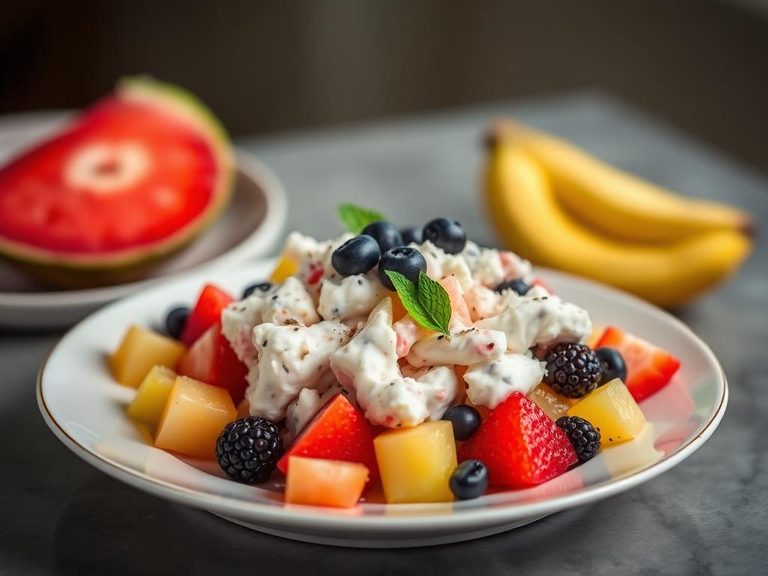
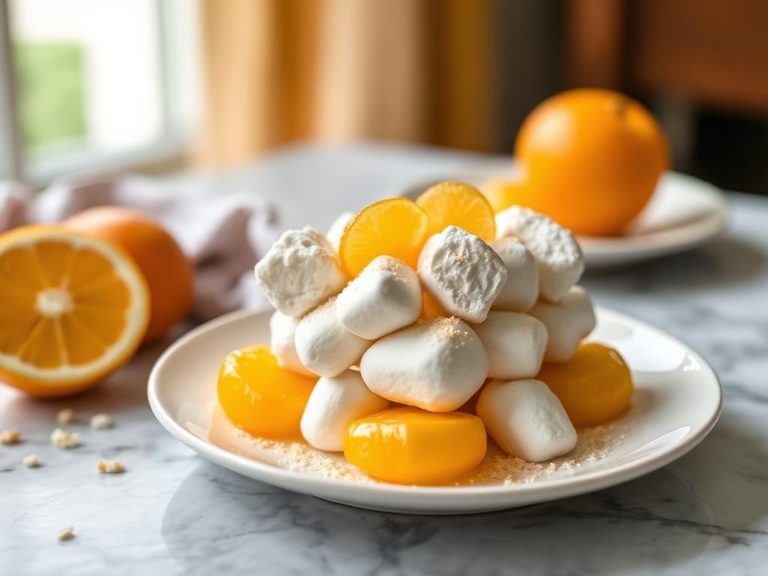
A vibrant medley of fresh citrus segments—like juicy oranges, tangy grapefruits, and sweet mandarins—tossed with soft, pillowy marshmallows. The texture is a delightful contrast: crisp, juicy fruit against the melt-in-your-mouth sweetness of the marshmallow. Nutritionally, it's a high-fat, high-sugar treat, with the fat largely coming from the marshmallows.
Calorie split: 3% protein · 27% carbs · 70% fat
↓ Full nutrition💚 Why it's loved
People adore it for the nostalgic, playful combination of bright, acidic fruit cutting through the sugary, creamy sweetness of marshmallows. It's a versatile, no-bake dish that feels like a special treat, often appearing at potlucks and holiday gatherings.
⚠️ Watch-outs & how to enjoy it better
The high sugar and fat content can cause rapid blood-sugar spikes, making it a poor choice for those managing diabetes or watching calorie intake. To counteract this, pair a small portion with a source of protein (like nuts or Greek yogurt) to slow sugar absorption, or use it as an occasional dessert rather than a regular snack.
Key benefits
- Quick source of energy from carbohydrates and sugar
- Provides some dietary fiber from the citrus fruits
- Contains vitamin C from the citrus components
- Offers a fun, textural eating experience
- Can be a festive or kid-friendly dessert option
🍽️ Popular dishes
🌍 Where it's eaten
💡 Did you know?
Marshmallows were originally made from the mallow plant root, but modern ones are a confection of sugar, water, and gelatin, making this salad a surprising mix of botanical fruit and processed candy.
Full nutrition (USDA data · scales with serving)
| Water | 61.3 g |
| Energy | 244 kcal |
| Protein | 1.9 g |
| Total lipid (fat) | 19.1 g |
| Carbohydrate, by difference | 16.9 g |
| Fiber, total dietary | 1.7 g |
| Total Sugars | 12.2 g |
| Calcium, Ca | 20.0 mg |
| Iron, Fe | 0.28 mg |
| Magnesium, Mg | 20.0 mg |
| Phosphorus, P | 43.0 mg |
| Potassium, K | 180 mg |
| Sodium, Na | 122 mg |
| Zinc, Zn | 0.29 mg |
| Copper, Cu | 0.14 mg |
| Selenium, Se | 1.0 ug |
| Vitamin C, total ascorbic acid | 15.5 mg |
| Thiamin | 0.06 mg |
| Riboflavin | 0.04 mg |
| Niacin | 0.32 mg |
| Vitamin B-6 | 0.12 mg |
| Folate, total | 18.0 ug |
| Folic acid | 0.00 ug |
| Folate, food | 18.0 ug |
| Folate, DFE | 18.0 ug |
| Choline, total | 14.1 mg |
| Vitamin B-12 | 0.02 ug |
| Vitamin B-12, added | 0.00 ug |
| Vitamin A, RAE | 6.0 ug |
| Retinol | 3.0 ug |
| Carotene, beta | 28.0 ug |
| Carotene, alpha | 4.0 ug |
| Cryptoxanthin, beta | 29.0 ug |
| Lycopene | 0.00 ug |
| Lutein + zeaxanthin | 49.0 ug |
| Vitamin E (alpha-tocopherol) | 0.76 mg |
| Vitamin E, added | 0.00 mg |
| Vitamin D (D2 + D3) | 0.00 ug |
| Vitamin K (phylloquinone) | 32.1 ug |
| Alcohol, ethyl | 0.00 g |
| Caffeine | 0.00 mg |
| Theobromine | 0.00 mg |
Fat & fatty acid profile (per 100g)
| Fatty acids, total saturated | 2.6 g |
| SFA 4:0 | 0.00 g |
| SFA 6:0 | 0.00 g |
| SFA 8:0 | 0.00 g |
| SFA 10:0 | 0.00 g |
| SFA 12:0 | 0.00 g |
| SFA 14:0 | 0.01 g |
| SFA 16:0 | 1.8 g |
| SFA 18:0 | 0.70 g |
| Fatty acids, total monounsaturated | 3.8 g |
| MUFA 16:1 | 0.02 g |
| MUFA 18:1 | 3.7 g |
| MUFA 20:1 | 0.05 g |
| MUFA 22:1 | 0.00 g |
| Fatty acids, total polyunsaturated | 11.9 g |
| PUFA 18:2 | 10.1 g |
| PUFA 18:3 | 1.7 g |
| PUFA 18:4 | 0.00 g |
| PUFA 20:4 | 0.01 g |
| PUFA 20:5 n-3 (EPA) | 0.00 g |
| PUFA 22:5 n-3 (DPA) | 0.00 g |
| PUFA 22:6 n-3 (DHA) | 0.00 g |
| Cholesterol | 8.0 mg |
FAQ
Is this a healthy fruit salad?
Not typically. While it contains fruit, the significant addition of marshmallows makes it a high-sugar, high-fat dessert rather than a healthful fruit dish.
Can I make a lighter version?
Yes. Use mini marshmallows sparingly, choose a sugar-free variety, or substitute with a small amount of whipped cream or yogurt. Boost the fruit ratio and add nuts or seeds for fiber and protein.
Why is the fat content so high?
The fat comes almost entirely from the marshmallows, which contain gelatin (an animal protein) and often added fats or oils for texture. The citrus fruits themselves are virtually fat-free.
Nutrient density (calculated · NRF9.3)
Nutrient Rich Foods index: beneficial nutrients (protein, fiber, vitamins, minerals) minus saturated fat, added sugar & sodium, per 100 kcal.
NRF9.3 index — Fulgoni, Keast & Drewnowski, 2009. Computed from USDA nutrients.
Weight-loss friendliness (composite index)
Energy density 2.44 kcal/g · 3% calories from protein · 1.7 g fiber · 12.2 g sugar per 100 g.
Composite of energy density (Rolls et al., 1999), protein & fiber satiety, minus sugar. A calculated heuristic — ranks satiety-per-calorie, not a clinical measure.
Dietary load (calculated from USDA values)
Potential renal acid load. Positive = acid-forming, negative = alkaline-forming.
Sodium-to-potassium ratio: 0.68 (lower is better — aim for ≤ 1)
Sodium:potassium per WHO potassium guidance. Computed from USDA nutrients.