

Fruit cocktail, canned, NFS
Common food

Photo: Wikipedia
This is a classic medley of diced peaches, pears, grapes, pineapple, and cherries, suspended in a light, sweet syrup. The texture is a soft, uniform bite with a pleasant, varied sweetness from the fruit and syrup. Nutritionally, it's a low-fat, low-protein source of quick energy from its carbohydrate content.
Calorie split: 3% protein · 96% carbs · 1% fat
↓ Full nutrition💚 Why it's loved
People love its nostalgic, comforting sweetness and the convenience of having a ready-to-eat fruit mix. It's a versatile staple that can be a simple dessert, a topping, or a salad ingredient.
⚠️ Watch-outs & how to enjoy it better
The primary downside is the high sugar content from both the fruit and the packing syrup, which can cause blood sugar spikes. To counteract this, choose varieties packed in juice or water instead of heavy syrup, and pair it with a source of protein or fat like yogurt, cottage cheese, or nuts to slow sugar absorption.
Key benefits
- Provides quick energy from natural and added sugars
- Low in fat and a source of dietary fiber
- Offers a convenient, pre-mixed serving of multiple fruits
- A hydrating option with a high water content from the fruit and syrup
🍽️ Popular dishes
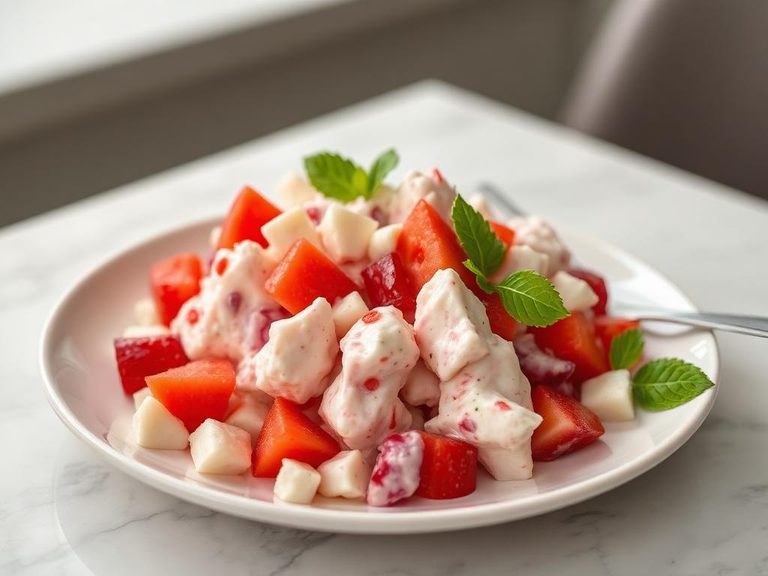


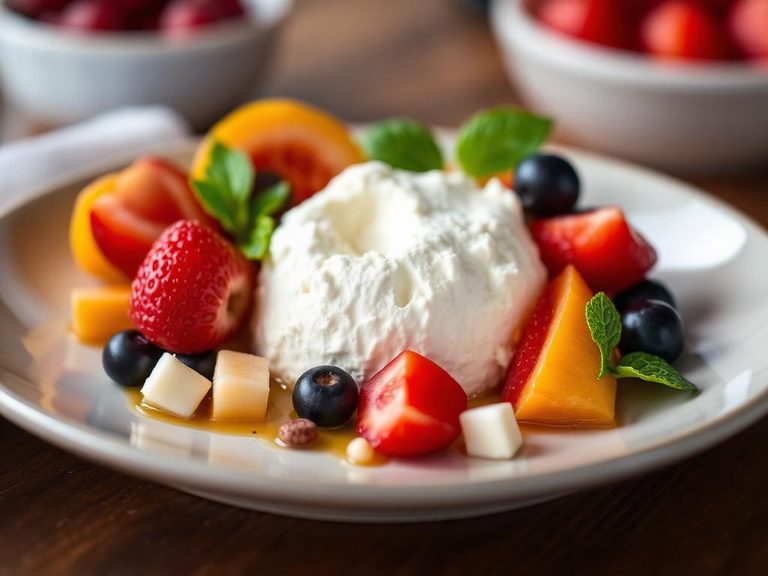


🌍 Where it's eaten
💡 Did you know?
The modern fruit cocktail as we know it was popularized in the early 20th century, with the Del Monte brand launching its first canned version in 1917, helping to standardize the mix of five specific fruits.
Full nutrition (USDA data · scales with serving)
| Water | 85.1 g |
| Energy | 55.0 kcal |
| Protein | 0.41 g |
| Total lipid (fat) | 0.08 g |
| Carbohydrate, by difference | 14.1 g |
| Fiber, total dietary | 0.90 g |
| Total Sugars | 13.1 g |
| Calcium, Ca | 6.0 mg |
| Iron, Fe | 0.28 mg |
| Magnesium, Mg | 7.0 mg |
| Phosphorus, P | 11.0 mg |
| Potassium, K | 112 mg |
| Sodium, Na | 5.0 mg |
| Zinc, Zn | 0.09 mg |
| Copper, Cu | 0.07 mg |
| Selenium, Se | 0.50 ug |
| Vitamin C, total ascorbic acid | 2.0 mg |
| Thiamin | 0.01 mg |
| Riboflavin | 0.01 mg |
| Niacin | 0.34 mg |
| Vitamin B-6 | 0.05 mg |
| Folate, total | 3.0 ug |
| Folic acid | 0.00 ug |
| Folate, food | 3.0 ug |
| Folate, DFE | 3.0 ug |
| Choline, total | 3.7 mg |
| Vitamin B-12 | 0.00 ug |
| Vitamin B-12, added | 0.00 ug |
| Vitamin A, RAE | 12.0 ug |
| Retinol | 0.00 ug |
| Carotene, beta | 113 ug |
| Carotene, alpha | 0.00 ug |
| Cryptoxanthin, beta | 43.0 ug |
| Lycopene | 0.00 ug |
| Lutein + zeaxanthin | 71.0 ug |
| Vitamin E (alpha-tocopherol) | 0.36 mg |
| Vitamin E, added | 0.00 mg |
| Vitamin D (D2 + D3) | 0.00 ug |
| Vitamin K (phylloquinone) | 2.3 ug |
| Alcohol, ethyl | 0.00 g |
| Caffeine | 0.00 mg |
| Theobromine | 0.00 mg |
Fat & fatty acid profile (per 100g)
| Fatty acids, total saturated | 0.01 g |
| SFA 4:0 | 0.00 g |
| SFA 6:0 | 0.00 g |
| SFA 8:0 | 0.00 g |
| SFA 10:0 | 0.00 g |
| SFA 12:0 | 0.00 g |
| SFA 14:0 | 0.00 g |
| SFA 16:0 | 0.01 g |
| SFA 18:0 | 0.00 g |
| Fatty acids, total monounsaturated | 0.01 g |
| MUFA 16:1 | 0.00 g |
| MUFA 18:1 | 0.01 g |
| MUFA 20:1 | 0.00 g |
| MUFA 22:1 | 0.00 g |
| Fatty acids, total polyunsaturated | 0.02 g |
| PUFA 18:2 | 0.02 g |
| PUFA 18:3 | 0.00 g |
| PUFA 18:4 | 0.00 g |
| PUFA 20:4 | 0.00 g |
| PUFA 20:5 n-3 (EPA) | 0.00 g |
| PUFA 22:5 n-3 (DPA) | 0.00 g |
| PUFA 22:6 n-3 (DHA) | 0.00 g |
| Cholesterol | 0.00 mg |
FAQ
What's the difference between fruit cocktail and fruit salad?
Fruit cocktail is a specific, standardized canned mix (peaches, pears, grapes, pineapple, cherries) in syrup. 'Fruit salad' is a broader term for any mixture of fresh or canned fruits, which can vary widely.
Is canned fruit as nutritious as fresh?
Canning can reduce some heat-sensitive vitamins like Vitamin C, but it preserves other nutrients like fiber and minerals. The main nutritional difference is often the added sugar in the syrup; choosing 'in juice' versions makes it closer to fresh.
Can I use the syrup from the can?
Yes, the syrup is edible and often used in recipes for cakes, drinks, or as a sweetener. However, it is high in sugar, so using it sparingly is best for a balanced diet.
Nutrient density (calculated · NRF9.3)
Nutrient Rich Foods index: beneficial nutrients (protein, fiber, vitamins, minerals) minus saturated fat, added sugar & sodium, per 100 kcal.
NRF9.3 index — Fulgoni, Keast & Drewnowski, 2009. Computed from USDA nutrients.
Weight-loss friendliness (composite index)
Energy density 0.55 kcal/g · 3% calories from protein · 0.9 g fiber · 13.1 g sugar per 100 g.
Composite of energy density (Rolls et al., 1999), protein & fiber satiety, minus sugar. A calculated heuristic — ranks satiety-per-calorie, not a clinical measure.
Dietary load (calculated from USDA values)
Potential renal acid load. Positive = acid-forming, negative = alkaline-forming.
Sodium-to-potassium ratio: 0.04 (lower is better — aim for ≤ 1)
Sodium:potassium per WHO potassium guidance. Computed from USDA nutrients.