

Energy Drink
Common food
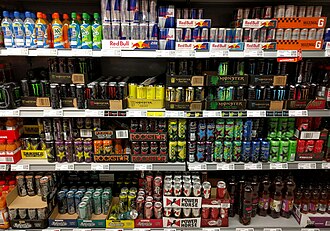
Photo: Wikipedia
An energy drink is a carbonated, sweetened beverage typically infused with caffeine, taurine, and B-vitamins, designed to provide a rapid mental and physical boost. Its flavor profile is often intensely sweet and fruity, with a sharp, effervescent texture that can leave a slightly syrupy or medicinal aftertaste. Nutritionally, it is essentially a source of quick-release sugars, offering 10.23g of carbohydrates per 100g with virtually no protein, fat, or fiber.
Calorie split: 4% protein · 96% carbs · 0% fat
↓ Full nutrition💚 Why it's loved
People love energy drinks for their immediate, palpable 'kick' and the wide array of bold, often candy-like flavors that make them feel like a treat. They are deeply embedded in youth and gaming culture, serving as a go-to fuel for late-night study sessions, long drives, or intense workouts.
⚠️ Watch-outs & how to enjoy it better
The high sugar content (over 10g per 100g) can lead to a sharp blood-sugar spike followed by a crash, and the caffeine can cause jitters, anxiety, or heart palpitations in sensitive individuals. To counteract these effects, pair the drink with a source of protein or healthy fat to slow sugar absorption, practice strict portion control by limiting consumption to half a can, and ensure you drink plenty of water to stay hydrated.
Key benefits
- Provides a rapid source of energy via simple sugars
- Contains caffeine to enhance alertness and focus
- Often fortified with B-vitamins for energy metabolism
- Convenient, portable, and widely available
- Can be used as a quick pre-workout stimulant
🍽️ Popular dishes





🌍 Where it's eaten
💡 Did you know?
The modern energy drink was pioneered by the Austrian company Red Bull in 1987, which adapted a Thai drink called Krating Daeng (meaning 'Red Bull') that was originally created for truck drivers and laborers.
Full nutrition (USDA data · scales with serving)
| Water | 89.2 g |
| Energy | 43.0 kcal |
| Protein | 0.46 g |
| Total lipid (fat) | 0.00 g |
| Carbohydrate, by difference | 10.2 g |
| Fiber, total dietary | 0.00 g |
| Total Sugars | 10.2 g |
| Calcium, Ca | 6.0 mg |
| Iron, Fe | 0.06 mg |
| Magnesium, Mg | 19.0 mg |
| Phosphorus, P | 0.00 mg |
| Potassium, K | 3.0 mg |
| Sodium, Na | 39.0 mg |
| Zinc, Zn | 0.01 mg |
| Copper, Cu | 0.00 mg |
| Selenium, Se | 0.20 ug |
| Vitamin C, total ascorbic acid | 0.00 mg |
| Thiamin | 0.04 mg |
| Riboflavin | 0.10 mg |
| Niacin | 9.8 mg |
| Vitamin B-6 | 2.2 mg |
| Folate, total | 0.00 ug |
| Folic acid | 0.00 ug |
| Folate, food | 0.00 ug |
| Folate, DFE | 0.00 ug |
| Choline, total | 0.30 mg |
| Vitamin B-12 | 2.0 ug |
| Vitamin B-12, added | 2.0 ug |
| Vitamin A, RAE | 0.00 ug |
| Retinol | 0.00 ug |
| Carotene, beta | 0.00 ug |
| Carotene, alpha | 0.00 ug |
| Cryptoxanthin, beta | 0.00 ug |
| Lycopene | 0.00 ug |
| Lutein + zeaxanthin | 0.00 ug |
| Vitamin E (alpha-tocopherol) | 0.00 mg |
| Vitamin E, added | 0.00 mg |
| Vitamin D (D2 + D3) | 0.00 ug |
| Vitamin K (phylloquinone) | 0.00 ug |
| Alcohol, ethyl | 0.00 g |
| Caffeine | 29.0 mg |
| Theobromine | 0.00 mg |
Fat & fatty acid profile (per 100g)
| Fatty acids, total saturated | 0.00 g |
| SFA 4:0 | 0.00 g |
| SFA 6:0 | 0.00 g |
| SFA 8:0 | 0.00 g |
| SFA 10:0 | 0.00 g |
| SFA 12:0 | 0.00 g |
| SFA 14:0 | 0.00 g |
| SFA 16:0 | 0.00 g |
| SFA 18:0 | 0.00 g |
| Fatty acids, total monounsaturated | 0.00 g |
| MUFA 16:1 | 0.00 g |
| MUFA 18:1 | 0.00 g |
| MUFA 20:1 | 0.00 g |
| MUFA 22:1 | 0.00 g |
| Fatty acids, total polyunsaturated | 0.00 g |
| PUFA 18:2 | 0.00 g |
| PUFA 18:3 | 0.00 g |
| PUFA 18:4 | 0.00 g |
| PUFA 20:4 | 0.00 g |
| PUFA 20:5 n-3 (EPA) | 0.00 g |
| PUFA 22:5 n-3 (DPA) | 0.00 g |
| PUFA 22:6 n-3 (DHA) | 0.00 g |
| Cholesterol | 0.00 mg |
FAQ
How much caffeine is in a typical energy drink?
A standard 250ml can contains about 80mg of caffeine, which is roughly equivalent to a cup of coffee, though some brands can have significantly more.
Are energy drinks safe for children?
Health organizations generally advise against children and adolescents consuming energy drinks due to the high caffeine and sugar content, which can affect their developing nervous systems and cardiovascular health.
Can I mix energy drinks with alcohol?
Mixing energy drinks with alcohol is not recommended, as the stimulant effect of caffeine can mask the depressant effects of alcohol, leading to increased risk-taking and impaired judgment.
Nutrient density (calculated · NRF9.3)
Nutrient Rich Foods index: beneficial nutrients (protein, fiber, vitamins, minerals) minus saturated fat, added sugar & sodium, per 100 kcal.
NRF9.3 index — Fulgoni, Keast & Drewnowski, 2009. Computed from USDA nutrients.
Weight-loss friendliness (composite index)
Energy density 0.43 kcal/g · 4% calories from protein · 0.0 g fiber · 10.2 g sugar per 100 g.
Composite of energy density (Rolls et al., 1999), protein & fiber satiety, minus sugar. A calculated heuristic — ranks satiety-per-calorie, not a clinical measure.
Dietary load (calculated from USDA values)
Potential renal acid load. Positive = acid-forming, negative = alkaline-forming.
Sodium-to-potassium ratio: 13.00 (lower is better — aim for ≤ 1)
Sodium:potassium per WHO potassium guidance. Computed from USDA nutrients.