

Egg sandwich on white bread
Common food
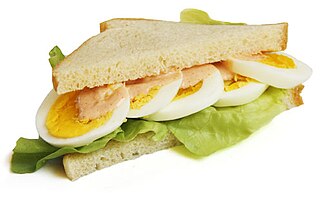
Photo: Wikipedia
A classic comfort food, the egg sandwich on white bread features a soft, pillowy texture with a rich, savory filling of scrambled or fried eggs. It offers a quick, satisfying source of protein and carbohydrates, making it a staple for breakfast or a light meal. Its simplicity is its strength, delivering a familiar, hearty taste that is both filling and easy to prepare.
Calorie split: 18% protein · 46% carbs · 36% fat
↓ Full nutrition💚 Why it's loved
People love it for its nostalgic, comforting appeal and the satisfying combination of soft bread and creamy eggs. It's a highly versatile meal that can be customized with various seasonings, spreads, or additional fillings to suit any taste.
⚠️ Watch-outs & how to enjoy it better
The white bread can cause a rapid blood-sugar spike, and the meal may be high in sodium if using processed bread or salty fillings. To counteract this, pair it with a source of fiber like a side of vegetables or use whole-grain bread, and be mindful of portion sizes or added salt.
Key benefits
- Provides a quick source of energy from carbohydrates.
- Offers a good balance of protein for satiety.
- Simple and affordable to prepare.
- Versatile for adding other ingredients like cheese or vegetables.
- Easy to digest for many people.
🍽️ Popular dishes





🌍 Where it's eaten
💡 Did you know?
The egg sandwich has been a staple in American diners since the early 20th century, often served as a quick, affordable meal for workers and students.
Full nutrition (USDA data · scales with serving)
| Water | 52.8 g |
| Energy | 228 kcal |
| Protein | 10.5 g |
| Total lipid (fat) | 9.1 g |
| Carbohydrate, by difference | 26.1 g |
| Fiber, total dietary | 1.2 g |
| Total Sugars | 2.9 g |
| Calcium, Ca | 132 mg |
| Iron, Fe | 2.5 mg |
| Magnesium, Mg | 19.0 mg |
| Phosphorus, P | 141 mg |
| Potassium, K | 120 mg |
| Sodium, Na | 353 mg |
| Zinc, Zn | 1.0 mg |
| Copper, Cu | 0.07 mg |
| Selenium, Se | 26.0 ug |
| Vitamin C, total ascorbic acid | 0.00 mg |
| Thiamin | 0.29 mg |
| Riboflavin | 0.30 mg |
| Niacin | 2.5 mg |
| Vitamin B-6 | 0.09 mg |
| Folate, total | 82.0 ug |
| Folic acid | 45.0 ug |
| Folate, food | 37.0 ug |
| Folate, DFE | 113 ug |
| Choline, total | 127 mg |
| Vitamin B-12 | 0.36 ug |
| Vitamin B-12, added | 0.00 ug |
| Vitamin A, RAE | 92.0 ug |
| Retinol | 92.0 ug |
| Carotene, beta | 5.0 ug |
| Carotene, alpha | 0.00 ug |
| Cryptoxanthin, beta | 6.0 ug |
| Lycopene | 0.00 ug |
| Lutein + zeaxanthin | 247 ug |
| Vitamin E (alpha-tocopherol) | 0.99 mg |
| Vitamin E, added | 0.00 mg |
| Vitamin D (D2 + D3) | 1.1 ug |
| Vitamin K (phylloquinone) | 2.5 ug |
| Alcohol, ethyl | 0.00 g |
| Caffeine | 0.00 mg |
| Theobromine | 0.00 mg |
Fat & fatty acid profile (per 100g)
| Fatty acids, total saturated | 2.6 g |
| SFA 4:0 | 0.02 g |
| SFA 6:0 | 0.01 g |
| SFA 8:0 | 0.01 g |
| SFA 10:0 | 0.02 g |
| SFA 12:0 | 0.03 g |
| SFA 14:0 | 0.09 g |
| SFA 16:0 | 1.7 g |
| SFA 18:0 | 0.64 g |
| Fatty acids, total monounsaturated | 3.0 g |
| MUFA 16:1 | 0.13 g |
| MUFA 18:1 | 2.8 g |
| MUFA 20:1 | 0.02 g |
| MUFA 22:1 | 0.00 g |
| Fatty acids, total polyunsaturated | 2.6 g |
| PUFA 18:2 | 2.2 g |
| PUFA 18:3 | 0.20 g |
| PUFA 18:4 | 0.00 g |
| PUFA 20:4 | 0.00 g |
| PUFA 20:5 n-3 (EPA) | 0.00 g |
| PUFA 22:5 n-3 (DPA) | 0.00 g |
| PUFA 22:6 n-3 (DHA) | 0.00 g |
| Cholesterol | 185 mg |
FAQ
Is an egg sandwich on white bread healthy?
It can be part of a balanced diet, providing protein and energy. However, white bread is low in fiber and can cause blood-sugar spikes, so pairing it with vegetables or choosing whole-grain bread is healthier.
How can I make an egg sandwich more nutritious?
Add vegetables like spinach, tomatoes, or avocado, use whole-grain bread, and consider using a mix of whole eggs and egg whites to reduce fat while keeping protein high.
What are common allergens in an egg sandwich?
Eggs and wheat (from bread) are common allergens. Some people may also be sensitive to dairy if cheese is added, or to soy if using certain spreads or bread ingredients.
Nutrient density (calculated · NRF9.3)
Nutrient Rich Foods index: beneficial nutrients (protein, fiber, vitamins, minerals) minus saturated fat, added sugar & sodium, per 100 kcal.
NRF9.3 index — Fulgoni, Keast & Drewnowski, 2009. Computed from USDA nutrients.
Weight-loss friendliness (composite index)
Energy density 2.28 kcal/g · 18% calories from protein · 1.2 g fiber · 2.9 g sugar per 100 g.
Composite of energy density (Rolls et al., 1999), protein & fiber satiety, minus sugar. A calculated heuristic — ranks satiety-per-calorie, not a clinical measure.
Dietary load (calculated from USDA values)
Potential renal acid load. Positive = acid-forming, negative = alkaline-forming.
Sodium-to-potassium ratio: 2.94 (lower is better — aim for ≤ 1)
Sodium:potassium per WHO potassium guidance. Computed from USDA nutrients.