

Egg salad, made with creamy dressing
Common food

Photo: Wikipedia
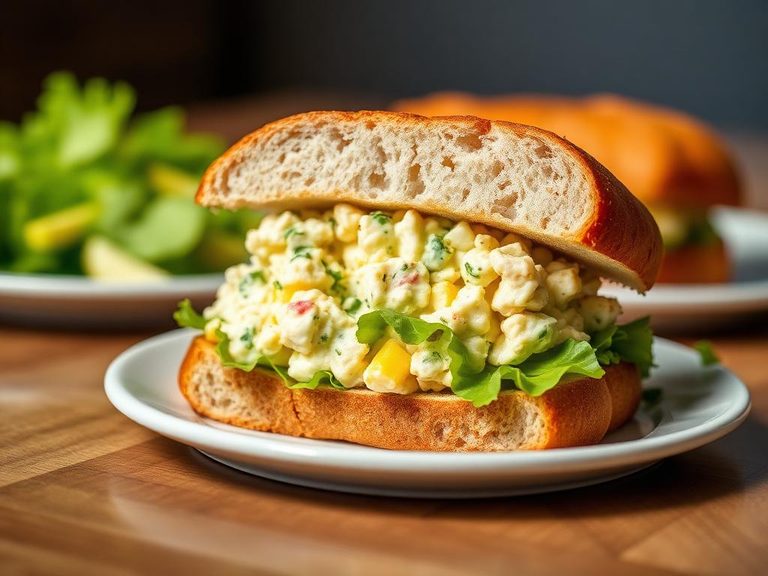
Egg salad with creamy dressing is a rich, savory blend of chopped hard-boiled eggs folded into a mayonnaise-based sauce, often seasoned with mustard and a touch of paprika. Its texture is a satisfying mix of tender egg whites and a velvety, slightly chunky binder. Nutritionally, it's a dense source of protein and fat, making it a very low-carb, energy-dense option.
Calorie split: 20% protein · 4% carbs · 76% fat
↓ Full nutrition💚 Why it's loved
People love it for its comforting, familiar flavor and the way it transforms simple ingredients into a satisfying meal. It's a versatile staple, equally at home in a sandwich, on a bed of greens, or as a dip.
⚠️ Watch-outs & how to enjoy it better
The high fat and calorie density from the mayonnaise can be a concern for calorie-controlled diets, and the sodium content can be high depending on seasoning and condiments used. For those watching saturated fat or cholesterol, portion control is key. Pair it with crunchy, fibrous vegetables like celery or lettuce to add volume and slow digestion.
Key benefits
- High in complete protein for muscle maintenance
- Excellent source of choline for brain health
- Contains fat-soluble vitamins A, D, E, and K
- Naturally very low in carbohydrates
- Provides selenium and B vitamins
🍽️ Popular dishes

🌍 Where it's eaten
💡 Did you know?
The classic American egg salad sandwich is a staple of Jewish delis, where it often shares the menu with its close relative, chopped liver, both representing the art of transforming humble ingredients into beloved comfort food.
Full nutrition (USDA data · scales with serving)
| Water | 68.3 g |
| Energy | 212 kcal |
| Protein | 10.2 g |
| Total lipid (fat) | 17.7 g |
| Carbohydrate, by difference | 2.1 g |
| Fiber, total dietary | 0.00 g |
| Total Sugars | 1.9 g |
| Calcium, Ca | 45.0 mg |
| Iron, Fe | 1.0 mg |
| Magnesium, Mg | 9.0 mg |
| Phosphorus, P | 174 mg |
| Potassium, K | 113 mg |
| Sodium, Na | 420 mg |
| Zinc, Zn | 0.86 mg |
| Copper, Cu | 0.01 mg |
| Selenium, Se | 25.0 ug |
| Vitamin C, total ascorbic acid | 0.00 mg |
| Thiamin | 0.06 mg |
| Riboflavin | 0.42 mg |
| Niacin | 0.06 mg |
| Vitamin B-6 | 0.10 mg |
| Folate, total | 35.0 ug |
| Folic acid | 0.00 ug |
| Folate, food | 35.0 ug |
| Folate, DFE | 35.0 ug |
| Choline, total | 238 mg |
| Vitamin B-12 | 0.91 ug |
| Vitamin B-12, added | 0.00 ug |
| Vitamin A, RAE | 120 ug |
| Retinol | 119 ug |
| Carotene, beta | 12.0 ug |
| Carotene, alpha | 0.00 ug |
| Cryptoxanthin, beta | 8.0 ug |
| Lycopene | 0.00 ug |
| Lutein + zeaxanthin | 282 ug |
| Vitamin E (alpha-tocopherol) | 1.3 mg |
| Vitamin E, added | 0.00 mg |
| Vitamin D (D2 + D3) | 1.8 ug |
| Vitamin K (phylloquinone) | 28.4 ug |
| Alcohol, ethyl | 0.00 g |
| Caffeine | 0.00 mg |
| Theobromine | 0.00 mg |
Fat & fatty acid profile (per 100g)
| Fatty acids, total saturated | 4.0 g |
| SFA 4:0 | 0.00 g |
| SFA 6:0 | 0.00 g |
| SFA 8:0 | 0.01 g |
| SFA 10:0 | 0.01 g |
| SFA 12:0 | 0.01 g |
| SFA 14:0 | 0.04 g |
| SFA 16:0 | 2.8 g |
| SFA 18:0 | 1.0 g |
| Fatty acids, total monounsaturated | 5.1 g |
| MUFA 16:1 | 0.26 g |
| MUFA 18:1 | 4.8 g |
| MUFA 20:1 | 0.05 g |
| MUFA 22:1 | 0.01 g |
| Fatty acids, total polyunsaturated | 6.5 g |
| PUFA 18:2 | 5.6 g |
| PUFA 18:3 | 0.74 g |
| PUFA 18:4 | 0.00 g |
| PUFA 20:4 | 0.12 g |
| PUFA 20:5 n-3 (EPA) | 0.00 g |
| PUFA 22:5 n-3 (DPA) | 0.00 g |
| PUFA 22:6 n-3 (DHA) | 0.03 g |
| Cholesterol | 299 mg |
FAQ
How long does homemade egg salad last?
Properly stored in an airtight container in the refrigerator, it is safe to eat for 3-4 days. It should not be frozen, as the mayonnaise will separate and become watery upon thawing.
Can I make a lighter version?
Yes. Substitute some or all of the mayonnaise with Greek yogurt, mashed avocado, or a mix of mustard and olive oil. You can also add extra vegetables like finely diced celery, onion, or pickles for crunch and volume without many calories.
Is it safe for pregnant women?
When made with fully cooked eggs and consumed promptly while fresh, it is generally considered safe. However, due to the risk of foodborne illness from mayonnaise-based salads, it's best to ensure all ingredients are fresh and the dish is kept refrigerated.
Nutrient density (calculated · NRF9.3)
Nutrient Rich Foods index: beneficial nutrients (protein, fiber, vitamins, minerals) minus saturated fat, added sugar & sodium, per 100 kcal.
NRF9.3 index — Fulgoni, Keast & Drewnowski, 2009. Computed from USDA nutrients.
Weight-loss friendliness (composite index)
Energy density 2.12 kcal/g · 19% calories from protein · 0.0 g fiber · 1.9 g sugar per 100 g.
Composite of energy density (Rolls et al., 1999), protein & fiber satiety, minus sugar. A calculated heuristic — ranks satiety-per-calorie, not a clinical measure.
Dietary load (calculated from USDA values)
Potential renal acid load. Positive = acid-forming, negative = alkaline-forming.
Sodium-to-potassium ratio: 3.72 (lower is better — aim for ≤ 1)
Sodium:potassium per WHO potassium guidance. Computed from USDA nutrients.