

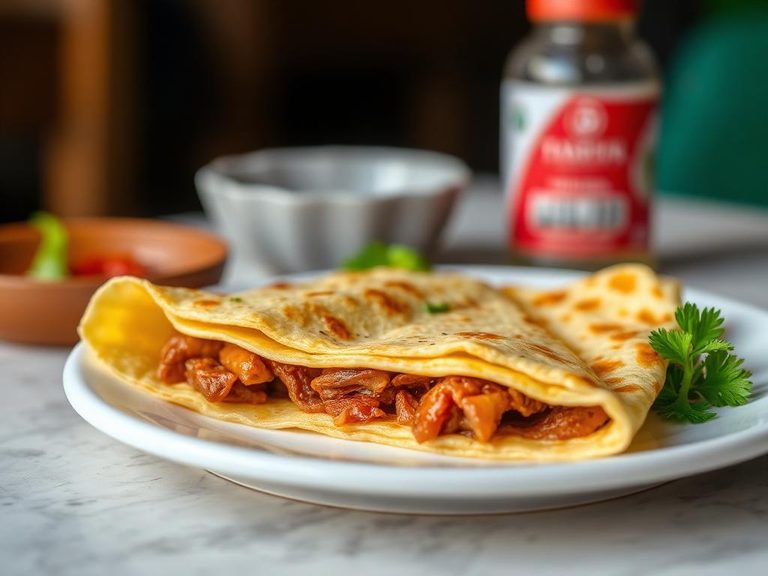
Crepe, with meat
Common food

Photo: Wikipedia
A savory crepe is a thin, delicate pancake made from a simple batter of flour, eggs, and milk, cooked until lightly golden and slightly crisp at the edges. When filled with seasoned meat—such as ground beef, pork, or chicken—it offers a satisfying contrast between the tender, eggy wrapper and the rich, savory filling. Nutritionally, it provides a solid protein boost (12.86g per 100g) with moderate fat, making it a more substantial meal than its sweet counterpart.
Calorie split: 30% protein · 18% carbs · 52% fat
↓ Full nutrition💚 Why it's loved
People love it for the perfect marriage of a delicate, eggy crepe and a hearty, savory filling—it's comfort food that feels both elegant and satisfying. Its versatility allows it to adapt to countless cultural flavors, from French classics to Asian-inspired wraps.
⚠️ Watch-outs & how to enjoy it better
The primary concern is the potential for high sodium in processed meat fillings and the refined flour in the crepe itself, which can lead to a quicker blood-sugar rise. To counteract this, choose low-sodium, unprocessed meats and consider adding a side of fibrous vegetables or a simple salad to slow digestion and enhance nutrient balance.
Key benefits
- High-quality protein for muscle maintenance and satiety
- Quick to prepare, making it ideal for weeknight meals
- Versatile base for various global fillings and cuisines
- Can be made ahead and frozen for convenient meals
- Lower in sugar than many other handheld foods
🍽️ Popular dishes
 Crêpe complète (French ham, cheese, egg)
 Banh xeo (Vietnamese savory crepe with pork/shrimp)
 Blini with meat (Russian/Eastern European)
 Maultaschen (German meat-filled pasta pockets, similar concept)
 Chilaquiles-style crepes (Mexican-inspired with salsa and meat)
 Roti john (Malaysian/Singaporean meat omelette crepe)
🌍 Where it's eaten
💡 Did you know?
The French word 'crêpe' comes from the Latin 'crispa,' meaning 'curled,' referring to the thin, ruffled edges that form during cooking.
Full nutrition (USDA data · scales with serving)
| Water | 67.8 g |
| Energy | 173 kcal |
| Protein | 12.9 g |
| Total lipid (fat) | 10.1 g |
| Carbohydrate, by difference | 7.7 g |
| Fiber, total dietary | 0.30 g |
| Total Sugars | 1.6 g |
| Calcium, Ca | 106 mg |
| Iron, Fe | 1.4 mg |
| Magnesium, Mg | 17.0 mg |
| Phosphorus, P | 159 mg |
| Potassium, K | 159 mg |
| Sodium, Na | 384 mg |
| Zinc, Zn | 1.8 mg |
| Copper, Cu | 0.08 mg |
| Selenium, Se | 20.3 ug |
| Vitamin C, total ascorbic acid | 0.80 mg |
| Thiamin | 0.08 mg |
| Riboflavin | 0.20 mg |
| Niacin | 2.8 mg |
| Vitamin B-6 | 0.12 mg |
| Folate, total | 15.0 ug |
| Folic acid | 5.0 ug |
| Folate, food | 10.0 ug |
| Folate, DFE | 18.0 ug |
| Choline, total | 53.1 mg |
| Vitamin B-12 | 0.80 ug |
| Vitamin B-12, added | 0.00 ug |
| Vitamin A, RAE | 82.0 ug |
| Retinol | 79.0 ug |
| Carotene, beta | 29.0 ug |
| Carotene, alpha | 2.0 ug |
| Cryptoxanthin, beta | 1.0 ug |
| Lycopene | 0.00 ug |
| Lutein + zeaxanthin | 49.0 ug |
| Vitamin E (alpha-tocopherol) | 0.52 mg |
| Vitamin E, added | 0.00 mg |
| Vitamin D (D2 + D3) | 0.80 ug |
| Vitamin K (phylloquinone) | 2.8 ug |
| Alcohol, ethyl | 0.00 g |
| Caffeine | 0.00 mg |
| Theobromine | 0.00 mg |
Fat & fatty acid profile (per 100g)
| Fatty acids, total saturated | 4.0 g |
| SFA 4:0 | 0.07 g |
| SFA 6:0 | 0.06 g |
| SFA 8:0 | 0.04 g |
| SFA 10:0 | 0.09 g |
| SFA 12:0 | 0.11 g |
| SFA 14:0 | 0.42 g |
| SFA 16:0 | 2.2 g |
| SFA 18:0 | 0.90 g |
| Fatty acids, total monounsaturated | 3.4 g |
| MUFA 16:1 | 0.29 g |
| MUFA 18:1 | 3.1 g |
| MUFA 20:1 | 0.02 g |
| MUFA 22:1 | 0.01 g |
| Fatty acids, total polyunsaturated | 1.1 g |
| PUFA 18:2 | 0.94 g |
| PUFA 18:3 | 0.08 g |
| PUFA 18:4 | 0.00 g |
| PUFA 20:4 | 0.01 g |
| PUFA 20:5 n-3 (EPA) | 0.00 g |
| PUFA 22:5 n-3 (DPA) | 0.00 g |
| PUFA 22:6 n-3 (DHA) | 0.02 g |
| Cholesterol | 75.0 mg |
FAQ
Can I use whole wheat flour for the crepe batter?
Yes, you can substitute up to half the all-purpose flour with whole wheat flour for added fiber and nutrients, though the crepes will be slightly denser and less delicate.
What's the best way to reheat leftover filled crepes?
Reheat gently in a skillet over medium-low heat with a lid to warm through, or bake at 325°F (160°C) for 10-15 minutes. Avoid microwaving, which can make the crepe rubbery.
Are crepes gluten-free?
Traditional crepes contain wheat flour and are not gluten-free. However, you can make gluten-free versions using blends of rice flour, tapioca starch, and potato starch.
Nutrient density (calculated · NRF9.3)
Nutrient Rich Foods index: beneficial nutrients (protein, fiber, vitamins, minerals) minus saturated fat, added sugar & sodium, per 100 kcal.
NRF9.3 index — Fulgoni, Keast & Drewnowski, 2009. Computed from USDA nutrients.
Weight-loss friendliness (composite index)
Energy density 1.73 kcal/g · 30% calories from protein · 0.3 g fiber · 1.6 g sugar per 100 g.
Composite of energy density (Rolls et al., 1999), protein & fiber satiety, minus sugar. A calculated heuristic — ranks satiety-per-calorie, not a clinical measure.
Dietary load (calculated from USDA values)
Potential renal acid load. Positive = acid-forming, negative = alkaline-forming.
Sodium-to-potassium ratio: 2.42 (lower is better — aim for ≤ 1)
Sodium:potassium per WHO potassium guidance. Computed from USDA nutrients.