

Cheeseburger (McDonalds)
Common food
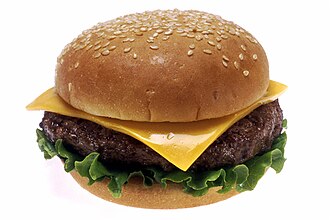
Photo: Wikipedia
The McDonald's Cheeseburger is a compact, iconic fast-food staple featuring a thin beef patty, a slice of processed American cheese, pickles, onions, ketchup, and mustard on a soft, steamed bun. Its taste is a familiar, salty-savory blend with a slight tang from the condiments and a soft, yielding texture. Nutritionally, it provides a moderate protein boost but is notably higher in sodium and refined carbohydrates per calorie.
Calorie split: 20% protein · 37% carbs · 43% fat
↓ Full nutrition💚 Why it's loved
People love it for its nostalgic, comforting, and intensely savory flavor combination that delivers a reliable hit of umami and salt. Its simplicity and cultural status make it a go-to for a quick, satisfying bite that requires no decision-making.
⚠️ Watch-outs & how to enjoy it better
The high sodium content and refined white bun can contribute to bloating and blood-sugar spikes, and it's a common allergen (wheat, dairy). To counteract, pair it with a side salad or apple slices for fiber, drink water instead of soda, and consider it an occasional treat rather than a dietary staple.
Key benefits
- Provides a quick, accessible source of protein (13.49g per 100g).
- Offers a convenient, portion-controlled meal or snack option.
- Contains calcium from the cheese slice.
- A familiar, consistent taste profile with global availability.
🍽️ Popular dishes
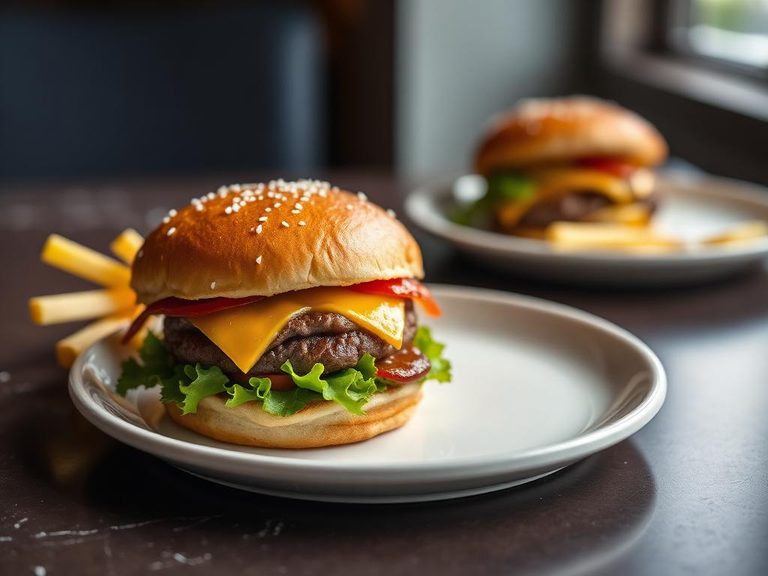
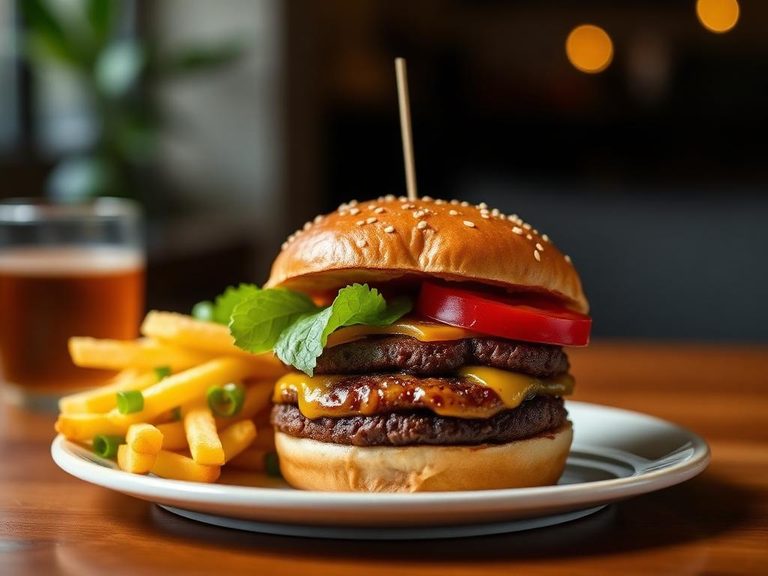
🌍 Where it's eaten
💡 Did you know?
The cheese in a McDonald's cheeseburger is a specific 'pasteurized process American cheese' product, engineered to melt perfectly at a consistent temperature without separating or becoming oily.
Full nutrition (USDA data · scales with serving)
| Water | 45.8 g |
| Energy | 270 kcal |
| Protein | 13.5 g |
| Total lipid (fat) | 12.9 g |
| Carbohydrate, by difference | 25.5 g |
| Fiber, total dietary | 1.9 g |
| Total Sugars | 5.2 g |
| Calcium, Ca | 123 mg |
| Iron, Fe | 2.3 mg |
| Magnesium, Mg | 23.0 mg |
| Phosphorus, P | 142 mg |
| Potassium, K | 184 mg |
| Sodium, Na | 628 mg |
| Zinc, Zn | 2.2 mg |
| Copper, Cu | 0.10 mg |
| Selenium, Se | 22.7 ug |
| Vitamin C, total ascorbic acid | 0.40 mg |
| Thiamin | 0.32 mg |
| Riboflavin | 0.19 mg |
| Niacin | 3.5 mg |
| Vitamin B-6 | 0.37 mg |
| Folate, total | 26.0 ug |
| Folic acid | 19.0 ug |
| Folate, food | 7.0 ug |
| Folate, DFE | 39.0 ug |
| Choline, total | 33.4 mg |
| Vitamin B-12 | 1.3 ug |
| Vitamin B-12, added | 0.00 ug |
| Vitamin A, RAE | 55.0 ug |
| Retinol | 50.0 ug |
| Carotene, beta | 55.0 ug |
| Carotene, alpha | 1.0 ug |
| Cryptoxanthin, beta | 2.0 ug |
| Lycopene | 1003 ug |
| Lutein + zeaxanthin | 22.0 ug |
| Vitamin E (alpha-tocopherol) | 0.09 mg |
| Vitamin E, added | 0.00 mg |
| Vitamin D (D2 + D3) | 0.10 ug |
| Vitamin K (phylloquinone) | 5.5 ug |
| Alcohol, ethyl | 0.00 g |
| Caffeine | 0.00 mg |
| Theobromine | 0.00 mg |
Fat & fatty acid profile (per 100g)
| Fatty acids, total saturated | 5.8 g |
| SFA 4:0 | 0.09 g |
| SFA 6:0 | 0.06 g |
| SFA 8:0 | 0.04 g |
| SFA 10:0 | 0.08 g |
| SFA 12:0 | 0.10 g |
| SFA 14:0 | 0.58 g |
| SFA 16:0 | 3.0 g |
| SFA 18:0 | 1.6 g |
| Fatty acids, total monounsaturated | 5.0 g |
| MUFA 16:1 | 0.42 g |
| MUFA 18:1 | 4.5 g |
| MUFA 20:1 | 0.03 g |
| MUFA 22:1 | 0.01 g |
| Fatty acids, total polyunsaturated | 1.4 g |
| PUFA 18:2 | 1.2 g |
| PUFA 18:3 | 0.12 g |
| PUFA 18:4 | 0.03 g |
| PUFA 20:4 | 0.02 g |
| PUFA 20:5 n-3 (EPA) | 0.00 g |
| PUFA 22:5 n-3 (DPA) | 0.00 g |
| PUFA 22:6 n-3 (DHA) | 0.00 g |
| Cholesterol | 39.0 mg |
FAQ
Is a McDonald's cheeseburger a good source of protein?
Yes, for its size, it provides a decent amount of protein (about 16g per 118g burger), which can help with satiety. However, it comes with significant sodium and saturated fat.
Why does the cheese taste different from store-bought slices?
It's a specially formulated 'pasteurized process cheese food' designed for superior meltability and a consistent, mild flavor that complements the other ingredients without overpowering them.
How can I make a healthier version at home?
Use a lean ground beef or turkey patty, a whole-grain bun, low-sodium cheese, and load it with fresh lettuce, tomato, and onion. Skip the sugary ketchup and salty pickles, or use them sparingly.
Nutrient density (calculated · NRF9.3)
Nutrient Rich Foods index: beneficial nutrients (protein, fiber, vitamins, minerals) minus saturated fat, added sugar & sodium, per 100 kcal.
NRF9.3 index — Fulgoni, Keast & Drewnowski, 2009. Computed from USDA nutrients.
Weight-loss friendliness (composite index)
Energy density 2.70 kcal/g · 20% calories from protein · 1.9 g fiber · 5.2 g sugar per 100 g.
Composite of energy density (Rolls et al., 1999), protein & fiber satiety, minus sugar. A calculated heuristic — ranks satiety-per-calorie, not a clinical measure.
Dietary load (calculated from USDA values)
Potential renal acid load. Positive = acid-forming, negative = alkaline-forming.
Sodium-to-potassium ratio: 3.41 (lower is better — aim for ≤ 1)
Sodium:potassium per WHO potassium guidance. Computed from USDA nutrients.