

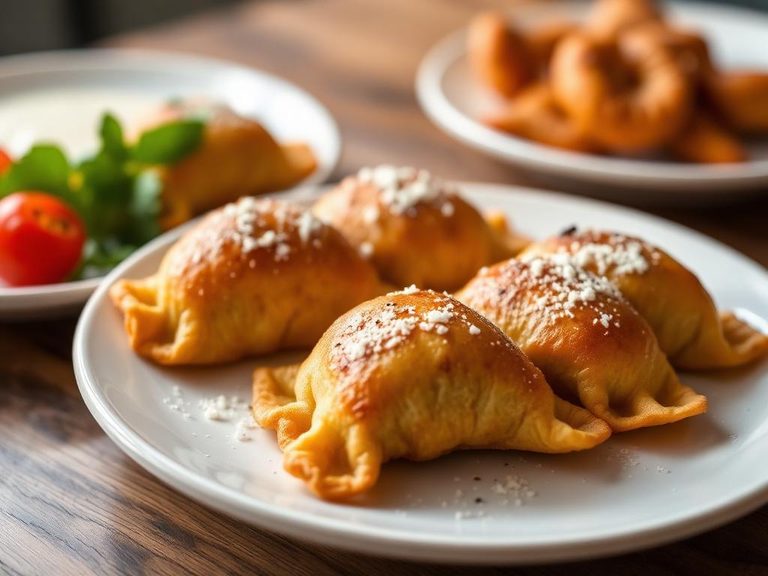
Calzone, with meat and cheese
Common food

Photo: Wikipedia
A calzone with meat and cheese is a golden, half-moon Italian turnover, sealed and baked to a crisp exterior that gives way to a molten core of savory ground meat and stretchy mozzarella. Its doughy crust offers a satisfying chew, while the interior delivers a rich, umami-packed, and salty flavor profile. Nutritionally, it's a calorie-dense, protein-rich meal that provides substantial energy from its combination of refined carbohydrates and fats.
Calorie split: 17% protein · 36% carbs · 46% fat
↓ Full nutrition💚 Why it's loved
People love it for the perfect handheld ratio of crispy, chewy dough to a hot, gooey, and savory filling, making it a more contained and less messy alternative to pizza. It's also cherished as a comforting, customizable classic that evokes the warmth of Italian-American pizzeria culture.
⚠️ Watch-outs & how to enjoy it better
Its refined white flour dough can cause rapid blood-sugar spikes, and it is often high in sodium and saturated fat from the cheese and processed meats. To counteract this, pair it with a large, vinegar-dressed green salad to slow digestion, opt for a smaller portion, and choose fillings like grilled chicken or vegetables to improve the nutrient profile.
Key benefits
- High-quality protein source for muscle maintenance and satiety.
- Provides quick energy from its carbohydrate-rich dough.
- Contains calcium and phosphorus from the cheese for bone health.
- A portable, self-contained meal that is easy to eat on the go.
- The dough acts as a vessel, preserving the moisture and flavor of the fillings.
🍽️ Popular dishes
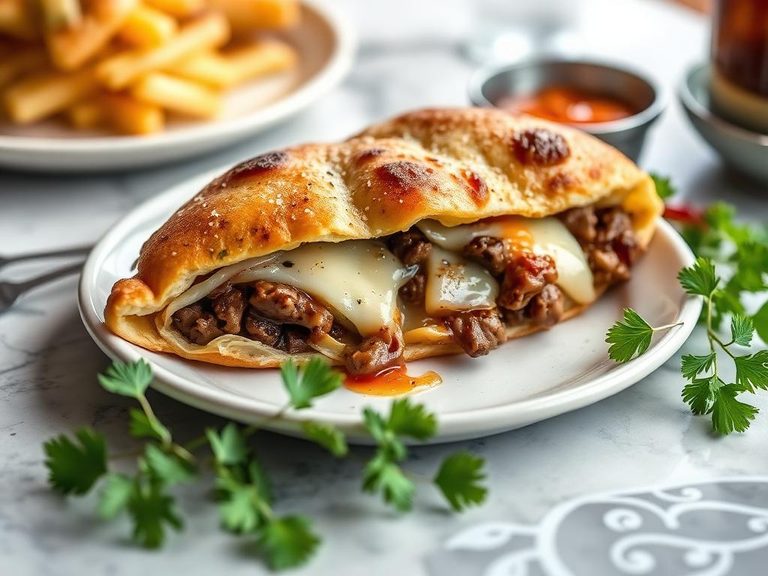
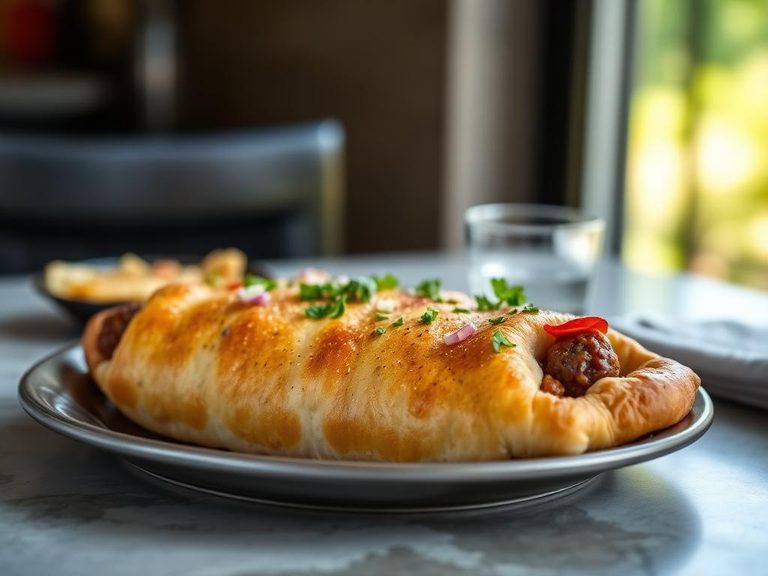
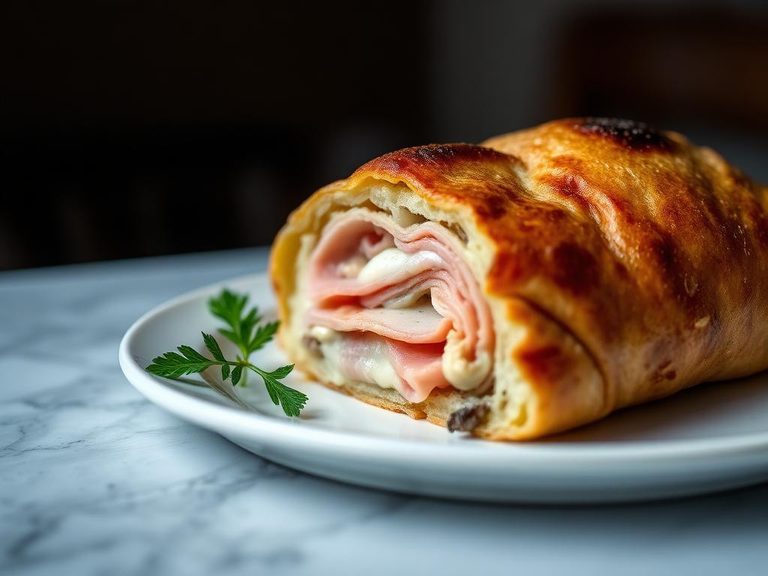
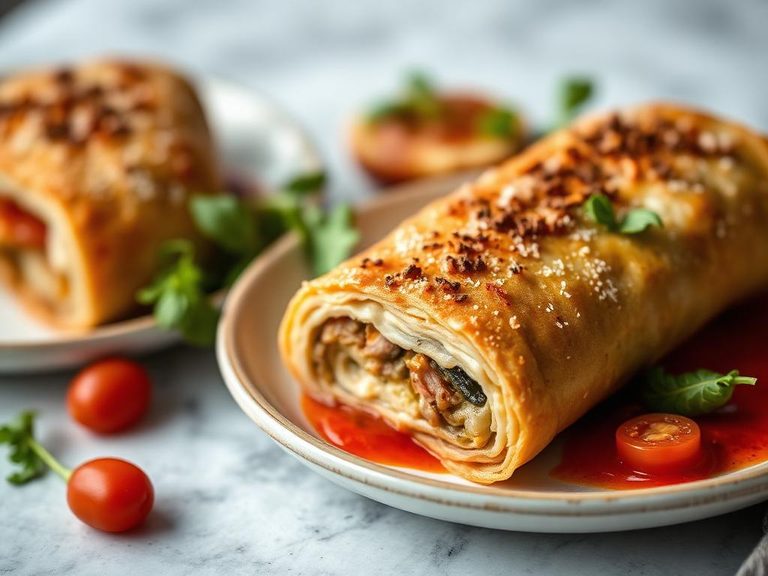
🌍 Where it's eaten
💡 Did you know?
The word 'calzone' means 'trouser leg' or 'stocking' in Italian, a reference to its shape and the idea that it's a meal you can eat while walking, like putting food in your pocket.
Full nutrition (USDA data · scales with serving)
| Water | 34.1 g |
| Energy | 343 kcal |
| Protein | 14.8 g |
| Total lipid (fat) | 17.7 g |
| Carbohydrate, by difference | 31.3 g |
| Fiber, total dietary | 1.4 g |
| Total Sugars | 0.59 g |
| Calcium, Ca | 177 mg |
| Iron, Fe | 2.6 mg |
| Magnesium, Mg | 22.0 mg |
| Phosphorus, P | 209 mg |
| Potassium, K | 169 mg |
| Sodium, Na | 434 mg |
| Zinc, Zn | 2.0 mg |
| Copper, Cu | 0.09 mg |
| Selenium, Se | 18.0 ug |
| Vitamin C, total ascorbic acid | 0.00 mg |
| Thiamin | 0.49 mg |
| Riboflavin | 0.36 mg |
| Niacin | 3.9 mg |
| Vitamin B-6 | 0.12 mg |
| Folate, total | 87.0 ug |
| Folic acid | 36.0 ug |
| Folate, food | 51.0 ug |
| Folate, DFE | 112 ug |
| Choline, total | 30.5 mg |
| Vitamin B-12 | 0.53 ug |
| Vitamin B-12, added | 0.00 ug |
| Vitamin A, RAE | 113 ug |
| Retinol | 109 ug |
| Carotene, beta | 42.0 ug |
| Carotene, alpha | 0.00 ug |
| Cryptoxanthin, beta | 0.00 ug |
| Lycopene | 0.00 ug |
| Lutein + zeaxanthin | 25.0 ug |
| Vitamin E (alpha-tocopherol) | 1.4 mg |
| Vitamin E, added | 0.00 mg |
| Vitamin D (D2 + D3) | 0.30 ug |
| Vitamin K (phylloquinone) | 9.6 ug |
| Alcohol, ethyl | 0.00 g |
| Caffeine | 0.00 mg |
| Theobromine | 0.00 mg |
Fat & fatty acid profile (per 100g)
| Fatty acids, total saturated | 5.7 g |
| SFA 4:0 | 0.11 g |
| SFA 6:0 | 0.07 g |
| SFA 8:0 | 0.05 g |
| SFA 10:0 | 0.11 g |
| SFA 12:0 | 0.12 g |
| SFA 14:0 | 0.53 g |
| SFA 16:0 | 3.0 g |
| SFA 18:0 | 1.5 g |
| Fatty acids, total monounsaturated | 6.8 g |
| MUFA 16:1 | 0.26 g |
| MUFA 18:1 | 6.4 g |
| MUFA 20:1 | 0.06 g |
| MUFA 22:1 | 0.00 g |
| Fatty acids, total polyunsaturated | 3.5 g |
| PUFA 18:2 | 3.2 g |
| PUFA 18:3 | 0.31 g |
| PUFA 18:4 | 0.00 g |
| PUFA 20:4 | 0.02 g |
| PUFA 20:5 n-3 (EPA) | 0.00 g |
| PUFA 22:5 n-3 (DPA) | 0.00 g |
| PUFA 22:6 n-3 (DHA) | 0.00 g |
| Cholesterol | 46.0 mg |
FAQ
What's the difference between a calzone and a stromboli?
A calzone is typically a folded circle of dough, sealed at the edges, and often contains ricotta cheese. A stromboli is a rectangle of dough rolled up like a jelly roll, sealed on the ends, and usually does not contain ricotta.
Is a calzone healthier than a pizza?
Not necessarily. While it contains similar ingredients, a calzone can be denser and higher in calories per serving due to the enclosed dough, which traps steam and can lead to a thicker, more absorbent crust. The healthiness depends entirely on portion size and fillings.
Why is my calzone soggy?
A soggy calzone is usually caused by wet fillings (like uncooked vegetables or excess sauce) releasing steam during baking. To prevent this, use well-drained ingredients, place a small dollop of sauce inside rather than smearing it, and ensure the oven is fully preheated.
Nutrient density (calculated · NRF9.3)
Nutrient Rich Foods index: beneficial nutrients (protein, fiber, vitamins, minerals) minus saturated fat, added sugar & sodium, per 100 kcal.
NRF9.3 index — Fulgoni, Keast & Drewnowski, 2009. Computed from USDA nutrients.
Weight-loss friendliness (composite index)
Energy density 3.43 kcal/g · 17% calories from protein · 1.4 g fiber · 0.6 g sugar per 100 g.
Composite of energy density (Rolls et al., 1999), protein & fiber satiety, minus sugar. A calculated heuristic — ranks satiety-per-calorie, not a clinical measure.
Dietary load (calculated from USDA values)
Potential renal acid load. Positive = acid-forming, negative = alkaline-forming.
Sodium-to-potassium ratio: 2.57 (lower is better — aim for ≤ 1)
Sodium:potassium per WHO potassium guidance. Computed from USDA nutrients.