

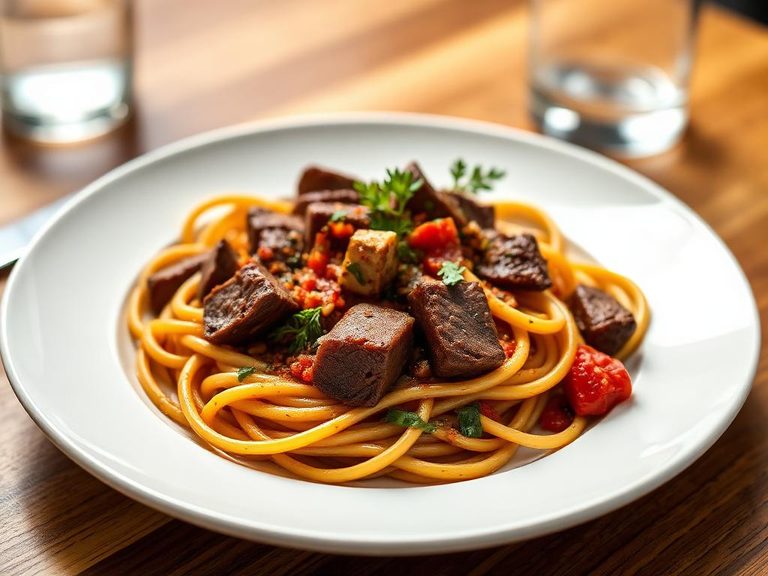
Venison or deer, noodles, and vegetables excluding carrots, broccoli, and dark-green leafy; tomato-based sauce
Common food

Photo: Wikipedia
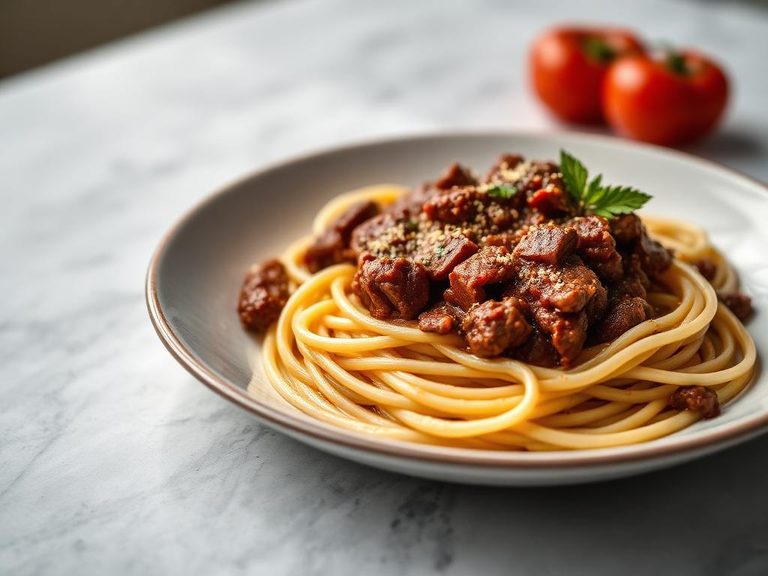
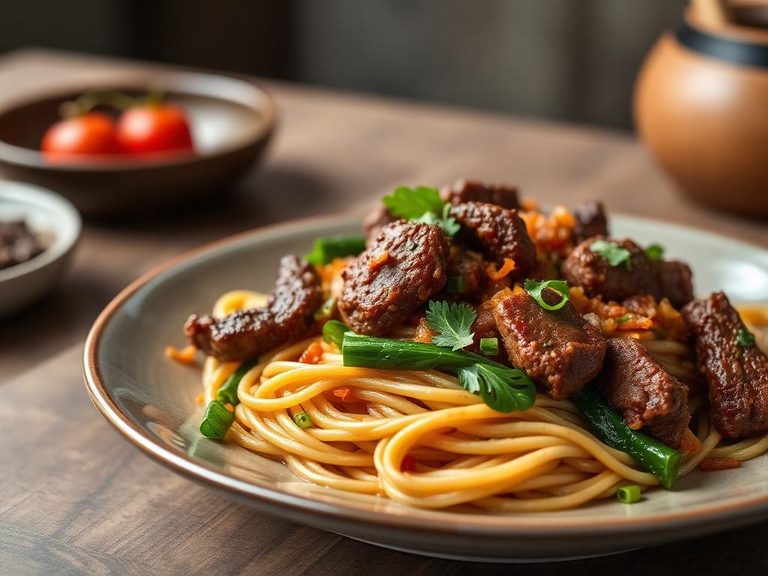
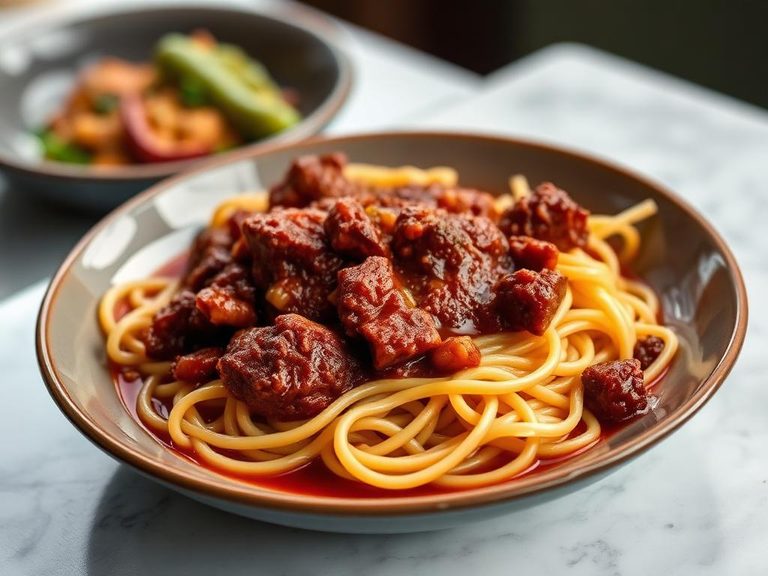
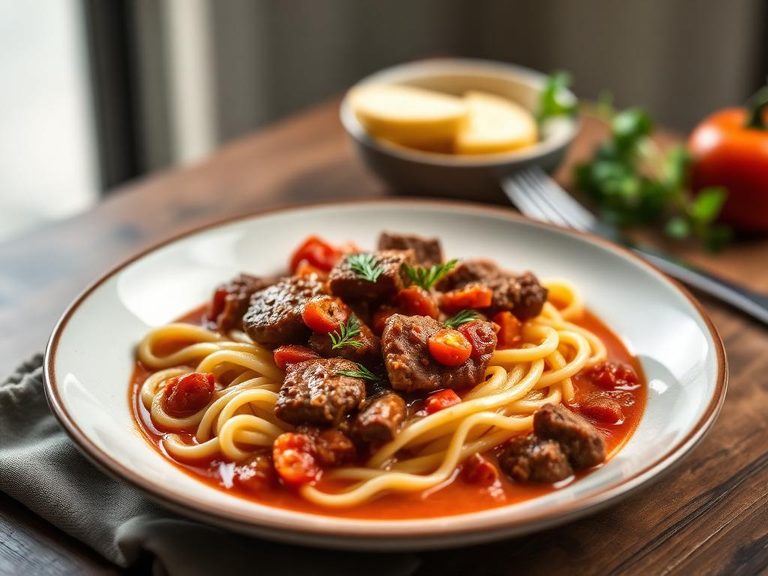
This is a hearty, savory dish combining tender, lean venison with soft noodles and a bright, tomato-based sauce, studded with vegetables like zucchini, bell peppers, or peas. The flavor is rich and slightly gamey, balanced by the acidity of the tomato and the comforting texture of the noodles. Nutritionally, it's a light yet satisfying meal, offering a good protein-to-calorie ratio with a moderate amount of healthy fats from the venison.
Calorie split: 22% protein · 44% carbs · 34% fat
↓ Full nutrition💚 Why it's loved
People love this dish for its comforting, rustic appeal and the unique, earthy flavor of venison that pairs beautifully with the tangy tomato sauce. It's a versatile one-pot meal that can be adapted with seasonal vegetables, making it a favorite in home cooking and hearty dinners.
⚠️ Watch-outs & how to enjoy it better
The dish may be high in sodium if using canned tomato sauce or processed noodles, which could be a concern for those watching blood pressure. To counteract this, opt for low-sodium sauce, use whole-grain noodles for added fiber, and pair with a side salad to balance the meal. Those sensitive to gamey flavors might find venison strong; marinating the meat beforehand can help mellow it out.
Key benefits
- High-quality, lean protein source from venison
- Low in calories per 100g, suitable for weight management
- Provides a good mix of complex carbs from noodles and fiber from vegetables
- Rich in iron and B vitamins from the deer meat
- Tomato sauce offers antioxidants like lycopene
🍽️ Popular dishes
🌍 Where it's eaten
💡 Did you know?
Venison is one of the leanest red meats, with less fat than chicken breast, and has been hunted and eaten by humans for over 500,000 years, making it one of the oldest consumed meats in history.
Full nutrition (USDA data · scales with serving)
| Water | 71.4 g |
| Energy | 134 kcal |
| Protein | 7.5 g |
| Total lipid (fat) | 5.1 g |
| Carbohydrate, by difference | 14.8 g |
| Fiber, total dietary | 1.4 g |
| Total Sugars | 1.6 g |
| Calcium, Ca | 14.0 mg |
| Iron, Fe | 1.7 mg |
| Magnesium, Mg | 21.0 mg |
| Phosphorus, P | 85.0 mg |
| Potassium, K | 171 mg |
| Sodium, Na | 305 mg |
| Zinc, Zn | 1.6 mg |
| Copper, Cu | 0.12 mg |
| Selenium, Se | 13.1 ug |
| Vitamin C, total ascorbic acid | 2.5 mg |
| Thiamin | 0.16 mg |
| Riboflavin | 0.18 mg |
| Niacin | 2.3 mg |
| Vitamin B-6 | 0.12 mg |
| Folate, total | 46.0 ug |
| Folic acid | 34.0 ug |
| Folate, food | 12.0 ug |
| Folate, DFE | 70.0 ug |
| Choline, total | 34.8 mg |
| Vitamin B-12 | 0.44 ug |
| Vitamin B-12, added | 0.00 ug |
| Vitamin A, RAE | 11.0 ug |
| Retinol | 3.0 ug |
| Carotene, beta | 93.0 ug |
| Carotene, alpha | 6.0 ug |
| Cryptoxanthin, beta | 12.0 ug |
| Lycopene | 3672 ug |
| Lutein + zeaxanthin | 128 ug |
| Vitamin E (alpha-tocopherol) | 1.2 mg |
| Vitamin E, added | 0.00 mg |
| Vitamin D (D2 + D3) | 0.00 ug |
| Vitamin K (phylloquinone) | 7.9 ug |
| Alcohol, ethyl | 0.00 g |
| Caffeine | 0.00 mg |
| Theobromine | 0.00 mg |
Fat & fatty acid profile (per 100g)
| Fatty acids, total saturated | 0.97 g |
| SFA 4:0 | 0.00 g |
| SFA 6:0 | 0.00 g |
| SFA 8:0 | 0.00 g |
| SFA 10:0 | 0.00 g |
| SFA 12:0 | 0.00 g |
| SFA 14:0 | 0.02 g |
| SFA 16:0 | 0.63 g |
| SFA 18:0 | 0.28 g |
| Fatty acids, total monounsaturated | 1.9 g |
| MUFA 16:1 | 0.04 g |
| MUFA 18:1 | 1.8 g |
| MUFA 20:1 | 0.02 g |
| MUFA 22:1 | 0.00 g |
| Fatty acids, total polyunsaturated | 1.7 g |
| PUFA 18:2 | 1.5 g |
| PUFA 18:3 | 0.18 g |
| PUFA 18:4 | 0.00 g |
| PUFA 20:4 | 0.01 g |
| PUFA 20:5 n-3 (EPA) | 0.00 g |
| PUFA 22:5 n-3 (DPA) | 0.00 g |
| PUFA 22:6 n-3 (DHA) | 0.00 g |
| Cholesterol | 28.0 mg |
FAQ
Is venison healthy to eat regularly?
Yes, venison is a lean, nutrient-dense red meat high in protein, iron, and B vitamins, making it a healthy choice when consumed in moderation as part of a balanced diet.
How can I reduce the gamey taste of venison?
Marinate the meat in acidic ingredients like vinegar, wine, or citrus juice for a few hours before cooking, or use strong herbs and spices such as rosemary, thyme, or juniper berries to balance the flavor.
What vegetables work well with venison and tomato sauce?
Zucchini, bell peppers, onions, mushrooms, peas, and celery are excellent choices that complement the rich flavor of venison without overpowering the tomato sauce.
Nutrient density (calculated · NRF9.3)
Nutrient Rich Foods index: beneficial nutrients (protein, fiber, vitamins, minerals) minus saturated fat, added sugar & sodium, per 100 kcal.
NRF9.3 index — Fulgoni, Keast & Drewnowski, 2009. Computed from USDA nutrients.
Weight-loss friendliness (composite index)
Energy density 1.34 kcal/g · 22% calories from protein · 1.4 g fiber · 1.6 g sugar per 100 g.
Composite of energy density (Rolls et al., 1999), protein & fiber satiety, minus sugar. A calculated heuristic — ranks satiety-per-calorie, not a clinical measure.
Dietary load (calculated from USDA values)
Potential renal acid load. Positive = acid-forming, negative = alkaline-forming.
Sodium-to-potassium ratio: 1.78 (lower is better — aim for ≤ 1)
Sodium:potassium per WHO potassium guidance. Computed from USDA nutrients.