

Tamale casserole with meat
Common food

Photo: Wikipedia
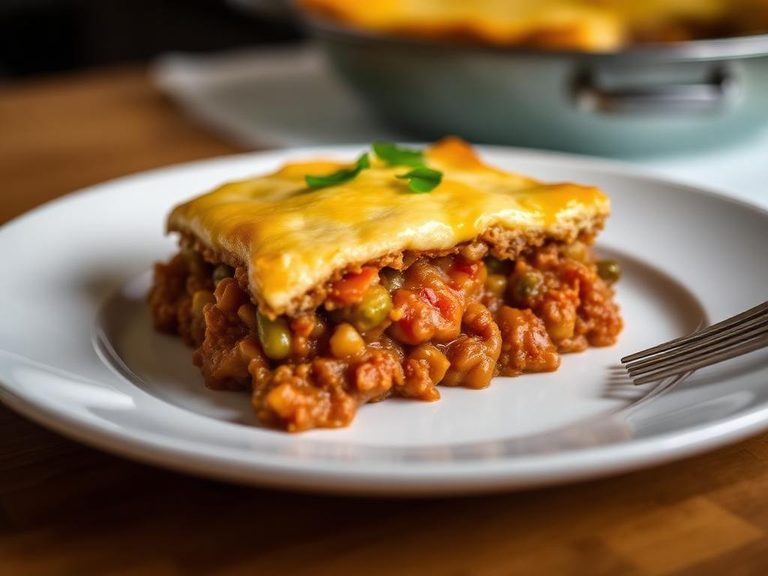
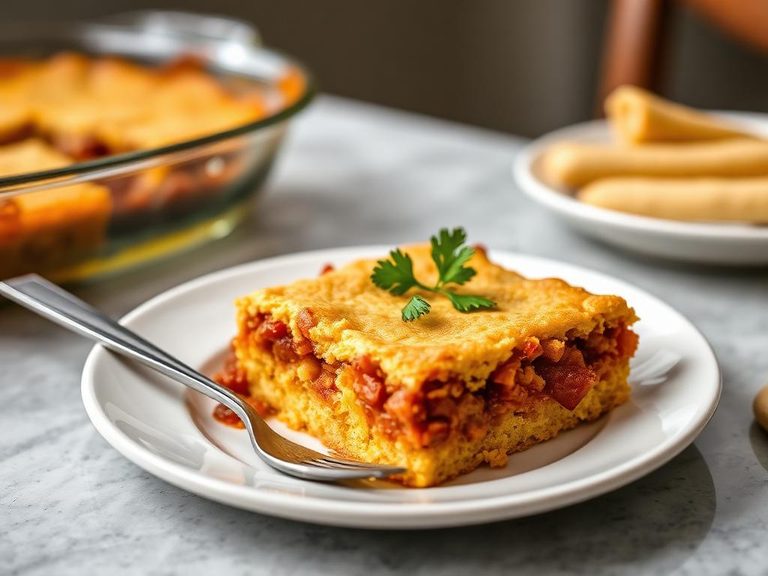
A hearty, layered casserole featuring seasoned ground meat and a sweet, corn-based masa or cornbread topping, often with cheese and chili sauce. It offers a comforting contrast of savory, spiced meat and a soft, slightly crumbly or custardy corn layer. With a balanced macro profile, it provides a good source of protein and moderate energy from carbs and fats.
Calorie split: 17% protein · 36% carbs · 47% fat
↓ Full nutrition💚 Why it's loved
People love it for its deeply satisfying, savory-sweet flavor profile and the way it brings together comforting textures in every bite. It's a versatile crowd-pleaser often associated with family gatherings and festive meals.
⚠️ Watch-outs & how to enjoy it better
The dish can be high in sodium and saturated fat depending on the meat and cheese used, which may concern those monitoring heart health or blood pressure. To counteract this, use lean ground meat, reduce added salt, and load up on a side of fresh, leafy greens or a vinegar-based slaw to add volume and fiber without extra sodium.
Key benefits
- Good source of protein from the meat component.
- Provides energy from complex carbohydrates in the corn base.
- Contains dietary fiber, especially if made with whole-grain corn or added beans.
- Can be a complete meal in one dish, combining protein, carbs, and fats.
🍽️ Popular dishes

🌍 Where it's eaten
💡 Did you know?
The 'tamale' in tamale casserole is often a shortcut using cornbread or cornmeal batter, not the traditional labor-intensive masa dough that is steamed in corn husks.
Full nutrition (USDA data · scales with serving)
| Water | 66.0 g |
| Energy | 174 kcal |
| Protein | 7.4 g |
| Total lipid (fat) | 9.0 g |
| Carbohydrate, by difference | 15.8 g |
| Fiber, total dietary | 2.4 g |
| Total Sugars | 0.46 g |
| Calcium, Ca | 75.0 mg |
| Iron, Fe | 0.87 mg |
| Magnesium, Mg | 26.0 mg |
| Phosphorus, P | 120 mg |
| Potassium, K | 152 mg |
| Sodium, Na | 473 mg |
| Zinc, Zn | 1.2 mg |
| Copper, Cu | 0.05 mg |
| Selenium, Se | 9.8 ug |
| Vitamin C, total ascorbic acid | 16.4 mg |
| Thiamin | 0.04 mg |
| Riboflavin | 0.05 mg |
| Niacin | 1.3 mg |
| Vitamin B-6 | 0.13 mg |
| Folate, total | 39.0 ug |
| Folic acid | 30.0 ug |
| Folate, food | 9.0 ug |
| Folate, DFE | 60.0 ug |
| Choline, total | 8.8 mg |
| Vitamin B-12 | 0.12 ug |
| Vitamin B-12, added | 0.00 ug |
| Vitamin A, RAE | 12.0 ug |
| Retinol | 1.0 ug |
| Carotene, beta | 113 ug |
| Carotene, alpha | 0.00 ug |
| Cryptoxanthin, beta | 58.0 ug |
| Lycopene | 85.0 ug |
| Lutein + zeaxanthin | 110 ug |
| Vitamin E (alpha-tocopherol) | 0.53 mg |
| Vitamin E, added | 0.00 mg |
| Vitamin D (D2 + D3) | 0.30 ug |
| Vitamin K (phylloquinone) | 5.1 ug |
| Alcohol, ethyl | 0.00 g |
| Caffeine | 0.00 mg |
| Theobromine | 0.00 mg |
Fat & fatty acid profile (per 100g)
| Fatty acids, total saturated | 2.7 g |
| SFA 4:0 | 0.00 g |
| SFA 6:0 | 0.00 g |
| SFA 8:0 | 0.00 g |
| SFA 10:0 | 0.01 g |
| SFA 12:0 | 0.01 g |
| SFA 14:0 | 0.10 g |
| SFA 16:0 | 1.7 g |
| SFA 18:0 | 0.82 g |
| Fatty acids, total monounsaturated | 3.2 g |
| MUFA 16:1 | 0.15 g |
| MUFA 18:1 | 3.0 g |
| MUFA 20:1 | 0.06 g |
| MUFA 22:1 | 0.00 g |
| Fatty acids, total polyunsaturated | 2.0 g |
| PUFA 18:2 | 1.8 g |
| PUFA 18:3 | 0.10 g |
| PUFA 18:4 | 0.00 g |
| PUFA 20:4 | 0.03 g |
| PUFA 20:5 n-3 (EPA) | 0.00 g |
| PUFA 22:5 n-3 (DPA) | 0.01 g |
| PUFA 22:6 n-3 (DHA) | 0.00 g |
| Cholesterol | 20.0 mg |
FAQ
Is this the same as a traditional tamale?
No. Traditional tamales are made with masa dough steamed in corn husks or banana leaves. A casserole is a baked, layered dish that simplifies the concept.
Can I make it vegetarian?
Yes. You can substitute the meat with a mix of beans (like black or pinto), lentils, or textured vegetable protein, and use vegetable broth.
How do I store and reheat leftovers?
Store covered in the refrigerator for up to 3-4 days. Reheat individual portions in the microwave or cover the dish with foil and warm in a 350°F (175°C) oven until heated through.
Nutrient density (calculated · NRF9.3)
Nutrient Rich Foods index: beneficial nutrients (protein, fiber, vitamins, minerals) minus saturated fat, added sugar & sodium, per 100 kcal.
NRF9.3 index — Fulgoni, Keast & Drewnowski, 2009. Computed from USDA nutrients.
Weight-loss friendliness (composite index)
Energy density 1.74 kcal/g · 17% calories from protein · 2.4 g fiber · 0.5 g sugar per 100 g.
Composite of energy density (Rolls et al., 1999), protein & fiber satiety, minus sugar. A calculated heuristic — ranks satiety-per-calorie, not a clinical measure.
Dietary load (calculated from USDA values)
Potential renal acid load. Positive = acid-forming, negative = alkaline-forming.
Sodium-to-potassium ratio: 3.11 (lower is better — aim for ≤ 1)
Sodium:potassium per WHO potassium guidance. Computed from USDA nutrients.