

Soft drink, cola, fruit or vanilla flavored
Common food

Photo: Wikipedia
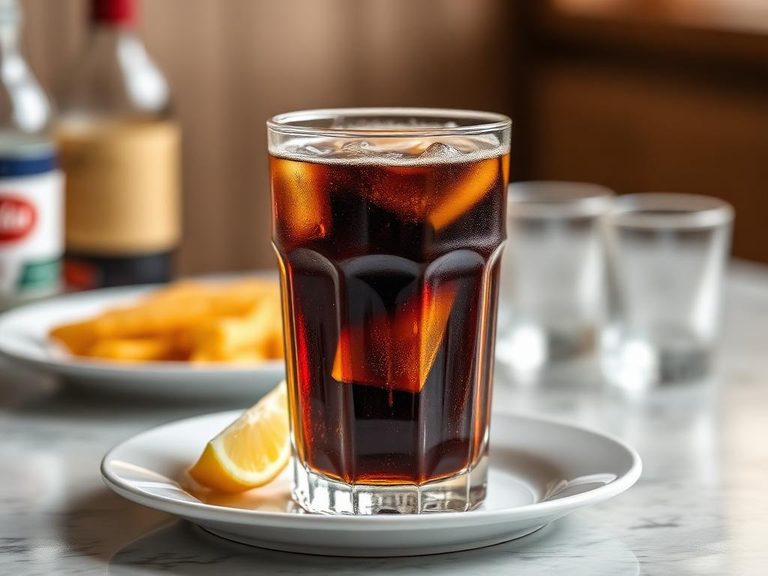
This is the quintessential carbonated sweet beverage, a fizzy, syrupy drink with a bold, caramel-vanilla or citrus profile. Its texture is light and effervescent, with a sugary kick that hits the palate instantly. Nutritionally, it is a source of quick energy from simple carbohydrates, offering 42 kcal and nearly 10 grams of sugar per 100g, but no protein, fat, or fiber.
Calorie split: 0% protein · 95% carbs · 5% fat
↓ Full nutrition💚 Why it's loved
People love it for its iconic, refreshing fizz and the nostalgic, sweet flavor that cuts through thirst. It's a cultural staple, often paired with fast food or enjoyed as a celebratory treat at social gatherings.
⚠️ Watch-outs & how to enjoy it better
The high sugar content can lead to rapid blood-sugar spikes and energy crashes, and the acidity can be harsh on dental enamel. To mitigate this, pair it with a protein or fat source (like nuts or cheese) to slow sugar absorption, practice portion control by choosing a smaller size, and rinse your mouth with water afterward to protect teeth.
Key benefits
- Provides a rapid source of energy from simple sugars.
- Contains caffeine, which can temporarily boost alertness and focus.
- Serves as a popular mixer for cocktails and mocktails.
- Often used in home remedies for upset stomachs or as a cooking glaze.
- Widely available and affordable for a quick refreshment.
🍽️ Popular dishes





🌍 Where it's eaten
💡 Did you know?
The original Coca-Cola recipe, created in 1886, contained cocaine from coca leaves, which was removed by 1903.
Full nutrition (USDA data · scales with serving)
| Water | 89.4 g |
| Energy | 42.0 kcal |
| Protein | 0.00 g |
| Total lipid (fat) | 0.25 g |
| Carbohydrate, by difference | 10.4 g |
| Fiber, total dietary | 0.00 g |
| Total Sugars | 9.9 g |
| Calcium, Ca | 1.0 mg |
| Iron, Fe | 0.02 mg |
| Magnesium, Mg | 0.00 mg |
| Phosphorus, P | 9.0 mg |
| Potassium, K | 5.0 mg |
| Sodium, Na | 3.0 mg |
| Zinc, Zn | 0.09 mg |
| Copper, Cu | 0.01 mg |
| Selenium, Se | 0.10 ug |
| Vitamin C, total ascorbic acid | 0.00 mg |
| Thiamin | 0.00 mg |
| Riboflavin | 0.00 mg |
| Niacin | 0.00 mg |
| Vitamin B-6 | 0.00 mg |
| Folate, total | 0.00 ug |
| Folic acid | 0.00 ug |
| Folate, food | 0.00 ug |
| Folate, DFE | 0.00 ug |
| Choline, total | 0.30 mg |
| Vitamin B-12 | 0.00 ug |
| Vitamin B-12, added | 0.00 ug |
| Vitamin A, RAE | 0.00 ug |
| Retinol | 0.00 ug |
| Carotene, beta | 0.00 ug |
| Carotene, alpha | 0.00 ug |
| Cryptoxanthin, beta | 0.00 ug |
| Lycopene | 0.00 ug |
| Lutein + zeaxanthin | 0.00 ug |
| Vitamin E (alpha-tocopherol) | 0.00 mg |
| Vitamin E, added | 0.00 mg |
| Vitamin D (D2 + D3) | 0.00 ug |
| Vitamin K (phylloquinone) | 0.00 ug |
| Alcohol, ethyl | 0.00 g |
| Caffeine | 9.0 mg |
| Theobromine | 0.00 mg |
Fat & fatty acid profile (per 100g)
| Fatty acids, total saturated | 0.00 g |
| SFA 4:0 | 0.00 g |
| SFA 6:0 | 0.00 g |
| SFA 8:0 | 0.00 g |
| SFA 10:0 | 0.00 g |
| SFA 12:0 | 0.00 g |
| SFA 14:0 | 0.00 g |
| SFA 16:0 | 0.00 g |
| SFA 18:0 | 0.00 g |
| Fatty acids, total monounsaturated | 0.00 g |
| MUFA 16:1 | 0.00 g |
| MUFA 18:1 | 0.00 g |
| MUFA 20:1 | 0.00 g |
| MUFA 22:1 | 0.00 g |
| Fatty acids, total polyunsaturated | 0.00 g |
| PUFA 18:2 | 0.00 g |
| PUFA 18:3 | 0.00 g |
| PUFA 18:4 | 0.00 g |
| PUFA 20:4 | 0.00 g |
| PUFA 20:5 n-3 (EPA) | 0.00 g |
| PUFA 22:5 n-3 (DPA) | 0.00 g |
| PUFA 22:6 n-3 (DHA) | 0.00 g |
| Cholesterol | 0.00 mg |
FAQ
Is diet soda a healthier alternative?
Diet sodas use artificial sweeteners instead of sugar, reducing calories and carbs, but they may still affect insulin response and dental health.
Can cola be used in cooking?
Yes, it's often used in marinades and glazes for meats like chicken or pork, where the sugar caramelizes and adds a sweet, tangy flavor.
How does cola affect hydration?
While it contains water, the caffeine and sugar can have a mild diuretic effect, making it less effective for hydration than plain water.
Nutrient density (calculated · NRF9.3)
Nutrient Rich Foods index: beneficial nutrients (protein, fiber, vitamins, minerals) minus saturated fat, added sugar & sodium, per 100 kcal.
NRF9.3 index — Fulgoni, Keast & Drewnowski, 2009. Computed from USDA nutrients.
Weight-loss friendliness (composite index)
Energy density 0.42 kcal/g · 0% calories from protein · 0.0 g fiber · 9.9 g sugar per 100 g.
Composite of energy density (Rolls et al., 1999), protein & fiber satiety, minus sugar. A calculated heuristic — ranks satiety-per-calorie, not a clinical measure.
Dietary load (calculated from USDA values)
Potential renal acid load. Positive = acid-forming, negative = alkaline-forming.
Sodium-to-potassium ratio: 0.60 (lower is better — aim for ≤ 1)
Sodium:potassium per WHO potassium guidance. Computed from USDA nutrients.