

Snacks, pretzels, hard, plain, made with unenriched flour, salted
Whole food · Snacks
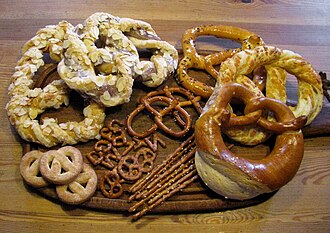
Photo: Wikipedia
A hard, crunchy, and salty snack, these plain pretzels are defined by their deep brown crust and dense, snappy interior. With nearly 80g of carbohydrates per 100g and minimal fat, they provide a quick, energy-dense boost. Their simple, unenriched flour base delivers a straightforward, toasted wheat flavor.
Calorie split: 9% protein · 82% carbs · 8% fat
↓ Full nutrition💚 Why it's loved
People love the satisfying crunch and the classic salty, baked-wheat flavor that pairs perfectly with dips or stands alone. Their long shelf life and portability make them a staple for road trips, movie nights, and casual gatherings.
⚠️ Watch-outs & how to enjoy it better
The high sodium and refined carbohydrate content can lead to blood-sugar spikes and water retention. To mitigate this, pair them with a protein or fat source like hummus or cheese, and practice strict portion control. Those with celiac disease must avoid them due to the wheat flour.
Key benefits
- Low in fat (3.5g per 100g)
- Good source of quick energy from complex carbs
- Provides a small amount of plant-based protein (9.1g)
- Simple, whole-ingredient snack with minimal processing
🍽️ Popular dishes





🌍 Where it's eaten
💡 Did you know?
The pretzel's distinctive knotted shape is said to have originated with European monks in the early Middle Ages, who baked them to resemble children's arms crossed in prayer.
Full nutrition (USDA data · scales with serving)
| Water | 3.3 g |
| Energy | 381 kcal |
| Energy | 1594 kj |
| Protein | 9.1 g |
| Total lipid (fat) | 3.5 g |
| Ash | 4.9 g |
| Carbohydrate, by difference | 79.2 g |
| Fiber, total dietary | 2.8 g |
| Calcium, Ca | 36.0 mg |
| Iron, Fe | 1.7 mg |
| Magnesium, Mg | 35.0 mg |
| Phosphorus, P | 113 mg |
| Potassium, K | 146 mg |
| Sodium, Na | 1715 mg |
| Zinc, Zn | 0.85 mg |
| Copper, Cu | 0.26 mg |
| Manganese, Mn | 1.8 mg |
| Selenium, Se | 5.8 ug |
| Vitamin C, total ascorbic acid | 0.00 mg |
| Thiamin | 0.18 mg |
| Riboflavin | 0.10 mg |
| Niacin | 1.9 mg |
| Pantothenic acid | 0.29 mg |
| Vitamin B-6 | 0.12 mg |
| Folate, total | 83.0 ug |
| Folic acid | 0.00 ug |
| Folate, food | 83.0 ug |
| Folate, DFE | 83.0 ug |
| Vitamin B-12 | 0.00 ug |
| Vitamin A, RAE | 0.00 ug |
| Retinol | 0.00 ug |
| Vitamin A, IU | 0.00 iu |
Fat & fatty acid profile (per 100g)
| Fatty acids, total saturated | 0.75 g |
| SFA 8:0 | 0.01 g |
| SFA 10:0 | 0.01 g |
| SFA 12:0 | 0.03 g |
| SFA 14:0 | 0.02 g |
| SFA 16:0 | 0.47 g |
| SFA 18:0 | 0.21 g |
| Fatty acids, total monounsaturated | 1.4 g |
| MUFA 16:1 | 0.02 g |
| MUFA 18:1 | 1.4 g |
| Fatty acids, total polyunsaturated | 1.2 g |
| PUFA 18:2 | 1.1 g |
| PUFA 18:3 | 0.06 g |
| Cholesterol | 0.00 mg |
Amino acid profile (per 100g)
| Tryptophan | 0.11 g |
| Threonine | 0.26 g |
| Isoleucine | 0.34 g |
| Leucine | 0.64 g |
| Lysine | 0.22 g |
| Methionine | 0.16 g |
| Cystine | 0.20 g |
| Phenylalanine | 0.45 g |
| Tyrosine | 0.27 g |
| Valine | 0.39 g |
| Arginine | 0.35 g |
| Histidine | 0.20 g |
| Alanine | 0.30 g |
| Aspartic acid | 0.41 g |
| Glutamic acid | 3.0 g |
| Glycine | 0.33 g |
| Proline | 1.0 g |
| Serine | 0.45 g |
FAQ
What is the difference between hard and soft pretzels?
Hard pretzels are baked longer to achieve a dry, crunchy texture, while soft pretzels are boiled briefly before baking to create a chewy interior and soft crust.
Are pretzels a healthy snack?
They are low in fat but high in sodium and refined carbohydrates. They can be part of a balanced diet when eaten in moderation and paired with protein or fiber-rich foods.
Why are pretzels often brown?
The brown color comes from the Maillard reaction, a chemical process that occurs when the dough is dipped in a baking soda or lye solution before baking, creating a deep color and distinct flavor.
Nutrient density (calculated · NRF9.3)
Nutrient Rich Foods index: beneficial nutrients (protein, fiber, vitamins, minerals) minus saturated fat, added sugar & sodium, per 100 kcal.
NRF9.3 index — Fulgoni, Keast & Drewnowski, 2009. Computed from USDA nutrients.
Weight-loss friendliness (composite index)
Energy density 3.81 kcal/g · 10% calories from protein · 2.8 g fiber · 0.0 g sugar per 100 g.
Composite of energy density (Rolls et al., 1999), protein & fiber satiety, minus sugar. A calculated heuristic — ranks satiety-per-calorie, not a clinical measure.
Dietary load (calculated from USDA values)
Potential renal acid load. Positive = acid-forming, negative = alkaline-forming.
Sodium-to-potassium ratio: 11.75 (lower is better — aim for ≤ 1)
Sodium:potassium per WHO potassium guidance. Computed from USDA nutrients.