

Shrimp creole, with rice
Common food

Photo: Wikipedia
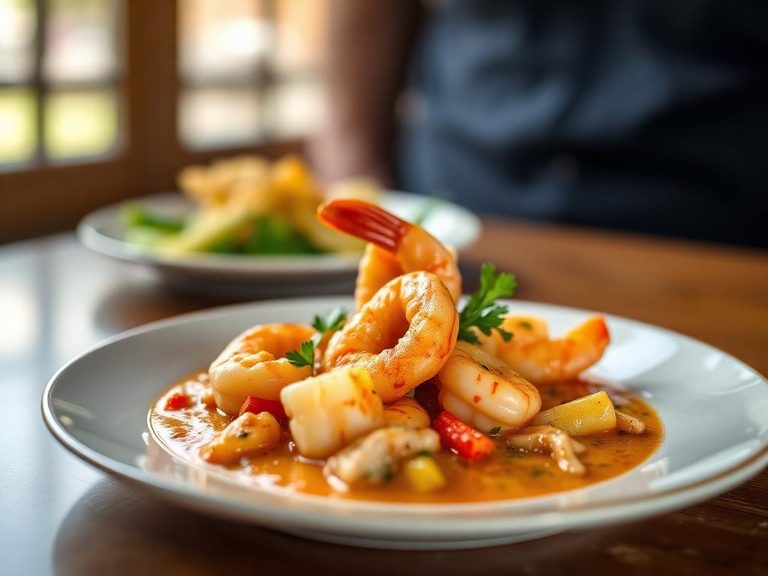
Shrimp Creole is a vibrant, saucy Louisiana classic where plump shrimp simmer in a spicy, tangy tomato-and-holy-trinity base, served over fluffy white rice. It offers a delightful contrast between the tender, briny seafood and the rich, aromatic sauce, with a texture that's both hearty and light. Per 100g, it's a lean, protein-packed dish with a modest calorie count, making it a satisfying yet balanced meal.
Calorie split: 33% protein · 39% carbs · 27% fat
↓ Full nutrition💚 Why it's loved
People adore Shrimp Creole for its bold, layered flavors—a perfect harmony of spicy, savory, and tangy notes from the Cajun/Creole seasoning and tomatoes. It's a beloved cultural staple in Louisiana, representing a delicious fusion of French, Spanish, West African, and Native American culinary traditions.
⚠️ Watch-outs & how to enjoy it better
The dish can be high in sodium due to the seasoning blends and canned tomatoes, which may concern those monitoring salt intake. Shrimp is a common shellfish allergen, and the tomato-based sauce can be acidic for some. To counteract sodium, use low-sodium broth and tomatoes, and rinse canned beans if adding them. For acidity, balance with a dollop of cooling Greek yogurt or a side of steamed greens.
Key benefits
- High-quality lean protein from shrimp for muscle maintenance.
- Low in fat, especially saturated fat, supporting heart health.
- Contains lycopene from tomatoes, a powerful antioxidant.
- Provides B-vitamins like B12 from shrimp for energy metabolism.
- Relatively low in calories for a flavorful, saucy dish.
🍽️ Popular dishes
🌍 Where it's eaten
💡 Did you know?
The 'holy trinity' of Cajun/Creole cooking—onion, celery, and bell pepper—is a local adaptation of the French mirepoix, substituting bell pepper for carrot, reflecting the ingredients available in the Gulf Coast region.
Full nutrition (USDA data · scales with serving)
| Water | 72.8 g |
| Energy | 123 kcal |
| Protein | 10.1 g |
| Total lipid (fat) | 3.6 g |
| Carbohydrate, by difference | 11.9 g |
| Fiber, total dietary | 0.80 g |
| Total Sugars | 0.96 g |
| Calcium, Ca | 77.0 mg |
| Iron, Fe | 1.6 mg |
| Magnesium, Mg | 22.0 mg |
| Phosphorus, P | 106 mg |
| Potassium, K | 114 mg |
| Sodium, Na | 436 mg |
| Zinc, Zn | 1.1 mg |
| Copper, Cu | 0.16 mg |
| Selenium, Se | 23.4 ug |
| Vitamin C, total ascorbic acid | 7.4 mg |
| Thiamin | 0.24 mg |
| Riboflavin | 0.04 mg |
| Niacin | 1.1 mg |
| Vitamin B-6 | 0.08 mg |
| Folate, total | 27.0 ug |
| Folic acid | 19.0 ug |
| Folate, food | 8.0 ug |
| Folate, DFE | 41.0 ug |
| Choline, total | 38.1 mg |
| Vitamin B-12 | 0.32 ug |
| Vitamin B-12, added | 0.00 ug |
| Vitamin A, RAE | 35.0 ug |
| Retinol | 27.0 ug |
| Carotene, beta | 97.0 ug |
| Carotene, alpha | 0.00 ug |
| Cryptoxanthin, beta | 0.00 ug |
| Lycopene | 731 ug |
| Lutein + zeaxanthin | 30.0 ug |
| Vitamin E (alpha-tocopherol) | 0.99 mg |
| Vitamin E, added | 0.00 mg |
| Vitamin D (D2 + D3) | 0.10 ug |
| Vitamin K (phylloquinone) | 4.3 ug |
| Alcohol, ethyl | 0.00 g |
| Caffeine | 0.00 mg |
| Theobromine | 0.00 mg |
Fat & fatty acid profile (per 100g)
| Fatty acids, total saturated | 0.66 g |
| SFA 4:0 | 0.00 g |
| SFA 6:0 | 0.00 g |
| SFA 8:0 | 0.00 g |
| SFA 10:0 | 0.00 g |
| SFA 12:0 | 0.00 g |
| SFA 14:0 | 0.00 g |
| SFA 16:0 | 0.37 g |
| SFA 18:0 | 0.25 g |
| Fatty acids, total monounsaturated | 1.5 g |
| MUFA 16:1 | 0.01 g |
| MUFA 18:1 | 1.4 g |
| MUFA 20:1 | 0.01 g |
| MUFA 22:1 | 0.00 g |
| Fatty acids, total polyunsaturated | 1.2 g |
| PUFA 18:2 | 0.85 g |
| PUFA 18:3 | 0.08 g |
| PUFA 18:4 | 0.00 g |
| PUFA 20:4 | 0.02 g |
| PUFA 20:5 n-3 (EPA) | 0.13 g |
| PUFA 22:5 n-3 (DPA) | 0.02 g |
| PUFA 22:6 n-3 (DHA) | 0.11 g |
| Cholesterol | 108 mg |
FAQ
Is Shrimp Creole spicy?
It can be, depending on the recipe. The heat comes from cayenne pepper, hot sauce, or spicy paprika in the Creole seasoning. Many versions are more savory and tangy than fiery, and the spice level is often adjustable to taste.
What's the difference between Shrimp Creole and Shrimp Étouffée?
Shrimp Creole is tomato-based, with a thinner, more acidic sauce. Shrimp Étouffée is a richer, gravy-like dish thickened with a roux (flour and fat cooked together) and typically has a deeper, more concentrated flavor without a prominent tomato presence.
Can I make Shrimp Creole ahead of time?
Yes, the sauce base (without the shrimp) can be made a day in advance and refrigerated. Add the shrimp and reheat gently just before serving to prevent them from becoming rubbery. The flavors often deepen and improve overnight.
Nutrient density (calculated · NRF9.3)
Nutrient Rich Foods index: beneficial nutrients (protein, fiber, vitamins, minerals) minus saturated fat, added sugar & sodium, per 100 kcal.
NRF9.3 index — Fulgoni, Keast & Drewnowski, 2009. Computed from USDA nutrients.
Weight-loss friendliness (composite index)
Energy density 1.23 kcal/g · 33% calories from protein · 0.8 g fiber · 1.0 g sugar per 100 g.
Composite of energy density (Rolls et al., 1999), protein & fiber satiety, minus sugar. A calculated heuristic — ranks satiety-per-calorie, not a clinical measure.
Dietary load (calculated from USDA values)
Potential renal acid load. Positive = acid-forming, negative = alkaline-forming.
Sodium-to-potassium ratio: 3.82 (lower is better — aim for ≤ 1)
Sodium:potassium per WHO potassium guidance. Computed from USDA nutrients.