

Sausage and rice with cheese sauce
Common food
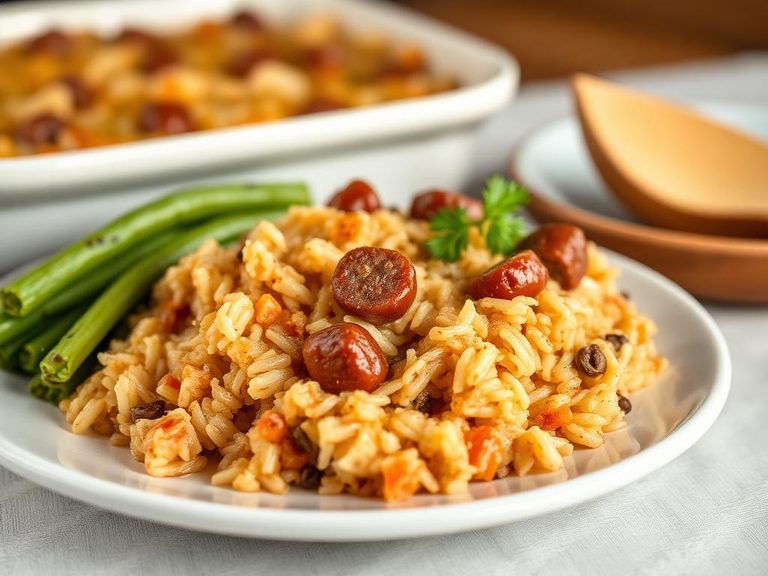
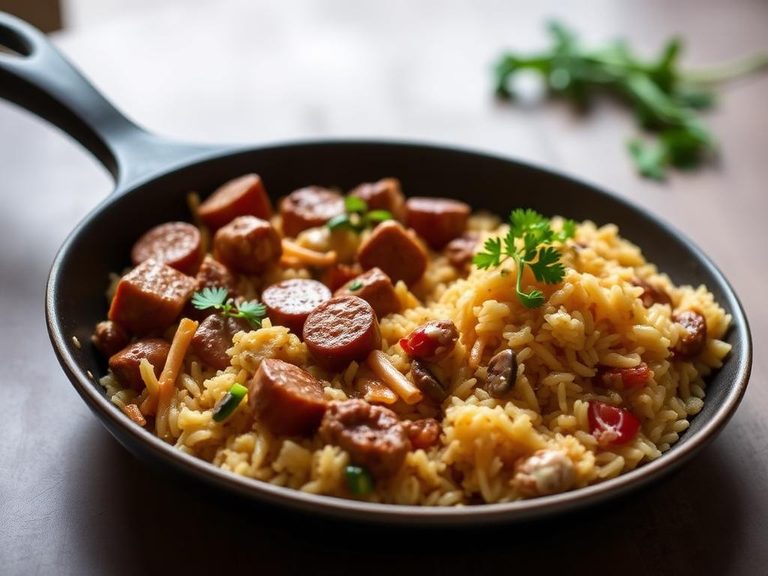
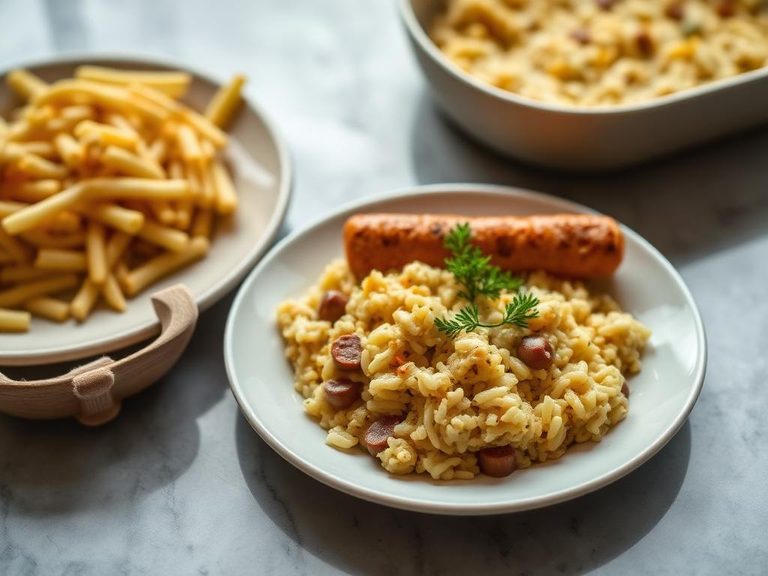
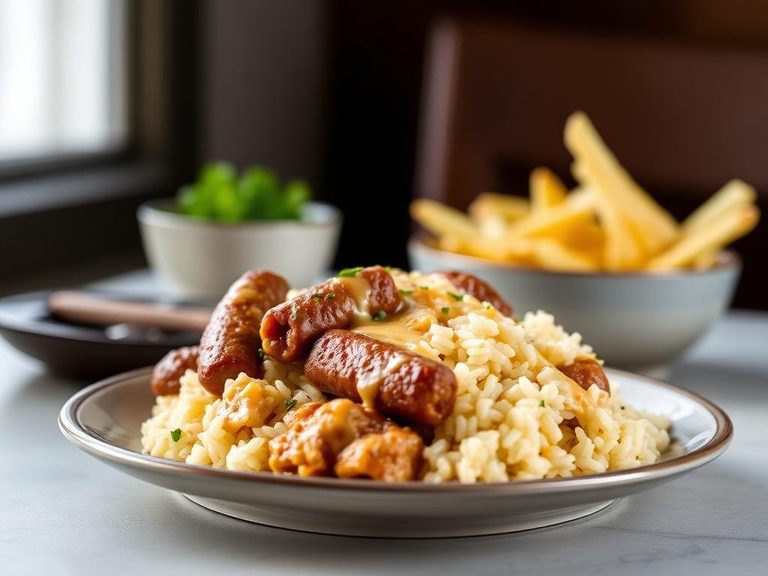
A comforting, creamy casserole where savory sausage and tender rice are bound together by a rich, velvety cheese sauce. It offers a satisfying blend of salty, meaty flavors with a smooth, starchy texture, making it a hearty and warming meal. Nutritionally, it provides a moderate energy source with a notable protein content for a dish of its type.
Calorie split: 17% protein · 37% carbs · 46% fat
↓ Full nutrition💚 Why it's loved
People love its ultimate comfort-food appeal, combining familiar, savory flavors in a cohesive, creamy package. It's also highly versatile, easily adapted with different sausages, cheeses, or added vegetables.
⚠️ Watch-outs & how to enjoy it better
This dish can be high in sodium and saturated fat, which may concern those monitoring heart health or blood pressure. The refined carbs and low fiber can lead to a quicker blood-sugar rise. To counteract, pair a moderate portion with a large side of non-starchy vegetables (like steamed broccoli or a leafy salad) to add fiber and volume, and choose a lower-sodium sausage if available.
Key benefits
- Provides a balanced mix of protein, carbs, and fat for sustained energy.
- High in calcium from the cheese sauce, supporting bone health.
- Contains B vitamins from the sausage and fortified rice.
- Offers a convenient, all-in-one meal format.
🍽️ Popular dishes
🌍 Where it's eaten
💡 Did you know?
The 'cheese sauce' in many casseroles is often a Mornay sauce—a classic French Béchamel (butter, flour, milk) with cheese melted in, making this humble dish a distant cousin to haute cuisine.
Full nutrition (USDA data · scales with serving)
| Water | 70.6 g |
| Energy | 151 kcal |
| Protein | 6.3 g |
| Total lipid (fat) | 7.6 g |
| Carbohydrate, by difference | 13.9 g |
| Fiber, total dietary | 0.20 g |
| Total Sugars | 0.22 g |
| Calcium, Ca | 88.0 mg |
| Iron, Fe | 0.77 mg |
| Magnesium, Mg | 13.0 mg |
| Phosphorus, P | 98.0 mg |
| Potassium, K | 97.0 mg |
| Sodium, Na | 373 mg |
| Zinc, Zn | 0.87 mg |
| Copper, Cu | 0.05 mg |
| Selenium, Se | 7.7 ug |
| Vitamin C, total ascorbic acid | 0.20 mg |
| Thiamin | 0.12 mg |
| Riboflavin | 0.09 mg |
| Niacin | 1.5 mg |
| Vitamin B-6 | 0.08 mg |
| Folate, total | 28.0 ug |
| Folic acid | 25.0 ug |
| Folate, food | 4.0 ug |
| Folate, DFE | 45.0 ug |
| Choline, total | 10.4 mg |
| Vitamin B-12 | 0.22 ug |
| Vitamin B-12, added | 0.00 ug |
| Vitamin A, RAE | 25.0 ug |
| Retinol | 25.0 ug |
| Carotene, beta | 7.0 ug |
| Carotene, alpha | 0.00 ug |
| Cryptoxanthin, beta | 0.00 ug |
| Lycopene | 0.00 ug |
| Lutein + zeaxanthin | 0.00 ug |
| Vitamin E (alpha-tocopherol) | 0.16 mg |
| Vitamin E, added | 0.00 mg |
| Vitamin D (D2 + D3) | 0.40 ug |
| Vitamin K (phylloquinone) | 0.20 ug |
| Alcohol, ethyl | 0.00 g |
| Caffeine | 0.00 mg |
| Theobromine | 0.00 mg |
Fat & fatty acid profile (per 100g)
| Fatty acids, total saturated | 3.3 g |
| SFA 4:0 | 0.10 g |
| SFA 6:0 | 0.05 g |
| SFA 8:0 | 0.03 g |
| SFA 10:0 | 0.06 g |
| SFA 12:0 | 0.06 g |
| SFA 14:0 | 0.37 g |
| SFA 16:0 | 1.8 g |
| SFA 18:0 | 0.81 g |
| Fatty acids, total monounsaturated | 2.8 g |
| MUFA 16:1 | 0.17 g |
| MUFA 18:1 | 2.6 g |
| MUFA 20:1 | 0.04 g |
| MUFA 22:1 | 0.00 g |
| Fatty acids, total polyunsaturated | 1.1 g |
| PUFA 18:2 | 0.93 g |
| PUFA 18:3 | 0.07 g |
| PUFA 18:4 | 0.00 g |
| PUFA 20:4 | 0.02 g |
| PUFA 20:5 n-3 (EPA) | 0.00 g |
| PUFA 22:5 n-3 (DPA) | 0.00 g |
| PUFA 22:6 n-3 (DHA) | 0.00 g |
| Cholesterol | 21.0 mg |
FAQ
Can I make this dish ahead of time?
Yes, it's excellent for meal prep. Assemble the casserole, cover, and refrigerate for up to 2 days before baking. You may need to add 5-10 minutes to the baking time if it's going straight from the fridge to the oven.
What's the best cheese for the sauce?
Mild or sharp cheddar melts smoothly and provides classic flavor. For a tangier note, try Gruyère or a blend with Monterey Jack. Avoid pre-shredded cheese with anti-caking agents, as it can make the sauce grainy.
How can I reduce the fat content?
Use a leaner turkey or chicken sausage, substitute low-fat milk for whole milk in the sauce, and reduce the cheese by about a quarter while adding a tablespoon of nutritional yeast for cheesy flavor.
Nutrient density (calculated · NRF9.3)
Nutrient Rich Foods index: beneficial nutrients (protein, fiber, vitamins, minerals) minus saturated fat, added sugar & sodium, per 100 kcal.
NRF9.3 index — Fulgoni, Keast & Drewnowski, 2009. Computed from USDA nutrients.
Weight-loss friendliness (composite index)
Energy density 1.51 kcal/g · 17% calories from protein · 0.2 g fiber · 0.2 g sugar per 100 g.
Composite of energy density (Rolls et al., 1999), protein & fiber satiety, minus sugar. A calculated heuristic — ranks satiety-per-calorie, not a clinical measure.
Dietary load (calculated from USDA values)
Potential renal acid load. Positive = acid-forming, negative = alkaline-forming.
Sodium-to-potassium ratio: 3.85 (lower is better — aim for ≤ 1)
Sodium:potassium per WHO potassium guidance. Computed from USDA nutrients.