Pie, peach
Common food
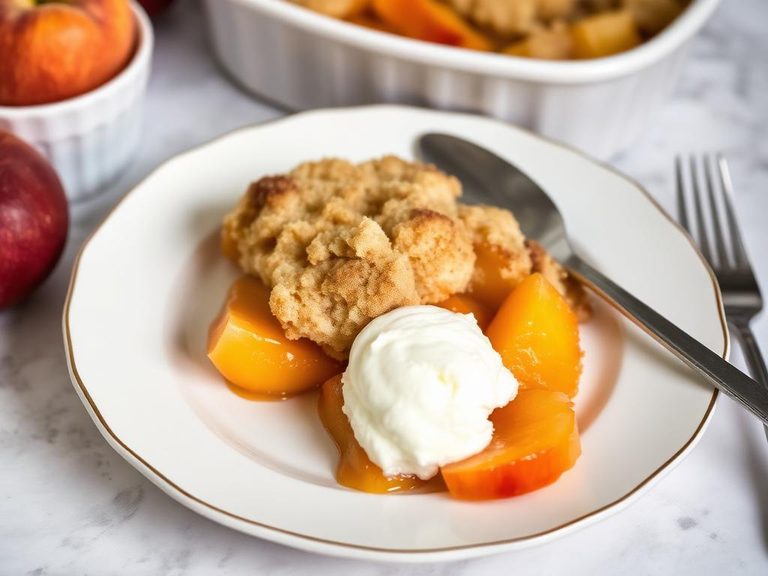
A classic dessert pie featuring a sweet, jammy peach filling encased in a flaky, buttery crust. The texture is a delightful contrast between the soft, cooked fruit and the crisp pastry, with a flavor profile that balances bright, floral peach notes with warm cinnamon and sugar. Nutritionally, it's a calorie-dense treat primarily from carbohydrates and fats, offering a modest amount of dietary fiber.
💚 Why it's loved
People love it for the nostalgic, comforting combination of warm, sweet fruit and buttery crust, often evoking memories of summer and home baking. Its versatility allows for variations with different crusts, spices, or additions like cream or ice cream.
⚠️ Watch-outs & how to enjoy it better
The high sugar and refined carbohydrate content can lead to blood sugar spikes, making it a concern for individuals managing diabetes or insulin resistance. The high fat and calorie density also means overconsumption can contribute to weight gain. To counteract these, enjoy a modest portion (like a thin slice) alongside a source of protein (e.g., Greek yogurt) or healthy fat (e.g., a handful of nuts) to slow sugar absorption and increase satiety.
Key benefits
- Provides quick energy from carbohydrates.
- Contains small amounts of vitamins A and C from peaches.
- Offers dietary fiber for digestive health.
- Can be a source of emotional comfort and social enjoyment.
- Peaches contain antioxidants like chlorogenic acid.
🍽️ Popular dishes
🌍 Where it's eaten
💡 Did you know?
The first known peach pie recipe in America appeared in a 1796 cookbook titled 'American Cookery' by Amelia Simmons, where it was called 'Peach Pudding' and baked in a crust.
Full nutrition (scales with serving)
| Water | 44.0 g |
| Energy | 296 kcal |
| Protein | 2.8 g |
| Total lipid (fat) | 15.3 g |
| Carbohydrate, by difference | 37.1 g |
| Fiber, total dietary | 1.9 g |
| Total Sugars | 15.7 g |
| Calcium, Ca | 11.0 mg |
| Iron, Fe | 1.3 mg |
| Magnesium, Mg | 10.0 mg |
| Phosphorus, P | 39.0 mg |
| Potassium, K | 110 mg |
| Sodium, Na | 219 mg |
| Zinc, Zn | 0.25 mg |
| Copper, Cu | 0.06 mg |
| Selenium, Se | 2.9 ug |
| Vitamin C, total ascorbic acid | 1.3 mg |
| Thiamin | 0.12 mg |
| Riboflavin | 0.07 mg |
| Niacin | 1.6 mg |
| Vitamin B-6 | 0.09 mg |
| Folate, total | 29.0 ug |
| Folic acid | 20.0 ug |
| Folate, food | 9.0 ug |
| Folate, DFE | 42.0 ug |
| Choline, total | 8.1 mg |
| Vitamin B-12 | 0.00 ug |
| Vitamin B-12, added | 0.00 ug |
| Vitamin A, RAE | 50.0 ug |
| Retinol | 38.0 ug |
| Carotene, beta | 122 ug |
| Carotene, alpha | 0.00 ug |
| Cryptoxanthin, beta | 43.0 ug |
| Lycopene | 0.00 ug |
| Lutein + zeaxanthin | 28.0 ug |
| Vitamin E (alpha-tocopherol) | 0.77 mg |
| Vitamin E, added | 0.00 mg |
| Vitamin D (D2 + D3) | 0.10 ug |
| Vitamin K (phylloquinone) | 6.0 ug |
| Fatty acids, total saturated | 5.3 g |
| SFA 4:0 | 0.06 g |
| SFA 6:0 | 0.04 g |
| SFA 8:0 | 0.03 g |
| SFA 10:0 | 0.06 g |
| SFA 12:0 | 0.07 g |
| SFA 14:0 | 0.33 g |
| SFA 16:0 | 2.9 g |
| SFA 18:0 | 1.7 g |
| Fatty acids, total monounsaturated | 6.4 g |
| MUFA 16:1 | 0.20 g |
| MUFA 18:1 | 6.1 g |
| MUFA 20:1 | 0.07 g |
| MUFA 22:1 | 0.00 g |
| Fatty acids, total polyunsaturated | 2.0 g |
| PUFA 18:2 | 1.9 g |
| PUFA 18:3 | 0.12 g |
| PUFA 18:4 | 0.00 g |
| PUFA 20:4 | 0.01 g |
| PUFA 20:5 n-3 (EPA) | 0.00 g |
| PUFA 22:5 n-3 (DPA) | 0.00 g |
| PUFA 22:6 n-3 (DHA) | 0.00 g |
| Cholesterol | 7.0 mg |
| Alcohol, ethyl | 0.00 g |
| Caffeine | 0.00 mg |
| Theobromine | 0.00 mg |
FAQ
Is peach pie healthy?
It's a dessert, so it's best enjoyed in moderation. While it provides some fiber and vitamins from the peaches, it is high in added sugars, fats, and calories. It's not considered a health food but can be part of a balanced diet when portion-controlled.
Why is my peach pie filling runny?
This is often due to undercooking, not using enough thickener (like cornstarch, flour, or tapioca), or using overly juicy peaches. Using a mix of ripe and slightly firmer peaches and ensuring the pie is baked until the filling is bubbly in the center helps.
Can I use frozen peaches?
Yes, frozen peaches are a great year-round option. Thaw and drain them well to remove excess liquid before using, and you may need to slightly increase the thickener in your recipe to account for the extra moisture.