

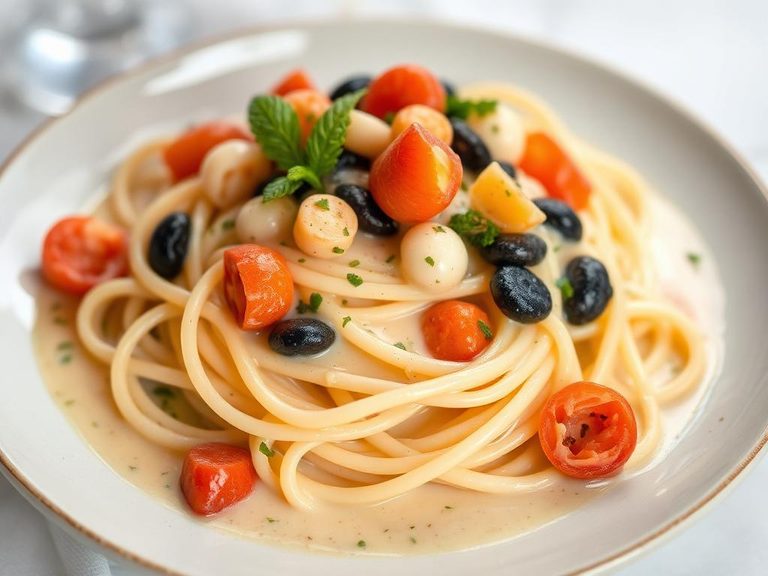
Pasta with cream sauce, seafood, and added vegetables, restaurant
Common food

Photo: Wikipedia
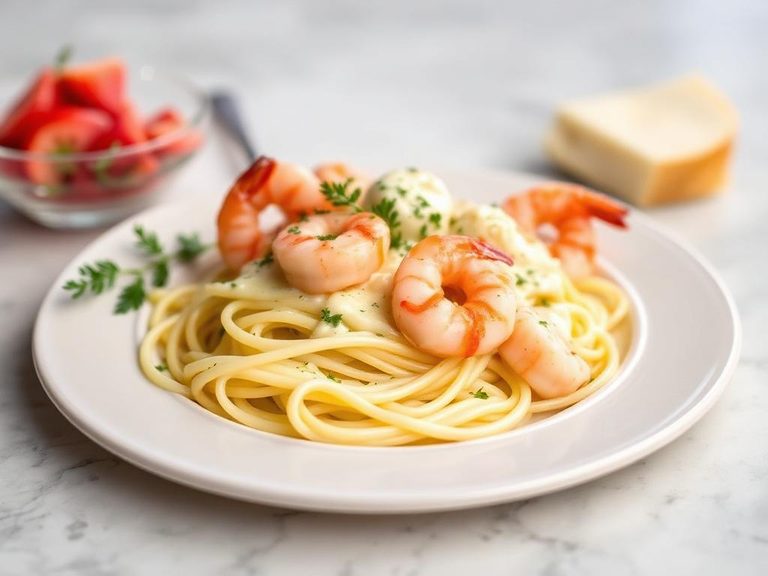
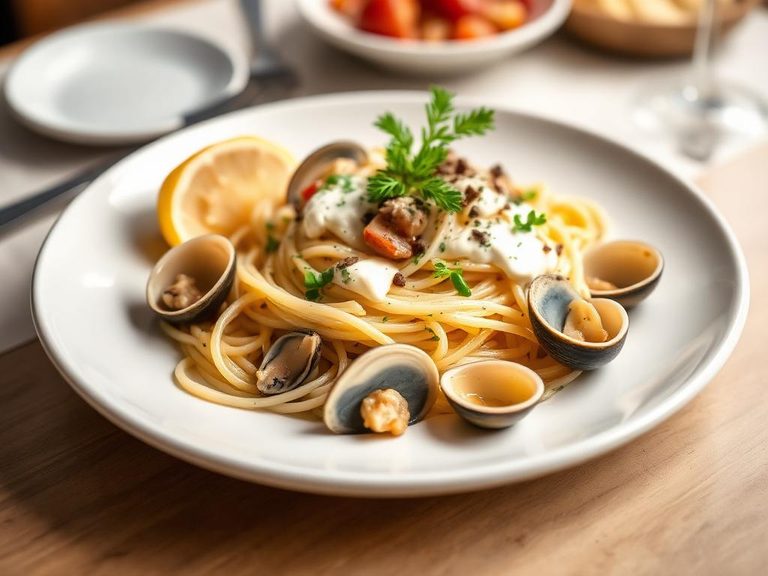
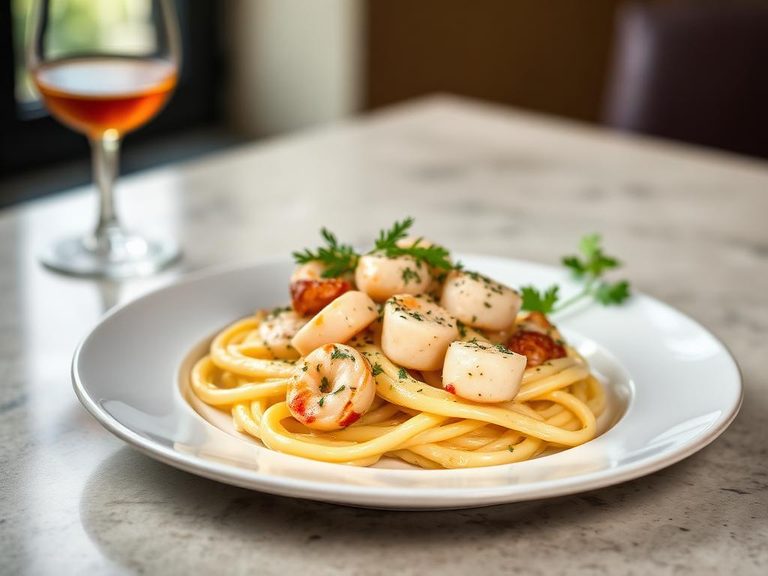
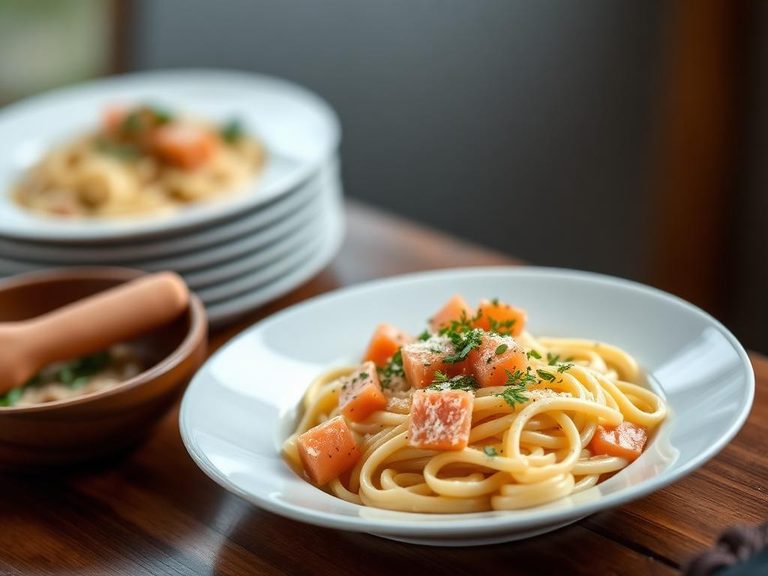
This is a rich, indulgent pasta dish where tender seafood and vibrant vegetables are tossed in a velvety cream sauce. The taste is a harmonious blend of savory umami from the seafood, a subtle sweetness from the vegetables, and a luxurious, coating mouthfeel from the cream. Nutritionally, it's a moderate-calorie option that provides a balanced mix of protein, fats, and carbohydrates, though the fat content is notable.
Calorie split: 11% protein · 34% carbs · 55% fat
↓ Full nutrition💚 Why it's loved
People love this dish for its comforting, luxurious texture and the way the creamy sauce complements the delicate flavors of the seafood. It's a versatile restaurant staple that can be customized with different seafood and vegetables, making it a crowd-pleaser across many cultures.
⚠️ Watch-outs & how to enjoy it better
The high fat and sodium content from the cream and restaurant preparation can be a concern for those managing heart health or blood pressure. The refined carbohydrates in the pasta can cause blood sugar spikes, especially for individuals with insulin resistance. To counteract this, opt for a smaller portion, pair it with a side salad to increase fiber, and choose whole-wheat pasta if available.
Key benefits
- Provides a balanced macronutrient profile with protein, fats, and carbs.
- Seafood offers lean protein and essential minerals like iodine and selenium.
- Vegetables contribute dietary fiber and a range of vitamins.
- The cream sauce can enhance the absorption of fat-soluble vitamins (A, D, E, K) from vegetables.
- A satisfying and complete meal that combines multiple food groups.
🍽️ Popular dishes
🌍 Where it's eaten
💡 Did you know?
The classic Italian Fettuccine Alfredo, the ancestor of many cream-sauced pastas, was originally made with just butter and Parmesan cheese, with no cream at all. The heavy cream version is largely an American invention.
Full nutrition (USDA data · scales with serving)
| Water | 65.3 g |
| Energy | 191 kcal |
| Protein | 5.4 g |
| Total lipid (fat) | 11.6 g |
| Carbohydrate, by difference | 16.0 g |
| Fiber, total dietary | 1.0 g |
| Total Sugars | 0.79 g |
| Calcium, Ca | 32.0 mg |
| Iron, Fe | 0.86 mg |
| Magnesium, Mg | 14.0 mg |
| Phosphorus, P | 68.0 mg |
| Potassium, K | 88.0 mg |
| Sodium, Na | 525 mg |
| Zinc, Zn | 0.47 mg |
| Copper, Cu | 0.08 mg |
| Selenium, Se | 18.1 ug |
| Vitamin C, total ascorbic acid | 4.0 mg |
| Thiamin | 0.14 mg |
| Riboflavin | 0.11 mg |
| Niacin | 1.0 mg |
| Vitamin B-6 | 0.04 mg |
| Folate, total | 39.0 ug |
| Folic acid | 32.0 ug |
| Folate, food | 7.0 ug |
| Folate, DFE | 61.0 ug |
| Choline, total | 13.7 mg |
| Vitamin B-12 | 0.83 ug |
| Vitamin B-12, added | 0.00 ug |
| Vitamin A, RAE | 47.0 ug |
| Retinol | 44.0 ug |
| Carotene, beta | 35.0 ug |
| Carotene, alpha | 1.0 ug |
| Cryptoxanthin, beta | 8.0 ug |
| Lycopene | 0.00 ug |
| Lutein + zeaxanthin | 47.0 ug |
| Vitamin E (alpha-tocopherol) | 1.5 mg |
| Vitamin E, added | 0.00 mg |
| Vitamin D (D2 + D3) | 0.10 ug |
| Vitamin K (phylloquinone) | 7.6 ug |
| Alcohol, ethyl | 0.00 g |
| Caffeine | 0.00 mg |
| Theobromine | 0.00 mg |
Fat & fatty acid profile (per 100g)
| Fatty acids, total saturated | 3.4 g |
| SFA 4:0 | 0.09 g |
| SFA 6:0 | 0.07 g |
| SFA 8:0 | 0.04 g |
| SFA 10:0 | 0.10 g |
| SFA 12:0 | 0.13 g |
| SFA 14:0 | 0.39 g |
| SFA 16:0 | 1.8 g |
| SFA 18:0 | 0.58 g |
| Fatty acids, total monounsaturated | 3.8 g |
| MUFA 16:1 | 0.10 g |
| MUFA 18:1 | 3.8 g |
| MUFA 20:1 | 0.05 g |
| MUFA 22:1 | 0.00 g |
| Fatty acids, total polyunsaturated | 3.0 g |
| PUFA 18:2 | 2.6 g |
| PUFA 18:3 | 0.33 g |
| PUFA 18:4 | 0.00 g |
| PUFA 20:4 | 0.01 g |
| PUFA 20:5 n-3 (EPA) | 0.02 g |
| PUFA 22:5 n-3 (DPA) | 0.01 g |
| PUFA 22:6 n-3 (DHA) | 0.01 g |
| Cholesterol | 25.0 mg |
FAQ
Is this dish high in calories?
At 191 kcal per 100g, it's moderately calorie-dense, primarily due to the fat from the cream sauce. A typical restaurant serving (around 300-400g) can easily exceed 600-700 calories.
What seafood is typically used in this dish?
Common choices include shrimp, scallops, mussels, clams, and pieces of white fish or salmon. The selection often varies by region and restaurant.
Can I make a lighter version at home?
Yes. You can substitute heavy cream with a blend of Greek yogurt and milk, use a roux with low-fat milk, or incorporate blended cauliflower or cashew cream for a lower-fat, higher-fiber alternative.
Nutrient density (calculated · NRF9.3)
Nutrient Rich Foods index: beneficial nutrients (protein, fiber, vitamins, minerals) minus saturated fat, added sugar & sodium, per 100 kcal.
NRF9.3 index — Fulgoni, Keast & Drewnowski, 2009. Computed from USDA nutrients.
Weight-loss friendliness (composite index)
Energy density 1.91 kcal/g · 11% calories from protein · 1.0 g fiber · 0.8 g sugar per 100 g.
Composite of energy density (Rolls et al., 1999), protein & fiber satiety, minus sugar. A calculated heuristic — ranks satiety-per-calorie, not a clinical measure.
Dietary load (calculated from USDA values)
Potential renal acid load. Positive = acid-forming, negative = alkaline-forming.
Sodium-to-potassium ratio: 5.97 (lower is better — aim for ≤ 1)
Sodium:potassium per WHO potassium guidance. Computed from USDA nutrients.