

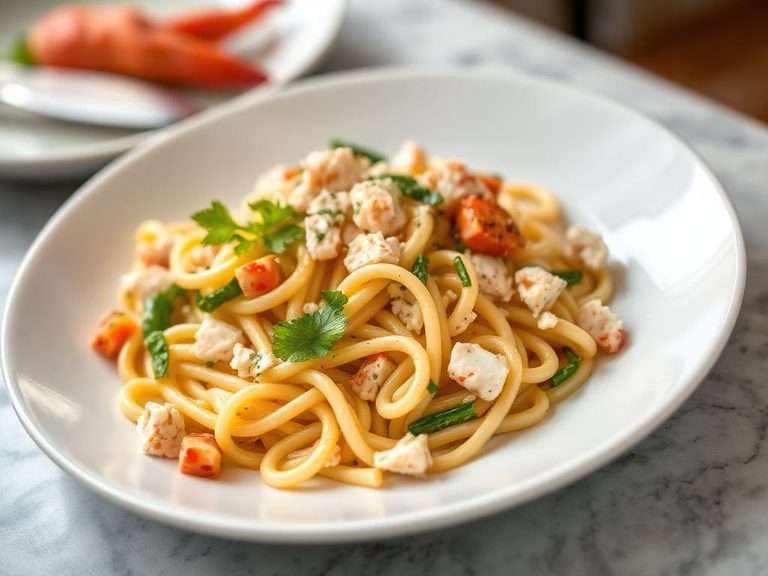
Macaroni or pasta salad with crab meat
Common food

Photo: Wikipedia
This is a chilled, creamy salad where tender elbow macaroni is tossed with sweet, flaky crab meat in a rich, tangy dressing. The texture is a delightful contrast between the soft pasta and the delicate, fibrous crab, all coated in a smooth, often mayonnaise-based sauce. Nutritionally, it's a protein-packed dish that provides a satisfying balance of carbs and fats for a complete meal.
Calorie split: 13% protein · 42% carbs · 45% fat
↓ Full nutrition💚 Why it's loved
People love it for its perfect blend of savory, sweet crab flavor with the comforting, familiar taste of pasta and a cool, creamy dressing. It's a beloved staple at summer picnics, potlucks, and beach gatherings, embodying casual, shareable comfort food.
⚠️ Watch-outs & how to enjoy it better
The mayonnaise-based dressing can be high in saturated fat and calories, and the dish may contain added sodium from seasoning or canned crab. Those monitoring blood sugar should be mindful of the refined carbs. To counteract, use a light mayo or Greek yogurt blend, choose low-sodium crab, and boost fiber by adding chopped vegetables like bell peppers or spinach.
Key benefits
- Excellent source of lean protein from crab meat
- Provides sustained energy from complex carbohydrates in pasta
- Contains essential minerals like zinc and selenium from seafood
- Offers a satisfying, balanced meal in one dish
- Versatile base for adding vegetables like celery or red onion
🍽️ Popular dishes
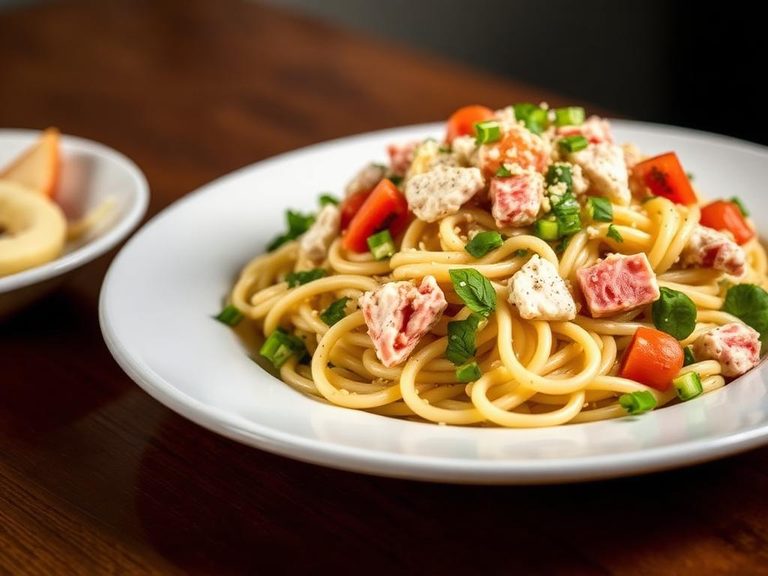
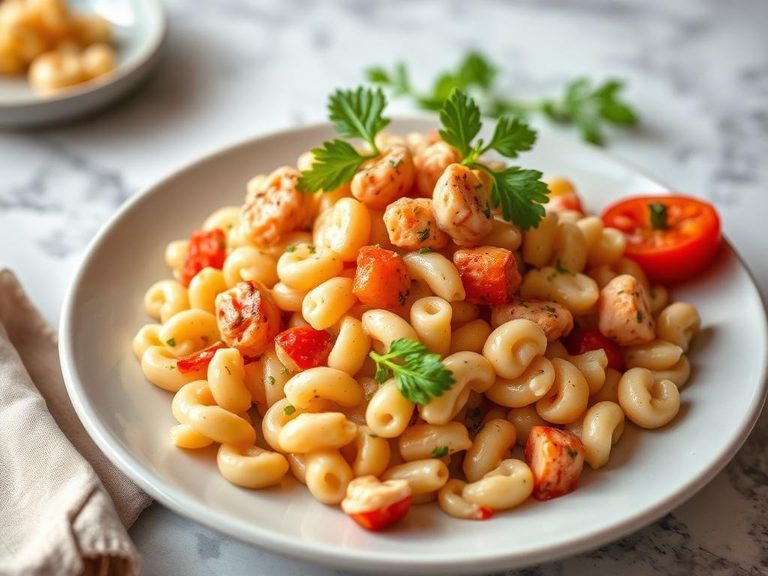
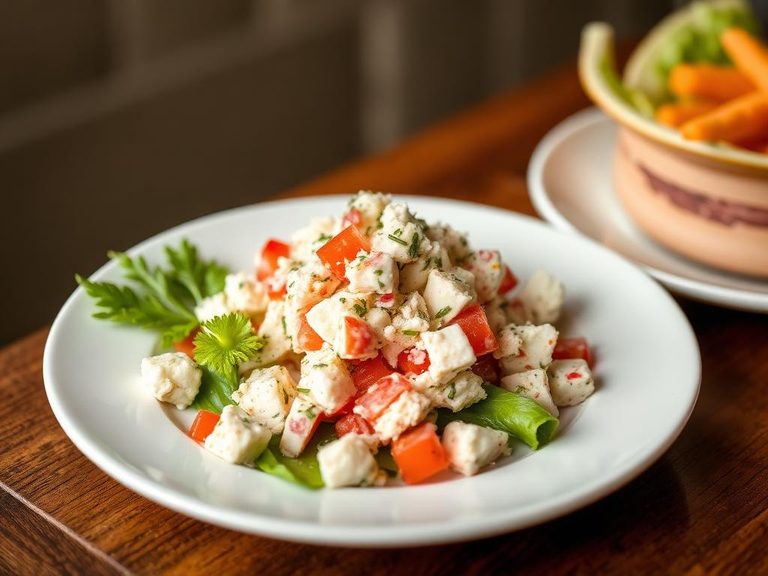
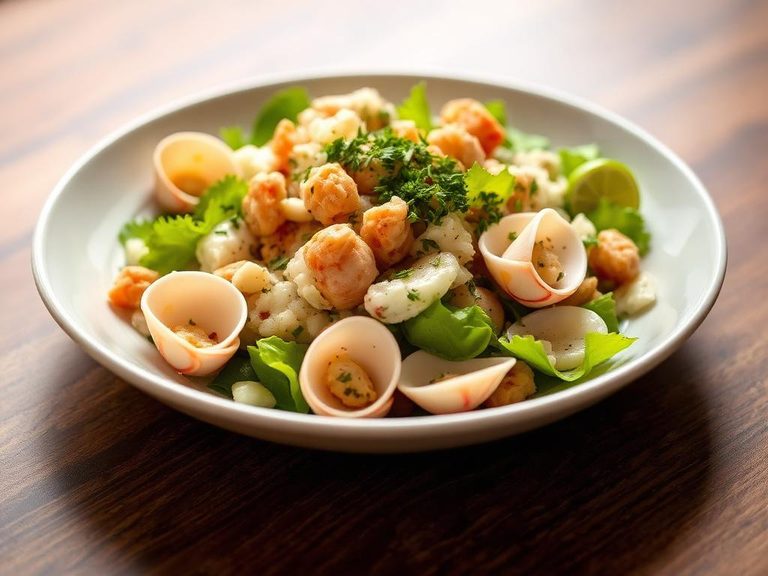
🌍 Where it's eaten
💡 Did you know?
The use of elbow macaroni in cold salads became hugely popular in the United States after World War II, thanks to the rise of home refrigeration and the marketing of convenient, canned seafood like crab and tuna.
Full nutrition (USDA data · scales with serving)
| Water | 61.8 g |
| Energy | 201 kcal |
| Protein | 6.5 g |
| Total lipid (fat) | 9.9 g |
| Carbohydrate, by difference | 20.9 g |
| Fiber, total dietary | 1.2 g |
| Total Sugars | 1.6 g |
| Calcium, Ca | 21.0 mg |
| Iron, Fe | 0.94 mg |
| Magnesium, Mg | 18.0 mg |
| Phosphorus, P | 76.0 mg |
| Potassium, K | 81.0 mg |
| Sodium, Na | 233 mg |
| Zinc, Zn | 0.92 mg |
| Copper, Cu | 0.19 mg |
| Selenium, Se | 23.2 ug |
| Vitamin C, total ascorbic acid | 2.0 mg |
| Thiamin | 0.18 mg |
| Riboflavin | 0.10 mg |
| Niacin | 1.5 mg |
| Vitamin B-6 | 0.06 mg |
| Folate, total | 56.0 ug |
| Folic acid | 41.0 ug |
| Folate, food | 14.0 ug |
| Folate, DFE | 84.0 ug |
| Choline, total | 20.9 mg |
| Vitamin B-12 | 0.52 ug |
| Vitamin B-12, added | 0.00 ug |
| Vitamin A, RAE | 5.0 ug |
| Retinol | 2.0 ug |
| Carotene, beta | 25.0 ug |
| Carotene, alpha | 4.0 ug |
| Cryptoxanthin, beta | 11.0 ug |
| Lycopene | 0.00 ug |
| Lutein + zeaxanthin | 22.0 ug |
| Vitamin E (alpha-tocopherol) | 0.75 mg |
| Vitamin E, added | 0.00 mg |
| Vitamin D (D2 + D3) | 0.00 ug |
| Vitamin K (phylloquinone) | 23.6 ug |
| Alcohol, ethyl | 0.00 g |
| Caffeine | 0.00 mg |
| Theobromine | 0.00 mg |
Fat & fatty acid profile (per 100g)
| Fatty acids, total saturated | 1.6 g |
| SFA 4:0 | 0.00 g |
| SFA 6:0 | 0.00 g |
| SFA 8:0 | 0.00 g |
| SFA 10:0 | 0.00 g |
| SFA 12:0 | 0.00 g |
| SFA 14:0 | 0.01 g |
| SFA 16:0 | 1.1 g |
| SFA 18:0 | 0.40 g |
| Fatty acids, total monounsaturated | 2.2 g |
| MUFA 16:1 | 0.01 g |
| MUFA 18:1 | 2.1 g |
| MUFA 20:1 | 0.03 g |
| MUFA 22:1 | 0.01 g |
| Fatty acids, total polyunsaturated | 5.7 g |
| PUFA 18:2 | 5.0 g |
| PUFA 18:3 | 0.69 g |
| PUFA 18:4 | 0.00 g |
| PUFA 20:4 | 0.01 g |
| PUFA 20:5 n-3 (EPA) | 0.01 g |
| PUFA 22:5 n-3 (DPA) | 0.00 g |
| PUFA 22:6 n-3 (DHA) | 0.01 g |
| Cholesterol | 20.0 mg |
FAQ
What kind of crab meat is best for pasta salad?
Lump or backfin crab meat offers the best balance of texture and value, providing nice chunks without being too expensive. Claw meat has a stronger flavor, while jumbo lump is premium and best for special occasions.
Can I make this salad ahead of time?
Yes, it actually benefits from chilling for at least an hour to let the flavors meld. Store it covered in the refrigerator for up to 2 days. The pasta may absorb some dressing, so you might want to reserve a little to stir in before serving.
How can I make it healthier?
Swap half the mayonnaise for plain Greek yogurt or avocado for creaminess with more nutrients. Add plenty of crunchy vegetables like celery, cucumber, or peas for fiber and volume. Use whole-wheat pasta for extra fiber.
Nutrient density (calculated · NRF9.3)
Nutrient Rich Foods index: beneficial nutrients (protein, fiber, vitamins, minerals) minus saturated fat, added sugar & sodium, per 100 kcal.
NRF9.3 index — Fulgoni, Keast & Drewnowski, 2009. Computed from USDA nutrients.
Weight-loss friendliness (composite index)
Energy density 2.01 kcal/g · 13% calories from protein · 1.2 g fiber · 1.6 g sugar per 100 g.
Composite of energy density (Rolls et al., 1999), protein & fiber satiety, minus sugar. A calculated heuristic — ranks satiety-per-calorie, not a clinical measure.
Dietary load (calculated from USDA values)
Potential renal acid load. Positive = acid-forming, negative = alkaline-forming.
Sodium-to-potassium ratio: 2.88 (lower is better — aim for ≤ 1)
Sodium:potassium per WHO potassium guidance. Computed from USDA nutrients.