

Fried green tomatoes
Common food

Photo: Wikipedia
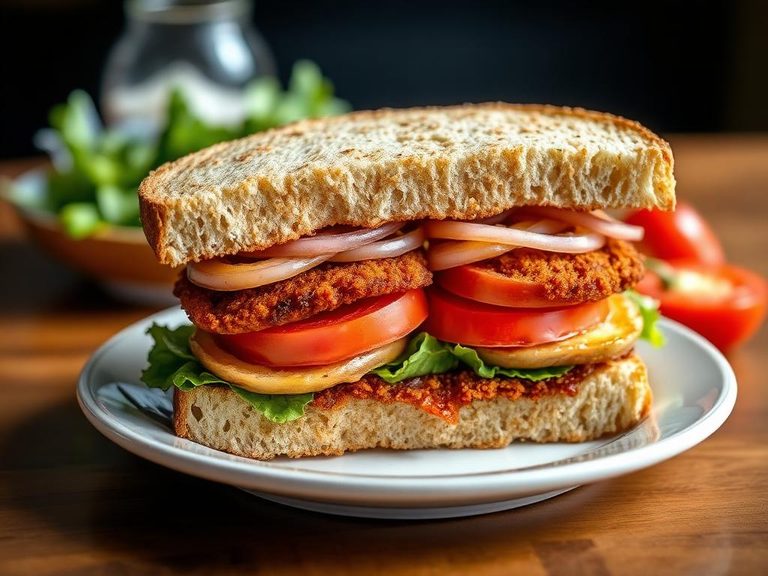
Fried green tomatoes are unripe tomatoes sliced, coated in a cornmeal or breadcrumb crust, and pan-fried until golden and crispy. The exterior shatters with a satisfying crunch, giving way to a firm, tangy, and slightly acidic interior that contrasts beautifully with the rich, savory coating. While a serving provides a notable 12.84g of fat and 21.78g of carbs, the tangy green tomatoes offer a unique flavor profile distinct from their ripe counterparts.
Calorie split: 7% protein · 40% carbs · 53% fat
↓ Full nutrition💚 Why it's loved
People love fried green tomatoes for their iconic Southern U.S. appeal, combining a tangy, firm bite with a crispy, savory crust that is both comforting and nostalgic. The dish is celebrated for its versatility, often served as a side, appetizer, or even a sandwich component, making it a beloved staple in Southern cuisine.
⚠️ Watch-outs & how to enjoy it better
The frying process adds significant fat and calories, which may be a concern for those monitoring their intake. Additionally, the cornmeal or breadcrumb coating can cause blood sugar spikes, so pairing with a protein-rich food like grilled chicken or a side of beans can help mitigate this effect. Those with gluten sensitivities should opt for a gluten-free coating, and portion control is key to enjoying this dish without overindulging.
Key benefits
- Rich in antioxidants like lycopene and vitamin C, which are preserved in the unripe state.
- The firm texture holds up well to frying, maintaining a satisfying crunch.
- Provides a good source of vitamin K and potassium from the tomato itself.
- The cornmeal coating can offer a source of iron and B vitamins.
- A versatile side dish that pairs well with a variety of proteins.
🍽️ Popular dishes




🌍 Where it's eaten
💡 Did you know?
Fried green tomatoes were not originally a Southern dish; they became popular in the South in the early 20th century, likely due to the influence of Jewish and Italian immigrants who brought their own fried vegetable traditions.
Full nutrition (USDA data · scales with serving)
| Water | 60.4 g |
| Energy | 216 kcal |
| Protein | 3.7 g |
| Total lipid (fat) | 12.8 g |
| Carbohydrate, by difference | 21.8 g |
| Fiber, total dietary | 1.3 g |
| Total Sugars | 1.6 g |
| Calcium, Ca | 29.0 mg |
| Iron, Fe | 1.6 mg |
| Magnesium, Mg | 13.0 mg |
| Phosphorus, P | 50.0 mg |
| Potassium, K | 153 mg |
| Sodium, Na | 317 mg |
| Zinc, Zn | 0.33 mg |
| Copper, Cu | 0.07 mg |
| Selenium, Se | 5.3 ug |
| Vitamin C, total ascorbic acid | 6.2 mg |
| Thiamin | 0.26 mg |
| Riboflavin | 0.13 mg |
| Niacin | 2.0 mg |
| Vitamin B-6 | 0.06 mg |
| Folate, total | 46.0 ug |
| Folic acid | 33.0 ug |
| Folate, food | 13.0 ug |
| Folate, DFE | 69.0 ug |
| Choline, total | 14.5 mg |
| Vitamin B-12 | 0.04 ug |
| Vitamin B-12, added | 0.00 ug |
| Vitamin A, RAE | 24.0 ug |
| Retinol | 5.0 ug |
| Carotene, beta | 202 ug |
| Carotene, alpha | 45.0 ug |
| Cryptoxanthin, beta | 0.00 ug |
| Lycopene | 1155 ug |
| Lutein + zeaxanthin | 72.0 ug |
| Vitamin E (alpha-tocopherol) | 2.6 mg |
| Vitamin E, added | 0.00 mg |
| Vitamin D (D2 + D3) | 0.10 ug |
| Vitamin K (phylloquinone) | 16.1 ug |
| Alcohol, ethyl | 0.00 g |
| Caffeine | 0.00 mg |
| Theobromine | 0.00 mg |
Fat & fatty acid profile (per 100g)
| Fatty acids, total saturated | 1.8 g |
| SFA 4:0 | 0.00 g |
| SFA 6:0 | 0.00 g |
| SFA 8:0 | 0.00 g |
| SFA 10:0 | 0.00 g |
| SFA 12:0 | 0.00 g |
| SFA 14:0 | 0.01 g |
| SFA 16:0 | 1.3 g |
| SFA 18:0 | 0.39 g |
| Fatty acids, total monounsaturated | 5.2 g |
| MUFA 16:1 | 0.05 g |
| MUFA 18:1 | 5.1 g |
| MUFA 20:1 | 0.08 g |
| MUFA 22:1 | 0.00 g |
| Fatty acids, total polyunsaturated | 4.9 g |
| PUFA 18:2 | 4.3 g |
| PUFA 18:3 | 0.54 g |
| PUFA 18:4 | 0.00 g |
| PUFA 20:4 | 0.00 g |
| PUFA 20:5 n-3 (EPA) | 0.00 g |
| PUFA 22:5 n-3 (DPA) | 0.00 g |
| PUFA 22:6 n-3 (DHA) | 0.00 g |
| Cholesterol | 11.0 mg |
FAQ
Are fried green tomatoes healthy?
While they contain beneficial nutrients like vitamin C and antioxidants, the frying process adds significant fat and calories. Enjoying them in moderation and pairing with protein can make them a more balanced part of a meal.
Can I make fried green tomatoes without frying?
Yes, you can bake or air-fry them for a healthier alternative. Baking at 400°F (200°C) for 20-25 minutes or air-frying at 375°F (190°C) for 10-12 minutes can achieve a crispy texture with less oil.
What is the best way to store leftover fried green tomatoes?
Store them in an airtight container in the refrigerator for up to 2 days. Reheat in an oven or air fryer to restore crispiness; avoid microwaving as it can make them soggy.
Nutrient density (calculated · NRF9.3)
Nutrient Rich Foods index: beneficial nutrients (protein, fiber, vitamins, minerals) minus saturated fat, added sugar & sodium, per 100 kcal.
NRF9.3 index — Fulgoni, Keast & Drewnowski, 2009. Computed from USDA nutrients.
Weight-loss friendliness (composite index)
Energy density 2.16 kcal/g · 7% calories from protein · 1.3 g fiber · 1.6 g sugar per 100 g.
Composite of energy density (Rolls et al., 1999), protein & fiber satiety, minus sugar. A calculated heuristic — ranks satiety-per-calorie, not a clinical measure.
Dietary load (calculated from USDA values)
Potential renal acid load. Positive = acid-forming, negative = alkaline-forming.
Sodium-to-potassium ratio: 2.07 (lower is better — aim for ≤ 1)
Sodium:potassium per WHO potassium guidance. Computed from USDA nutrients.